How to Install Geogrid Driveway
You want a driveway that carries trucks, drains fast, and stays flat. You also want a method crews can repeat with zero rework.
In short: evaluate subgrade, grade and proof-roll, place a separator if needed, install a first lift of aggregate, tension and stake biaxial geogrid, backfill in thin lifts with dense-graded stone, compact to spec, add edge restraint, and finish the wearing layer.
What you’ll achieve
You will increase bearing capacity, cut rutting, and reduce base thickness. Geogrid interlocks with stone to create a stiff, reinforced platform. Use geotextile only for separation and filtration; use geogrid for reinforcement. If your driveway ties into a geogrid retaining wall, coordinate elevations and drainage early.
Materials and specs that work
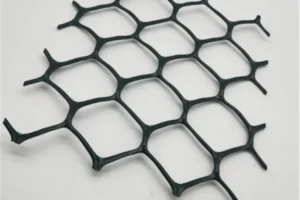
- Geogrid type: use biaxial geogrid for driveways. It delivers strength in both machine and cross directions for wheel loads.
- Polymer: polypropylene or HDPE are common for road subgrades. Polyester geogrid (knitted/woven PET with coating) shines in soil reinforcement and is often chosen for retaining walls geogrid, slopes, and soft ground where high modulus and low creep matter.
- Base aggregate: crushed, well-graded stone (e.g., 0–32 mm or 3/4″ minus) with low fines for interlock and drainage.
- Separator: nonwoven geotextile only if you have pumping fines or very soft subgrade. Remember the SEO staple “geogrid vs geotextile”: they are different tools. Geotextile separates and filters; geogrid reinforces.
- Edge restraint: concrete, steel, or treated timber to lock the section laterally.
- Compaction: target ≥95% Standard Proctor (or as specified).
| Subgrade CBR | Typical base without geogrid | Typical base with biaxial geogrid |
|---|---|---|
| < 2% (very soft) | 350–450 mm | 250–300 mm (often two geogrid layers) |
| 2–5% (soft) | 250–300 mm | 175–225 mm |
| 5–8% (medium) | 200–250 mm | 150–200 mm |
| > 8% (firm) | 150–200 mm | 125–175 mm |
Guide values only. Follow your engineer’s design and local code.
Tools and site prep checklist
- Plate compactor or roller, jumping jack for tight edges
- Stringlines, laser level, rake, screed
- Rebar pins or stakes for tensioning geogrid
- Utility knife/shears, marking chalk
- Nonwoven geotextile rolls (if separation required)
- Biaxial geogrid rolls, mill certs, and roll labels on site
- PPE and traffic control
Step-by-step installation
1) Assess, strip, and proof-roll
- Strip organics and topsoil to design depth.
- Proof-roll the subgrade. Undercut soft spots; replace with compacted granular.
- Shape crown or cross-fall for surface drainage away from structures.
2) Place separator (only if needed)
- If fines pump under traffic, lay nonwoven geotextile flat with 300 mm overlaps.
- Avoid wrinkles. Pin lightly at overlaps. This is your “geogrid vs geotextile” moment: the fabric is not structural; it keeps fines down and flows water.
3) First lift of aggregate
- Place 100–150 mm of crushed stone. Pre-level so the geogrid lies flat and supported.
- Lightly compact to provide a firm bed for the geogrid.
4) Install the geogrid
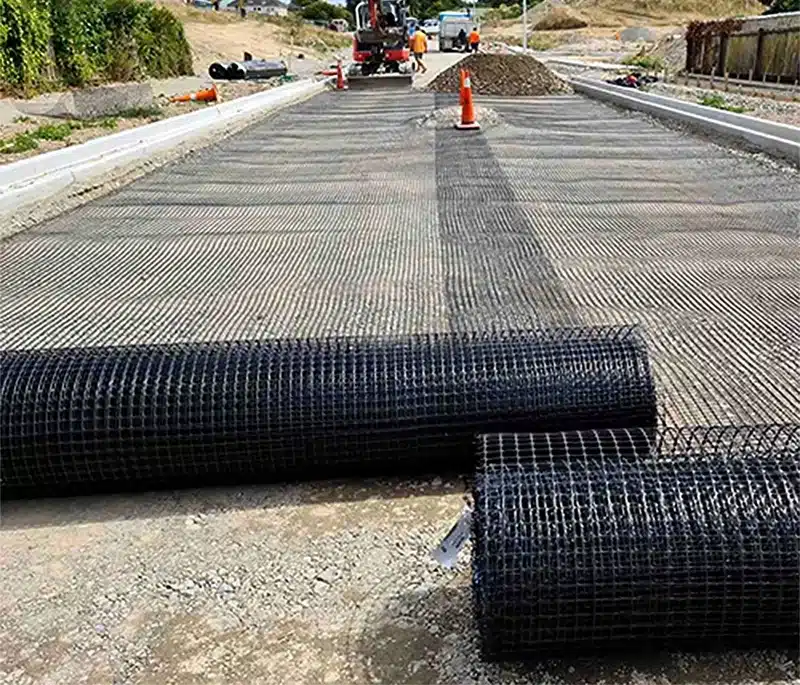
- Roll biaxial geogrid perpendicular to the driveway centerline so wheel loads engage both directions.
- Tension the sheet by pulling from the free end; remove wrinkles. Stake the rear edge every 1–2 m.
- Overlap across roll widths by 300–450 mm. Do not overlap in the primary strength direction unless specified.
- For curves, cut and fan panels so ribs stay aligned with traffic. Keep overlaps tight.
5) Backfill and compact
- Place aggregate from the far end toward the overlap to avoid dragging the geogrid.
- Keep a minimum 150 mm cover over geogrid before allowing equipment on it.
- Compact in thin lifts (100–150 mm). Check density and smoothness each pass.
- If the design calls for a second geogrid layer, repeat steps 4–5 at mid-depth.
6) Edge restraint and finish
- Install edge restraints along borders to prevent lateral spread.
- Add the wearing course (clean gravel, asphalt, pavers) per your specification.
- Sweep, water-roll if required, and verify drainage paths.
Geogrid vs geotextile: clear roles
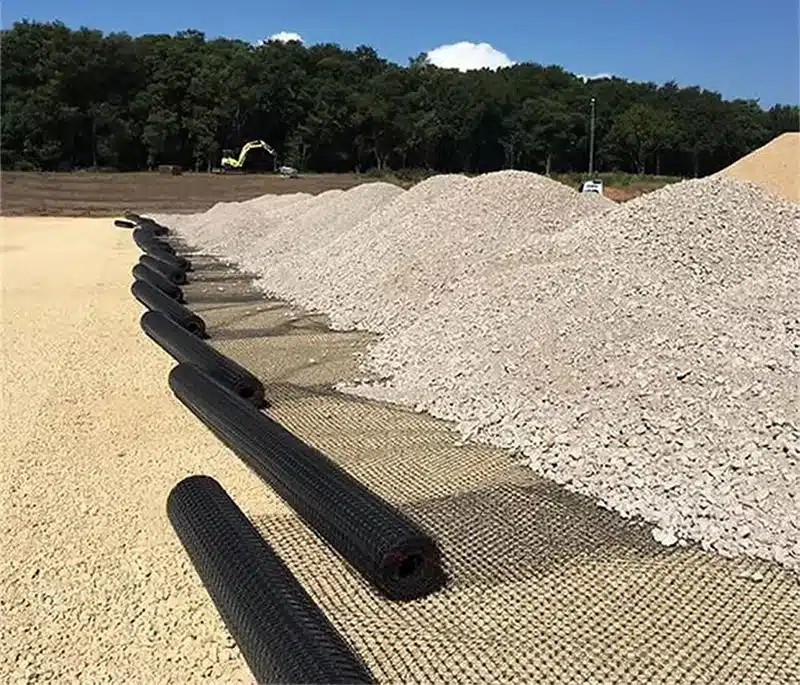
- Geogrid: structural reinforcement. It provides interlock and confinement for stone, reduces shear strain, and limits rutting. Your driveway needs this for wheel paths.
- Geotextile: separation and filtration. It keeps fines out of the base and maintains flow. Use it under the base where soils are wet or weak.
Pair both when subgrade is poor: geotextile on the subgrade, biaxial geogrid above the first stone lift.
Polyester geogrid or biaxial geogrid for a driveway?
- Biaxial geogrid (usually PP/HDPE, punched and drawn) is the default for driveways because traffic loads act in two directions and require balanced stiffness.
- Polyester geogrid (knitted/woven PET with a protective coating) offers high modulus and low creep, which is excellent for long-term soil reinforcement, tie-backs, and geogrid retaining wall applications. You can use PET under heavy, long-term loads or where temperature and chemical environment favor PET performance.
- For most residential and light-commercial driveways, a quality biaxial geogrid is the value choice. For industrial yards with sustained loads or if the driveway interfaces a reinforced slope or retaining walls geogrid zone, consider polyester geogrid per the engineer’s design.
If your driveway meets a wall: coordination notes
- Drainage continuity: daylight base drains from the driveway without loading the wall backfill.
- Setback and embedment: match wall cap elevation to driveway finish with a bond breaker where needed.
- Connection: geogrid retaining wall design example will specify layer spacing, length (often 0.7–1.0H), and facing connection. Do not rely on driveway base geogrid to replace structural wall reinforcement.
Common mistakes to avoid
- Driving equipment directly on exposed geogrid. Always cover first.
- Placing lifts too thick for compaction energy. Keep to 100–150 mm.
- Skipping edge restraint, which allows base spread and edge raveling.
- Using round, poorly graded stone that limits interlock.
- Confusing “geogrid vs geotextile” and expecting fabric to add structural stiffness.
Quick BOQ template (edit for your bid)
- Biaxial geogrid, tensile class _ kN/m, roll width m, total __ m²
- Nonwoven geotextile, survivability class , total m² (if required)
- Crushed base aggregate, _ m³ (include waste factor)
- Edge restraint, type , length m
- Stakes/pins _ pcs; mobilization; compaction and testing
FAQ
Q: How many layers of geogrid does a geogrid driveway need?
A: Many driveways use one layer at base mid-depth. Very soft soils often need two layers. Follow the engineer’s section.
Q: What overlap should I use between rolls?
A: 300–450 mm across roll width. Avoid overlaps in the primary load direction unless the design allows it.
Q: Can I replace geogrid with geotextile?
A: No. Geotextile separates and filters; it does not provide the confinement and stiffness that geogrid delivers.
Q: When should I choose polyester geogrid?
A: Use PET when long-term reinforcement, higher modulus, or creep control is critical, such as under sustained loads or near a geogrid retaining wall.
Conclusion
Select the right grid, build in thin compacted lifts, and lock edges. Use biaxial geogrid for the driveway’s wheel loads, add geotextile only for separation, and your section will stay flat, dry, and durable.