what is geotextile?
Ever need a layer that keeps soils apart, drains water fast, and holds your base together under traffic? That’s exactly what geotextile fabric does. In simple terms, geotextiles are permeable synthetic textiles placed between soil layers to separate, filter, drain, protect, and reinforce. You’ll see them under roads, rail, driveways, retaining walls, landfills, shorelines, and green infrastructure—anywhere subgrade control and long service life matter.
Geotextile basics: definition, materials & how it works
Geotextile (also called geotextile cloth or geotextile fabric) is a permeable sheet made from polypropylene (PP) or polyester (PET). It allows water to pass while holding soil/aggregate in place.
Core functions you count on
- Separation: Stops subgrade fines pumping into base stone—keeps thickness and stiffness you paid for.
- Filtration & drainage: Lets water through while retaining soil (defined by AOS/sieve opening and permittivity).
- Reinforcement: Adds tensile restraint to weak subgrades, reducing rutting and maintenance.
- Protection/cushion: Shields geomembranes and insulation from puncture in landfill and containment works.
Common product families
- Woven geotextiles: Interlaced yarns (PP or PET). High tensile/low elongation—great for stabilization and haul roads.
- Non-woven geotextile fabric / non-woven geotextile fabric: Needle-punched mats with high permeability—your go-to for filtration, drainage wraps, and protection layers.
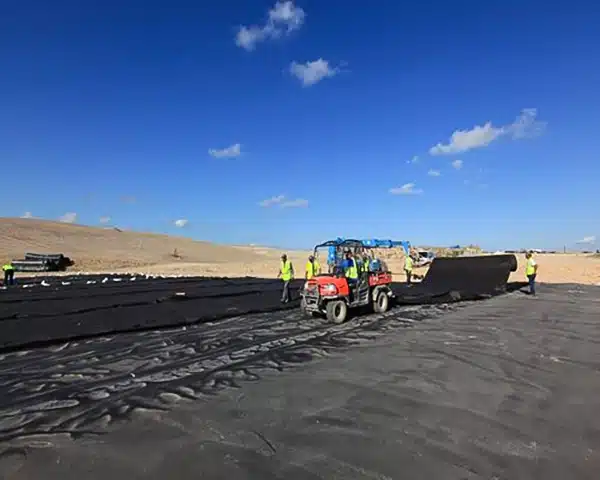
Geotextile types and when to use them
Use this quick map to choose between woven and non woven geotextile fabric on typical jobs.
| Type | Construction | Typical Specs (guide) | Best for | Notes |
|---|---|---|---|---|
| Woven (PP/PET) | Interlaced tapes/yarns | Tensile 20–120 kN/m, AOS per design | Road & yard stabilization, working platforms, soft subgrade improvement | Low strain, good modulus, cost-effective for rut control |
| Non-woven (PP/PET) | Needle-punched felt | 100–800 g/m², high permittivity | Filtration & drainage, French drains, behind retaining walls, coastal works, protection of geomembranes | Conforms to irregular subgrades; excellent cushion |
| High-strength PET woven | Oriented PET yarns | High tensile, low creep | Long-term reinforcement, MSE layers | Choose PET when chemical/creep performance is critical |
Application cues
- Roads/driveways/parking: Woven for separation + stabilization over weak subgrades; non-woven above subgrade for filtration under base.
- Subsurface drains & wrap: Non-woven for filter/drain envelopes around pipes and aggregates.
- Retaining walls & erosion control: Non-woven behind wall for filter, woven for stabilization of backfill benches; add geogrid when reinforcement is required.
- Geomembrane protection: Heavy non-woven (≥400–600 g/m²) as cushion layer to meet puncture/CBR criteria.
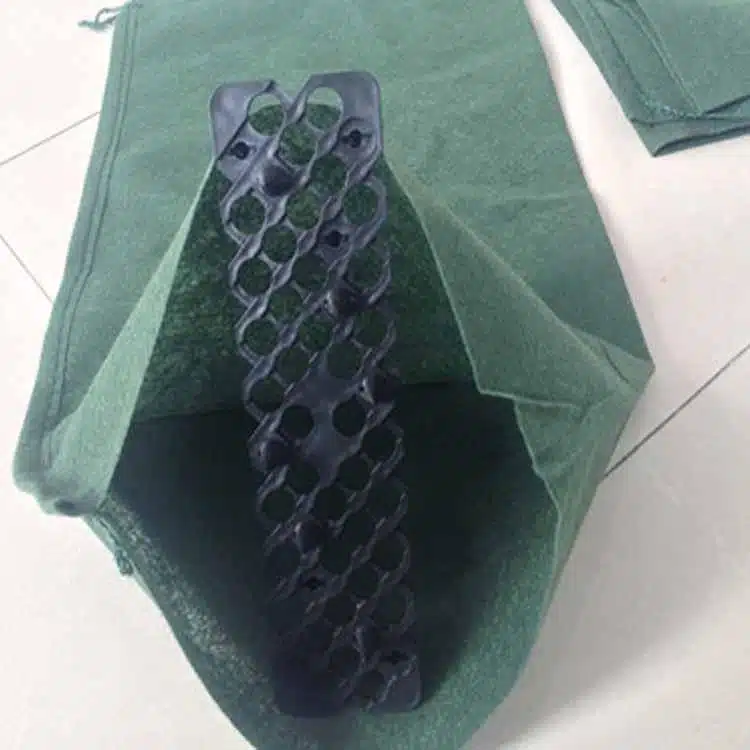
Selection & installation: specs that keep projects on-spec
How to specify the right geotextile
- Function first: separation, filtration, protection, or reinforcement.
- Hydraulics: Permittivity (s⁻¹) and AOS/O95 to match soil gradation—retain fines while letting design flow through.
- Mechanics: Grab/strip tensile, CBR puncture, tear, and UV durability to match load and exposure.
- Polymer & durability: PP for broad chemical resistance; PET for low creep at sustained load; both commonly used in geotextiles.
- Roll logistics: Standard 3.7–5.2 m widths; plan overlaps and waste.
Field practices that save rework
- Prepare subgrade: trim, remove organics, and smooth; no sharp protrusions.
- Lay geotextile cloth tension-free with the long direction along traffic; avoid wrinkles.
- Overlaps: typically 300–600 mm (increase on very soft soils). Sewn seams for very weak subgrades or high hydraulic gradients.
- Place first lift of aggregate carefully (no direct dozer turns on fabric); then compact to spec.
- Protect non-wovens from prolonged UV before cover.
Conclusion
Choose geotextile fabric for predictable performance: longer-lasting bases, cleaner drainage, and fewer call-backs. Match geotextile types to function—woven for stabilization, non-woven geotextile fabric for filtration and protection—then specify hydraulics and mechanics that fit your soils and loads.