Underwater Geomembrane Repair—Is It Really Feasible?
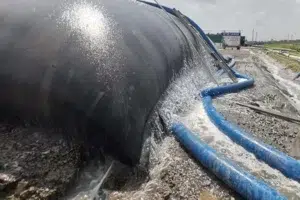
Are you experiencing underwater leaks that are preventing construction and causing increasing losses? You need an effective and reliable underwater geomembrane repair solution to solve the problem once and for all.
Yes—U can repair a submerged geomembrane liner. Diagnose (diver/ROV, dye), stabilize hydraulics, install a temporary mechanical/adhesive patch, then execute a permanent dry weld or liner-in-liner within a complete geomembrane liner system.

The following is a contractor-level field operations manual: how to classify and address underwater leaks, which repair methods are truly effective, which geomembrane liner materials and repair materials should be used, and how to verify quality in a compliant geomembrane liner system.
Can U repair a liner geomembrane underwater without draining?
1) Rapid, Non-Destructive Diagnosis
- Visual Inspection + Dye Tracing: Divers/ROVs inject fluorescent dye near suspected leaks; observe water flow direction/speed.
- Depth Measurement/ROV Mapping: Record wrinkled areas, ballast loss, and raised areas that may conceal holes.
- Upstream Head Control: If possible, reduce the pressure differential to slow flow through the geomembrane breach
2)Stabilizing Hydraulic Conditions Before Contacting the Liner
- Ballast Sandbags: Reduce vibrations that could lead to tear propagation.
- Local Cofferdam “Work Chamber”: Create a dry space using magnetic or weighted skirts for subsequent welding.
3) Temporary wet repair—then permanent dry repair
- Temporary Repair: Mechanical clamp or wet-tolerant patch to stop loss now.
- Permanent Repair: Drain small amounts of accumulated water or, during planned water level reduction, perform extrusion/dual-track welding with comprehensive quality checks to rebuild the geomembrane liner system.
Which Underwater Repair Methods Are Truly Effective?
Not all “remediation” methods are effective.
Underwater adhesives are only suitable for short-term use; mechanical clamps are more robust; truly permanent repairs require dry welding, or, if necessary, the installation of a second HDPE geomembrane liner (double liner).

Method comparison (selection by risk, access, and schedule)
| Method | Works Underwater? | Typical Service Life | Pros | Cautions/Limits |
|---|---|---|---|---|
| Mechanical clamp/plate (SS + gasket) | Yes | Medium (months–years) | Immediate seal; strong on tears and punctures | Needs smooth substrate; may require periodic re-torque |
| Wet-applied patch (MS/PU/epoxy systems) | Yes | Short–Medium | Conforms to irregularities; quick | HDPE is low-energy—surface prep critical; monitor aging |
| Local cofferdam + thermal weld (HDPE) | Dry only | Long (design life) | Permanent; restores geomembrane hdpe liner continuity | Requires habitat logistics; skilled welders & CQA |
| Liner-in-liner (secondary membrane) | Dry install | Long (design life) | Bypasses hard-to-find pinholes; new geomembrane liner product throughout | Cost, detailing penetrations/outfalls |
What patches and materials should U specify?
Choose wrong materials and the patch becomes the next leak.
Patch selection & detailing (permanent, dry habitat)
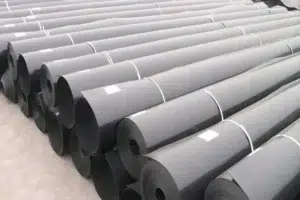
- Material match: Patch in same geomembrane liner material (e.g., 1.5–2.0 mm HDPE geomembrane) or thicker.
- Surface prep: abrasion of oxide; remove biofilm/sediment.
- Geometry: Round corners (R ≥ 50 mm); patch overlap ≥ 100 mm beyond damage.
- Welding: Dual-track hot-wedge for perimeter + extrusion fillet at edges/penetrations.
- ID/traceability: Stamp roll/lot and location; add to geomembrane lining as-builts.
Temporary wet patching tips (when U must)
- Gasketed plates: 316 SS plate + EPDM/NBR gasket; torque in cross pattern.
- Wet adhesives: Bonding is performed using PE-grade adhesive products suitable for underwater environments.
How do U verify the repair and close out CQA?
Completed geomembrane liners require leak testing.
Test seams, prove integrity, and document. Use air-channel, vacuum box, and electric leak location after the area is dry; monitor flow to confirm leak abatement.
CQA matrix (dry habitat or post-drawdown)
| Checkpoint | Method | Acceptance Intent |
|---|---|---|
| Seam continuity (dual-track) | Air-channel pressure decay | No pressure loss; continuous channel |
| Extrusion seams/edges | Vacuum box (soap film) | No bubbles/leaks |
| Destructive seam tests | Peel/shear coupons | Meets % of parent sheet per project spec |
| Whole-area integrity | ELL (water puddle/ARC/bridge methods) | Pinpoint remaining defects before re-submergence |
| Documentation | As-builts, photos, test logs, locations | Traceability for the geomembrane lining system |
Performance confirmation
- Hydraulic: Trend make-up flows/drop in leakage.
- Visual: No uplift, no flutter, ballast stable.
- Programmatic: Schedule re-inspection, especially after storm or level changes.
Conclusion
Underwater repairs buy time; permanent dry welds restore design life—verify both with CQA.
Note: project conditions vary. As a leading manufacturer, U get durable, reliable geomembrane solutions and field support—free samples, 24/7 technical guidance, and professional installation assistance—to ensure success. Partner with us for a one-stop, sustainable geomembrane lining program from diagnosis to commissioning.