
Does Geotextile Fabric Stop Weeds?
Ever had a gravel path or driveway overrun by crabgrass and rhizomes within months? Used correctly, geotextile fabric can dramatically cut weed pressure and keep aggregates clean. This guide separates landscaping myths from civil-grade facts and shows you when non woven geotextile fabric vs woven geotextile fabric makes sense for weed suppression under gravel, pavers, and heavy-duty surfaces.
MJY Geosynthetics Manufacturer has been dedicated to producing high-quality geosynthetic materials for 15 years and is a recognized leader in the industry. If you are interested in finding a reliable one-stop geosynthetics supplier for your project or business, please visit our website for more information.
Does Non Woven Geotextile Fabric Stop Weeds?
Yes—under aggregate cover. Needle-punched non woven geotextile fabric reduces light, blocks soil–aggregate mixing, and maintains drainage. It does not sterilize soil or stop aggressive rhizomes on its own; pair it with adequate cover depth and edge control.
How it works (and when it excels)
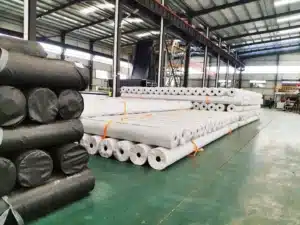
- Separation + filtration: The random fiber matrix (typical 100–180 gsm for landscaping; 200–300 gsm for driveways) keeps fines below your gravel so weed seeds don’t find a fertile top layer. Water still passes through, limiting hydrostatic pressure.
- Coverage rules: 3–4 in (75–100 mm) of compacted gravel over the fabric starves seedlings of light and moisture. Overlap adjacent sheets 12–18 in (300–450 mm) and pin at 2–3 ft (0.6–0.9 m) centers.
- Edge control: Most weeds breach from the perimeter. Use metal or concrete edging that traps the textile and aggregate, and seal transitions to turf.
- Limitations: Vigorous runners (e.g., bamboo, bindweed) can puncture; add a root barrier at edges or upgrade fabric mass and cover thickness.
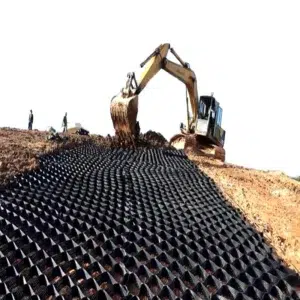
Use this when: you need permeability and fine filtration under gravel paths, patios, French drains, and geogrid or geocell systems where water must move freely.
Does Woven Geotextile Fabric Stop Weeds?
Yes—under aggregate and traffic. High-strength woven geotextile fabric denies light and provides superb separation; the stabilized aperture also improves load distribution. Drainage is more directional vs nonwovens, so design for flow paths.
Where it shines (and trade-offs)
- Strength first: Higher tensile and lower elongation help resist deformation under parking areas, access roads, and geogrid retaining wall base courses.
- Lower AOS options: Tighter weaves restrict upward migration of fines (and seedbed formation), reducing volunteer growth in the gravel layer.
- Hydraulics: Wovens can have lower cross-plane permeability; in poorly drained subgrades use drainage layers or combine with nonwoven separators.
- Installation specifics: Keep overlaps tight, pre-tension before pinning, and maintain 4–6 in (100–150 mm) compacted cover in vehicular zones.
Use this when: you need separation + high tensile for driveways, yards with turning loads, and staging pads where does woven geotextile fabric stop weeds is asked alongside bearing capacity concerns.
Practical Specification & Installation Tips (Both Types)
- Choose by function first:
- Weed suppression under pedestrian gravel → Non woven 120–180 gsm.
- Driveways / light-vehicle gravel → Woven (200+ lb grab) or non woven 200–300 gsm depending on drainage needs.
- AOS & flow: Smaller AOS (O95) blocks fines but can slow flow; balance with site drainage.
- Pins: 6–8 in (150–200 mm) steel sod staples; closer spacing in wind or on slopes.
- Cover depth: Minimum 75 mm for paths, 100–150 mm for vehicle areas; compact in 2 lifts.
- Perimeter defense: The majority of “breakthroughs” happen at edges and seams—detail these like a water barrier.
- Expectations: Does geotextile fabric stop weeds completely? No membrane is a herbicide. Aim for 90%+ suppression with correct cover, compaction, and edges; spot treat perimeters seasonally.
Conclusion
Both non woven and woven geotextiles stop weeds when U use a full system: fabric for separation/filtration, plus correct overlaps, pins, edging, and a compacted aggregate cover. Choose nonwoven for drainage/filtration; choose woven for strength/deformation control. Partner with a geotextiles factory to match AOS, tensile, and gsm for a clean, stable, low-maintenance surface.
Need help selecting the spec for your path, patio, or truck apron? MJY supplies both woven and non-woven rolls, cut widths, and project-matched submittals to keep your schedule and budget on track.

 English
  Spanish
  Arabic