
How Does Geogrid Soil Reinforcement Work? A Specialist’s Guide
Dealing with unstable foundations or landslides is a significant challenge for any contractor. But there’s a reason why geogrid soil reinforcement has become an industry standard.
In this guide, I am breaking down exactly how geogrid works to distribute loads and prevent structural failure—helping you build stronger foundations while significantly reducing aggregate costs.
What Is Geogrid and How Is It Made?
Geogrid is a high-strength geosynthetic material engineered specifically for reinforcement. Unlike flat fabrics, it features an open, grid-like structure. This allows soil and rock to “nest” inside the mesh, creating a rigid backbone for your infrastructure.
Geogrid products are typically manufactured from three primary materials, and each one offers distinct performance characteristics and best-fit applications:
- HDPE: Great for chemical resistance.
- Polyester (PET): The standard for high tensile strength and low stretching.
- Polypropylene (PP): Known for its flexibility.
Core Mechanisms: The Physics of Interlock
I have seen firsthand how geogrid transforms weak mud into a solid platform. It works through three main mechanisms:
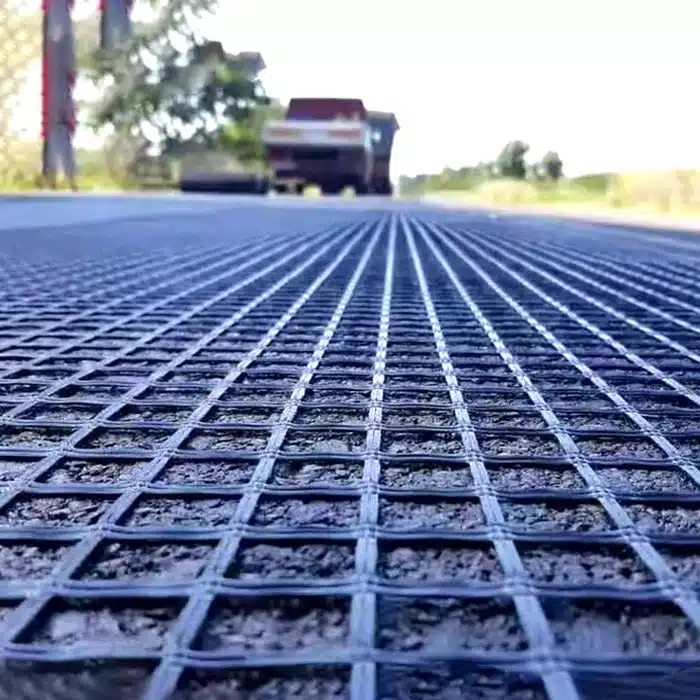
- Mechanical Interlock: This is the most critical part. When you compact gravel over the grid, the stones lock into the apertures (holes). The grid acts like a cage, preventing the rocks from moving laterally.
- Lateral Restraint (The Snowshoe Effect): Just as snowshoes spread your weight over soft powder, geogrid distributes heavy vehicle loads across a massive footprint. This prevents deep ruts and structural sinking.
- Junction Strength: The points where the ribs meet must be strong enough to hold this tension without ripping apart.
Choosing the Right Type: Uniaxial vs. Biaxial
Not all grids are created equal. The geometry determines the job:
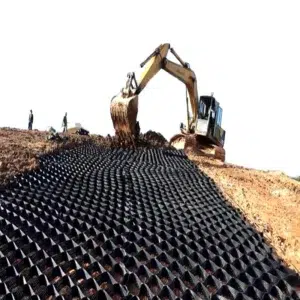
- Uniaxial Geogrid (One-Way Strength): Used primarily for retaining walls and slopes. It acts as a “tail” that anchors the wall face deep into the soil bank.
- Biaxial Geogrid (Two-Way Strength): The standard for driveways and roads. It locks aggregate in two directions to support traffic loads.
- Triaxial Geogrid (Multi-Directional): Offers 360-degree load distribution, perfect for high-traffic highways.
Proven Benefits: Why Use Geogrids?
Integrating geogrid isn’t just an engineering win; it is a financial one.
- Cut Material Costs: Because the reinforced layer is so stiff, you can often reduce your aggregate base thickness by up to 50%.
- Extend Lifespan: It prevents the “alligator cracking” that destroys parking lots, potentially tripling the life of your pavement.
- Less Maintenance: A stable base means fewer potholes and fewer callbacks for repairs.
Geogrid vs. Geotextile: Know the Difference
I often see these terms confused. Here is the rule of thumb:
- Geogrid is for Structural Reinforcement. It locks rocks in place.
- Geotextile is for Separation. It keeps mud from mixing with your clean gravel.
The Pro Move: For swampy sites, we often layer both—geotextile first to separate the muck, then geogrid on top for strength.

FAQ
- Can geogrid really reduce gravel needs? Yes. The mechanical interlock creates a stiffer base, allowing you to use less rock while maintaining the same load capacity.
- How long does it last? Quality HDPE or Polyester grids are designed to last 75 to 100 years underground.
- Is it necessary for small walls? Absolutely. For any wall over 3 feet tall, geogrid is your insurance policy against collapse.
Conclusion
By understanding the physics of mechanical interlock, you can turn “bad” soil into a stable, long-lasting platform. Whether for a driveway or a massive retaining wall, geogrid ensures your project stands the test of time.

 English
  Spanish
  Arabic