
What are geogrids?
I see many buyers ask why bases fail and walls crack. The problem looks complex. The fix is simple: use the right geogrid, with the right spec, in the right layer.
Geogrids are open-grid reinforcement sheets that interlock with aggregate and deliver tensile resistance to soils. I use uniaxial, biaxial geogrids, and multi-axial grids to stabilize subgrades, build retaining walls, and reduce rutting, with clear test methods and installation rules.
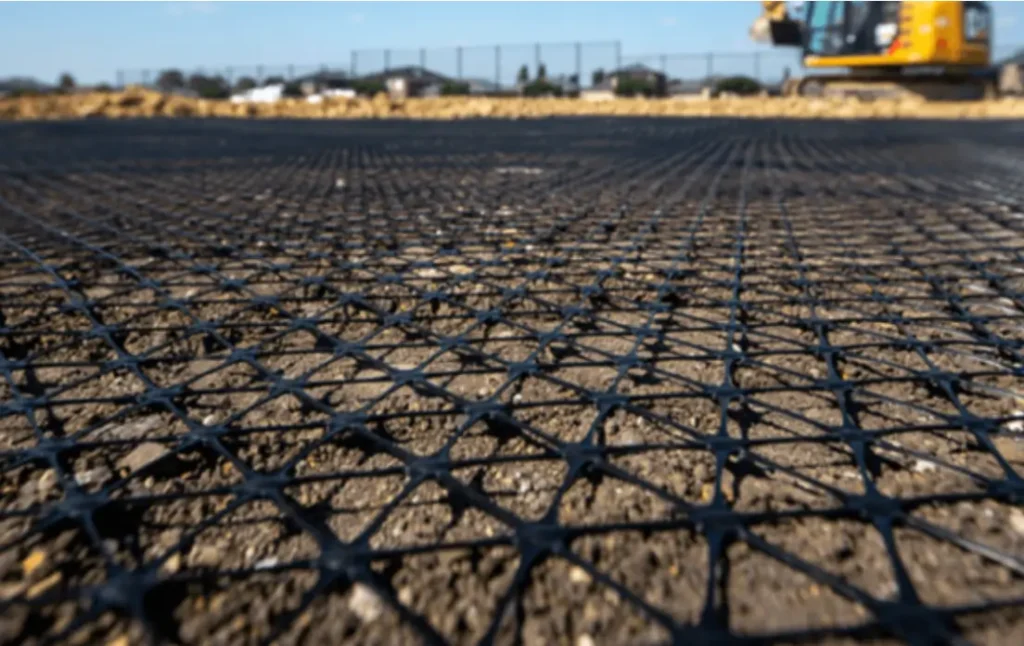
You want fast clarity and fewer callbacks. I keep terms simple, map choices to jobs, and show the numbers buyers check before issuing a PO. Read on and pick a configuration that fits your project and inspection plan.
How do geogrids work in soil reinforcement?
I meet many teams who compact well but still see movement. The common cause is lack of lateral restraint at the aggregate interface. Geogrids change load paths by creating mechanical interlock and confinement.
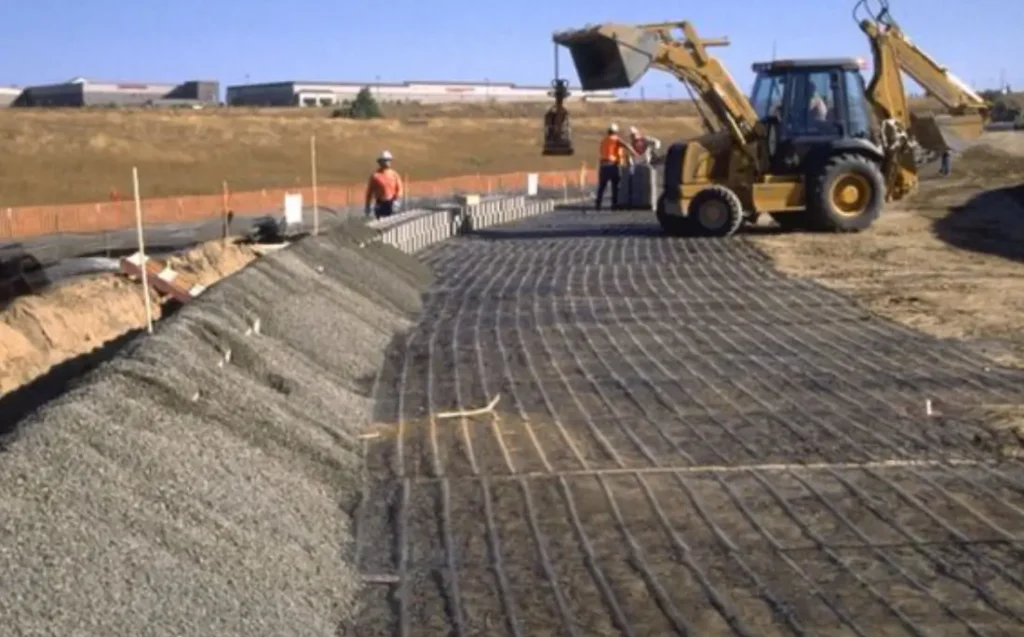
Geogrids work by interlocking with properly graded aggregate. The ribs mobilize friction and bearing on particles, and the junctions transfer tensile forces across apertures. The result is lower lateral strain, higher modulus, and reduced deformation under repeated loads. I size aperture to the aggregate, select a rib stiffness that matches expected strain, and confirm junction strength with published data and test reports.
Mechanism and key parameters
I break the mechanism into three parts. First, interlock: the stone wedges into the aperture, so the grid resists lateral movement. Second, confinement: the grid limits dilation, so the layer acts stiffer. Third, load transfer: junctions pass tensile forces between ribs.
I control performance with a short list of parameters. Aperture size must match the aggregate top size and gradation. Tensile stiffness at 2% and 5% strain shows how the grid acts in service, since most sections work at low strain. Junction efficiency protects against tearing where ribs meet. Creep behavior matters for sustained loads, especially in reinforced soil walls. Chemical and UV resistance matter for durability.
I also think about the soil. In soft subgrades, I want a grid that spreads load fast at low strain. In base reinforcement, I want high stiffness and strong junctions. In reinforced walls, I want design values that include reduction factors for creep, installation damage, and durability. I ask the lab for tests like tensile per ASTM D6637, junction strength, installation damage simulations, and durability reports.
| Parameter | What it controls | Typical target range | Notes |
|---|---|---|---|
| Aperture size | Stone interlock | 25–65 mm | Match to base aggregate; avoid oversize gaps |
| Tensile stiffness @2% | Service stiffness | 200–1000 kN/m | Relevant for pavements and platforms |
| Junction strength | Load transfer | ≥90% of rib strength | Protects against tearing |
| Creep reduction factor | Long-term design | 1.2–2.0 | Higher for high temp/long life |
| Chemical/UV resistance | Durability | Project-specific | Check pH, salts, UV exposure |
What are the different types of geogrids?
People often ask me what are geogrids by type. I group them by load direction and manufacturing route. This makes selection easy and avoids over-spec.
Geogrids come as uniaxial geogrids for one primary direction, biaxial geogrids for two directions, and multi-axial (tri- or multi-directional) for radial load paths. I also choose between extruded PP/HDPE geogrids and woven or warp-knitted polyester geogrids with polymer coatings. Each type serves a different function and budget.

Families and when I use each
I use uniaxial geogrids when pull-out resistance in one direction dominates, like reinforced soil walls and steep slopes. The ribs run parallel to the design pull direction, so I anchor layers with wraps or connectors. I confirm long-term design strengths with full reduction factors.
I use biaxial geogrids when loads act in two main directions, like sub-base stabilization in roads, yards, and rail ballast. The square apertures and stiff junctions help confine the stone and reduce rutting. This is a good first choice when the load path is predictable and mostly planar.
I use multi-axial grids when truck paths change often or when stress rotates, like turning zones, aprons, or areas with complex wheel paths. The triangular apertures and radial stiffness help keep deformation low when directions vary.
Material systems also matter. Extruded PP/HDPE grids have integrally formed ribs and junctions, good chemical resistance, and easy handling. Polyester geogrids use high-tenacity PET yarns coated with PVC or bitumen. They offer high modulus and low creep at low strain, which helps in long-term reinforcement and on soft soils. I choose the system that fits the design strain, temperature, and environment.
| Type | Directionality | Typical uses | Material route | Notes |
|---|---|---|---|---|
| Uniaxial | One major axis | Reinforced walls, steep slopes | PET woven/knit or extruded HDPE | Align ribs with pull direction |
| Biaxial geogrids | Two axes | Sub-base, yards, rails | Extruded PP/HDPE | Good for uniform load paths |
| Multi-axial | Radial | Aprons, turning areas | Extruded | Better under rotating stresses |
| Polyester geogrids | Depends on weave | Soft soil, long-term loads | Woven/knit PET + coating | High modulus, check coating |
How do geogrids and geotextiles work together?
I often get asked about geogrids and geotextiles in one section. The short answer is they do different jobs and often work better together.
Geogrids reinforce and confine. Geotextiles separate, filter, drain, and protect. I layer a nonwoven geotextile under a geogrid to keep fines out of the base and to maintain drainage. I add a woven geotextile when I need high in-plane tensile with separation. The pairing reduces pumping, improves modulus, and protects liners or soft subgrades.

Task mapping and simple stackups
I map tasks first. If I need filtration and separation under aggregate, I place a nonwoven geotextile with the right AOS and permittivity. Then I lay a biaxial geogrid to interlock with the base stone. This stackup cuts rutting and keeps the base clean, which extends life. If I need reinforcement under a temporary platform on very soft soils, I may pick a polyester geogrid with higher modulus at low strain and add a nonwoven for separation and puncture resistance.
I watch for installation sequence. I smooth the subgrade, roll out the geotextile with correct overlaps, then place the geogrid tight and flat. I use a dozer with a blade up slightly to avoid snagging. I tip the first lift of aggregate gently, keep traffic slow, and compact in thin layers.
I use clear specs. For the geotextile I set survivability class, AOS (O90) versus soil D85–D90, and permittivity. For the geogrid I set tensile at 2% and 5% strain, junction strength, aperture size, and roll width. I also request mill certs and, if needed, third-party reports.
| Function | Preferred product | Key property | Quick check |
|---|---|---|---|
| Separation/filtration | Nonwoven geotextile | AOS, permittivity | Match soil gradation |
| Reinforcement/confinement | Biaxial geogrid | Stiffness at 2% | Suit base design strain |
| Long-term reinforcement | Uniaxial/PET grid | Creep design values | Use reduction factors |
| Protection/cushion | Heavy nonwoven | Thickness under load | Protect liners |
What are the main uses of geogrids in projects?
Buyers want a short list they can put into scopes. I give uses of geogrids by segment with simple triggers and benefits that you can verify on site.
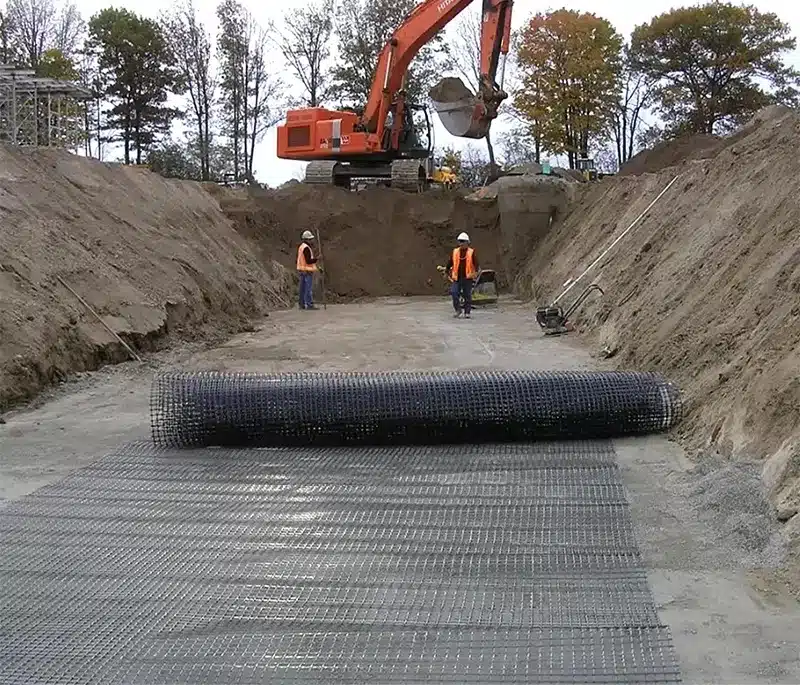
I deploy geogrids in road and yard bases, rail ballast, working platforms, retaining structures, and slopes. I also use them in embankments over soft soils and in haul roads. Each use case has a trigger condition and a clear benefit line item for tenders.
Triggers, benefits, and quick sizing logic
For road bases and yards, I add a biaxial geogrid when subgrade CBR is low, traffic is heavy, or life-cycle cost matters. The grid reduces base thickness or extends life at the same thickness. I confirm by rut depth or modulus targets. I often see 20–40% rut reduction in practice when the aggregate matches the aperture and compaction is good.
For rail ballast, I place a geogrid at the ballast–sub-ballast interface to reduce settlement and ballast degradation. The interlock stabilizes the lower ballast and spreads load to the subgrade. Ballast cleaning intervals often extend, which lowers maintenance.
For retaining walls and slopes, I use uniaxial geogrids in layers behind the face. I design embedment length, spacing, and pullout resistance with the soil friction and grid–soil interaction. I include facing connections that match design loads. The result is higher factors of safety with less settlement and fewer face issues.
For embankments over soft soils, I use high-modulus polyester geogrids or multi-layer systems to bridge weak zones and control differential settlement. I combine with drainage and staged construction when required. I also use geogrids for working platforms under cranes and piling rigs to cut stone usage and keep platforms stable under repeated passes.
| Application | Trigger condition | Grid type | Primary benefit |
|---|---|---|---|
| Roads, yards | Low CBR, heavy traffic | Biaxial geogrids | Less rutting or thinner base |
| Rail ballast | Settlement, fouling | Biaxial/multi-axial | Longer maintenance cycle |
| Retaining walls | Reinforced backfill | Uniaxial | Pullout resistance, stability |
| Slopes | Steep angles | Uniaxial | Increased factor of safety |
| Soft ground | Low shear strength | PET/high-modulus | Bridging and settlement control |
How do I specify, install, and verify geogrids?
Many projects fail in the details. I keep the spec short, the install steps clear, and the checks simple. This protects margins and schedules.
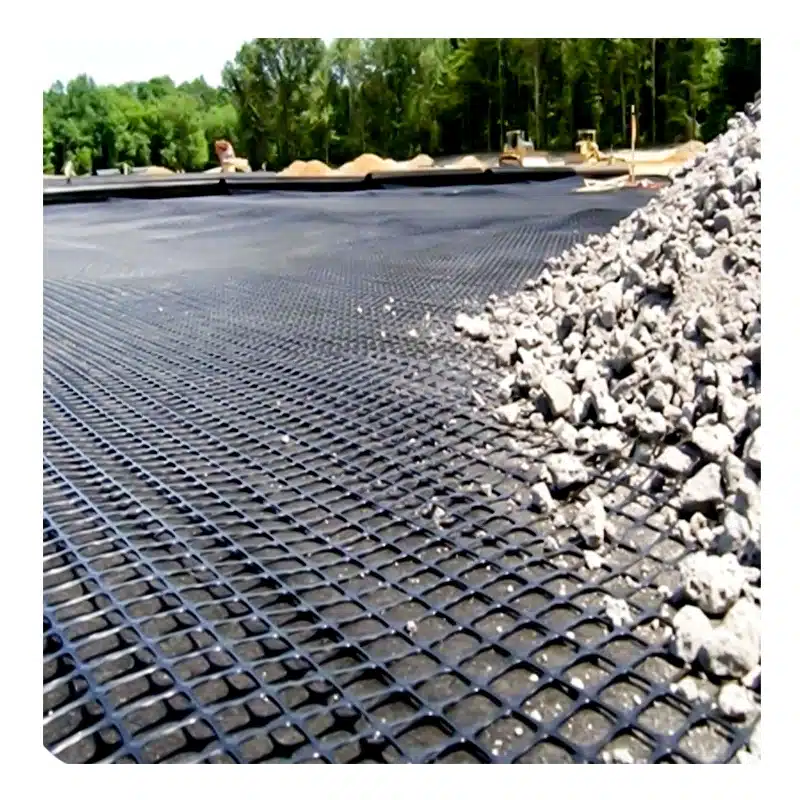
I specify a grid by function, stiffness at service strain, aperture match to aggregate, junction strength, and durability. I install on a smooth bed, keep grids taut, and place aggregate gently. I verify with basic field checks, and I keep records that inspectors accept.
Specs, steps, and acceptance checks
I start with the function: reinforcement for a base, or reinforcement for a wall. For bases, I select a biaxial geogrid with stiffness at 2% strain that meets the design modulus. I match aperture to the base stone. I set junction strength to avoid tearing under dozer turns. I confirm roll width fits lane width to reduce overlaps. For walls, I choose uniaxial PET with design strengths that include creep and durability reduction factors.
I write install steps in ten lines or less. Grade and proof-roll the subgrade. Remove soft spots. Roll out geotextile if separation is needed, with overlaps. Place the geogrid flat and tight. Use mechanical ties at overlaps if the spec requires. Tip aggregate carefully, avoid pushing with blade down on the bare grid. Compact in thin lifts. Keep early traffic slow. Protect edges.
I verify with three simple checks. Visual: grid is flat, overlaps are correct, and no damage. Density: compaction meets target. Modulus or plate load: spot checks show improved response where needed. I collect delivery docs, mill certs, and any third-party test reports for the closeout package.
| Step | What I check | Acceptance tip | Common pitfall |
|---|---|---|---|
| Subgrade prep | Smooth, firm | Proof-roll passes | Leaving ruts under grid |
| Grid placement | Flat, tight | Correct overlaps | Wrinkles and slack |
| Aggregate placement | Gentle, uniform | No direct blade on grid | Snagging ribs |
| Compaction | Thin lifts | Meets density | Over-thick lifts |
| Records | Certs, tests | Filed and signed | Missing lot traceability |
FAQ
Q: What are geogrids in one sentence?
A: Geogrids are open-grid polymer sheets that provide tensile reinforcement to soil and aggregate through interlock and confinement.
Q: Are biaxial geogrids always better than uniaxial?
A: No. Biaxial geogrids suit bases with two-way loads. Uniaxial grids suit walls and slopes where forces act mainly in one direction.
Q: Do I need a geotextile under every geogrid?
A: Not always. Use a geotextile when you need separation and filtration. Skip it only when the soil and aggregate will not mix and drainage is secure.
Q: How do I match aperture to stone?
A: I compare aperture size to the aggregate top size and gradation. I avoid apertures that are too large, which reduce interlock, or too small, which trap fines.
Q: What documents do inspectors ask for?
A: Mill certificates, tensile and junction strength reports, creep data for design strengths, installation records, and delivery traceability.
Conclusion
Define the job first. Select grid type by load path. Match aperture to stone and stiffness to strain. Keep specs short, install clean, and verify simply.




 English
  Spanish
  Russian
  Portuguese
  Arabic
  Hindi
Hindi