
What Is Geogrid for Retaining Walls? (Contractor-Ready Guide)
You want a wall that stays straight, drains clean, and resists bulging under surcharge. That’s exactly where geogrid for retaining wall systems shine. This guide explains what is geogrid for retaining walls, when to use it, how it works with block systems, and the must-know details for geogrid retaining wall installation that pass inspection the first time.
What Is Geogrid for Retaining Walls?
Geogrid is a high-tensile geosynthetic (polyester or polyethylene) mesh that interlocks with compacted backfill to create a wider, stronger gravity mass behind your wall. Instead of the blocks alone resisting soil pressure, the retaining wall geogrid spreads loads deep into the reinforced zone—cutting lateral earth pressure and controlling deformation.
What geogrid does in a wall (quick hits)
- Reinforcement: The grid’s apertures lock with well-graded aggregate; friction + bearing create pullout resistance.
- Load sharing: Turns the backfill into a stabilized, composite mass (your geogrid wall).
- Serviceability: Minimizes facing bulge and settlement under surcharges (traffic, parking, slopes).
- Reliability: Provides redundancy across layers—critical in geogrid reinforced retaining wall designs.
Terminology you’ll hear on plans: retaining wall geogrid, geogrid fabric retaining wall, wall geogrid, geogrid mesh retaining wall, geogrid retaining wall system. They all point to the same concept—soil reinforcement layers tied to the wall face.
When Do You Need Geogrid Behind a Retaining Wall?
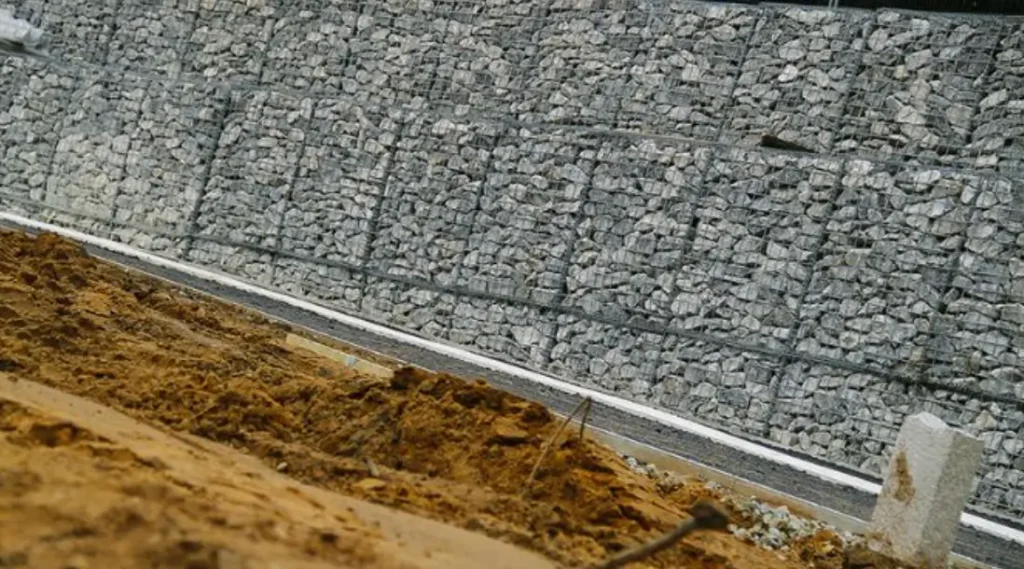
Use geogrid behind retaining wall whenever any of these flags show up:
- Wall height ≥ 3–4 ft (0.9–1.2 m) or local code requires engineering.
- Poor subgrade or backfill, high plasticity, or limited embedment.
- Surcharge loads (drive lanes, parking, structures, slopes above the wall).
- Tight deflection criteria—architectural faces, stairs, or fencing atop the wall.
- Water in the retained zone; critical drainage details are needed.
If you’re asking “geogrid vs retaining wall (no grid)?”—the moment height or surcharge increases, choose geogrid retaining wall reinforcement. You’ll reduce facing movement, improve global stability, and often cut block/footing quantities.
Geogrid Types & “Best Geogrid for Retaining Wall”
Not all grids behave the same. For segmental block walls, you’ll typically see:
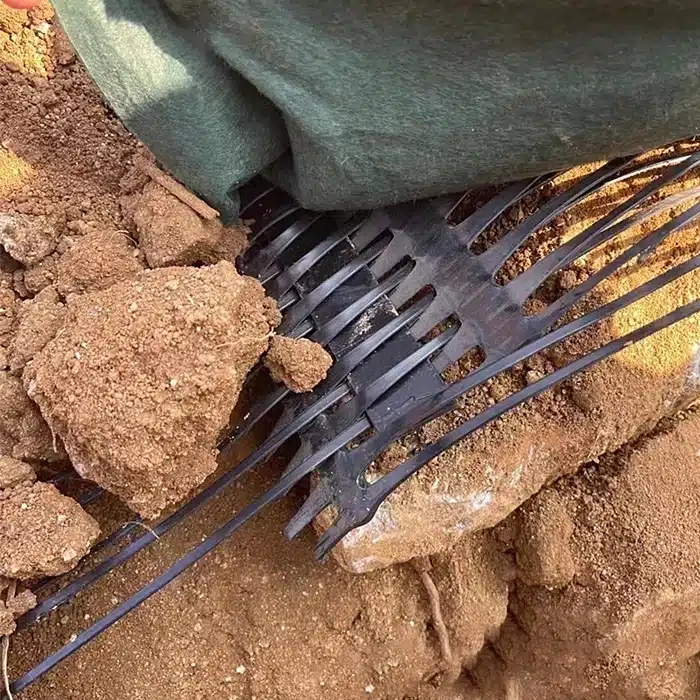
- Uniaxial HDPE geogrid (strength primarily in the roll direction): common for geogrid retaining wall design with modular blocks.
- Woven polyester geogrids / polyester geogrid (PET): high long-term design strength with low creep; often specified where sustained loads or elevated temperatures matter.
- Biaxial geogrid: great for base/subbase stabilization; occasionally used near the base but uniaxial/PET dominate wall reinforcement.
Choosing the best geogrid for retaining wall comes down to:
- Connection testing with your specific block (shear/pullout values).
- Long-term design strength (LTDS) after creep, installation damage, and durability reductions.
- Soil interaction (pullout factors) with your selected backfill.
Ask for: connection test report, LTDS, product data sheet, and pullout coefficients for your retaining wall geogrid specification.
Geogrid Retaining Wall Design—Numbers That Keep You Safe
Every project needs stamped calcs, but these planning rules keep bids realistic:
- Reinforced zone depth (embed length): commonly 0.7–1.0 × wall height (H) measured from the face into the backfill (longer for poor soils/surcharge).
- Vertical spacing: typically one geogrid layer every block course or every second course (≈8–16 in / 200–400 mm), tighter near the base where pressures peak.
- Facing connection: grid tails centered on the block, fully seated, no wrinkles.
- Backfill: well-graded, free-draining aggregate (not clay).
- Drainage: perforated toe drain, clean stone chimney, and wrapped outlets—non-negotiable for durability.
Geogrid Retaining Wall Installation (Step-by-Step)
This is the field method inspectors expect for geogrid installation retaining wall crews.
- Base & first course
- Leveling pad per plans, compacted. Set the first block course dead-level (this controls the whole wall).
- Drainage & geotextile
- Install toe drain and clean stone. Line soil/stone interfaces with geotextile (separation) if specified.
- Backfill to grid elevation
- Place and compact in ≤8 in (200 mm) lifts to the first grid layer elevation.
- Place the geogrid layer
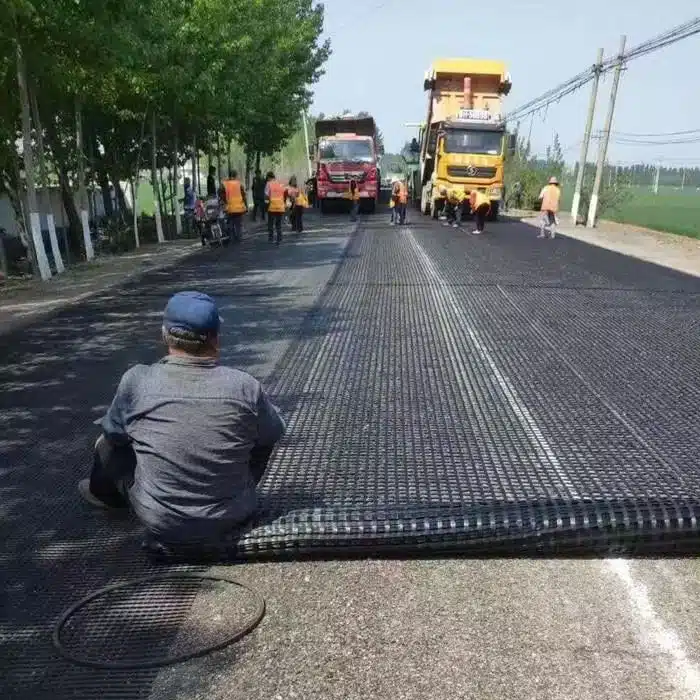
- Roll retaining wall geogrid fabric perpendicular to the wall, strength direction pointing away from the face. Seat it flat—no slack, no waves.
- Connection at the face
- Follow the block manufacturer detail (embed between courses, pins/keys as required). This is your geogrid wall retaining connection.
- Tension & temporary stake
- Pull grid taut back from the wall, stake outside the reinforced zone to maintain tension.
- Backfill and compact over the grid
- Place aggregate from the wall face outward to avoid rolling the face. Compact; keep heavy equipment off the block edge.
- Repeat
- Continue courses and retaining wall geogrid installation layers per plan.
Pro tips
- Overlap adjacent grid rolls 6–12 in (150–300 mm) side-to-side (unless mechanically connected).
- Never substitute clayey backfill in the reinforced zone.
- Keep water out during construction; protect drains from fines.
Common Mistakes (and Fast Fixes)
- Wrong grid orientation (strength the wrong way). → Re-orient; strength direction must run perpendicular to the wall.
- Short embed length to save material. → Extends failure plane; use designed length.
- Poor compaction near face (fear of pushing blocks). → Use lighter plates close to the face with more passes.
- No drainage or clogged outlets. → Add chimney stone, filter fabric wraps, clean outlets—don’t bury them.
- Mixing soil types inside the reinforced zone. → Stick to the specified gradation.
Spec & Submittal Checklist (Copy/Paste)
- Product: retaining wall geogrid fabric (uniaxial HDPE or woven polyester geogrids) with published LTDS.
- Docs: Current connection test with specified block; pullout data in project backfill; durability reduction factors; roll ID & QA certificates.
- Layout: Layer elevations, embed lengths, overlaps, and returns at corners/steps.
- Materials: Free-draining reinforced backfill; chimney and toe drains; geotextile separators where specified.
- QC: Lift thickness, density targets, proof-roll protocols, face alignment tolerances.
FAQ—Using Geogrid Retaining Wall Systems
What is a geogrid retaining wall?
A modular block wall with engineered soil reinforcement layers—geogrid wall—forming a composite gravity mass.
Where does the geogrid sit?
In layers behind the facing, extending back into compacted backfill—this is your geogrid behind retaining wall zone.
Can geocells replace geogrid?
For wrapped-face or steepened slopes, geogrid geocell retaining wall hybrids exist, but conventional block walls typically rely on geogrid.
Do small garden walls need grid?
Under ~3–4 ft without surcharge and on good soils, some walls are gravity-only. Anything taller or loaded? Plan on geogrid.
Conclusion
If the question is “what is geogrid for retaining wall?” the answer is simple: it’s the reinforcement that turns loose backfill into a stable, engineered mass—reducing pressure on the face, tightening deflection, and extending service life. For predictable outcomes, select the right product (HDPE uniaxial or woven polyester geogrids), follow tested connection details with your block, and execute retaining wall geogrid installation with disciplined drainage and compaction. That’s how geogrid retaining wall reinforcement delivers walls that look great on day one—and still look great years later.
Need a spec pack or a one-page geogrid retaining wall PDF with layer spacing and embed tables? Say the word—we’ll format a submittal-ready set you can hand to your crew and inspector.





 English
  Spanish
  Russian
  Portuguese
  Arabic
  Hindi
Hindi