
You want stronger bases, safer walls, and fewer callbacks. You ask what is geogrid used for. The answer starts with the right geogrid material.
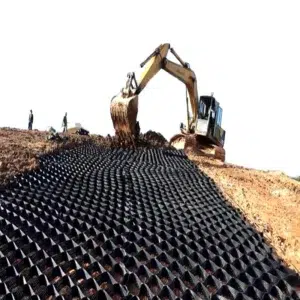
Geogrid material is a polymer lattice that locks with compacted stone. This geogrid reinforcement stops lateral movement, spreads load, and reduces rutting. You use it in roads, platforms, retaining walls, and slopes where soil strength is low or traffic is heavy.
What are geogrids?
Geogrids are open grids made from PP or PET. Ribs and junctions create apertures that hold aggregate in place. With the right geogrid material, the base acts stiffer on day one.
Use cases:
- Roads and yards: less rutting, thinner base for the same performance.
- Working platforms: better bearing for cranes and trucks.
- Geogrid retaining wall: layers extend back to form a reinforced soil block.
- Slopes and embankments: higher shear resistance with staged fill.
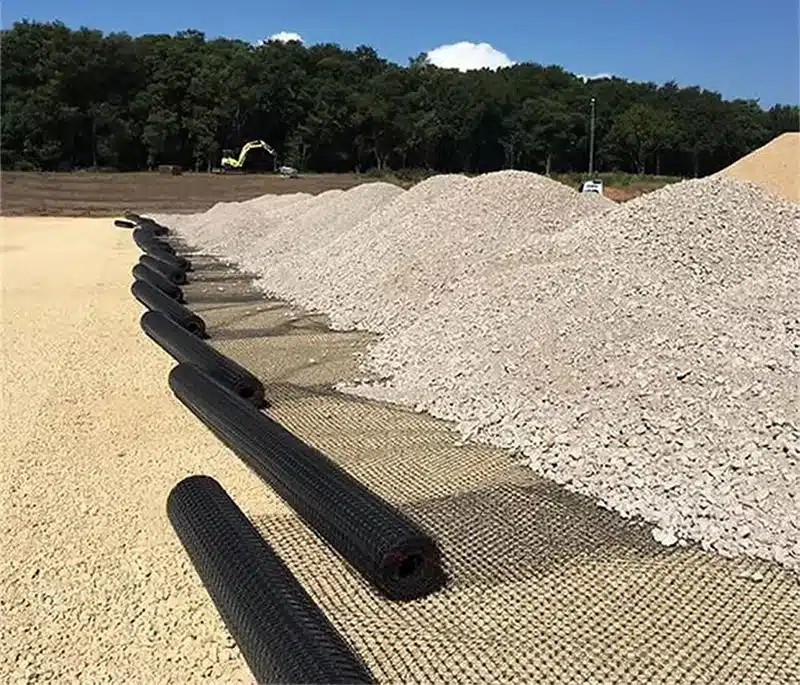
Where geogrid material helps most?
- Soft subgrade with tight schedules.
- High traffic with turning and braking.
- Poor access where extra stone is costly.
- Walls that need tested, repeatable connections.
Results you can expect:
- Reduced base thickness.
- Longer service life.
- Fewer maintenance passes.
- Faster inspection sign-off.
Choose the right geogrid material
Match material to job and risk. Keep the spec short and testable.
- Polymer: PP for broad chemical resistance; PET for higher modulus and creep control (check pH and temperature).
- Direction: biaxial for bases and platforms; uniaxial for walls and steep slopes.
- Aperture vs stone: fit the median size for strong interlock.
- Stiffness at small strain: controls early rut depth more than ultimate strength.
- Junction efficiency: high transfer between ribs for reliable performance.
Quick table:
| Function | Geogrid type | Geogrid material note |
|---|---|---|
| Road base / yard | Biaxial | PP common; aperture sized to aggregate |
| Working platform | Biaxial | High stiffness at 2% strain target |
| Retaining wall | Uniaxial | PET or PP with tested connection data |
| Steep slope | Uniaxial | Long lengths, pullout and creep checked |
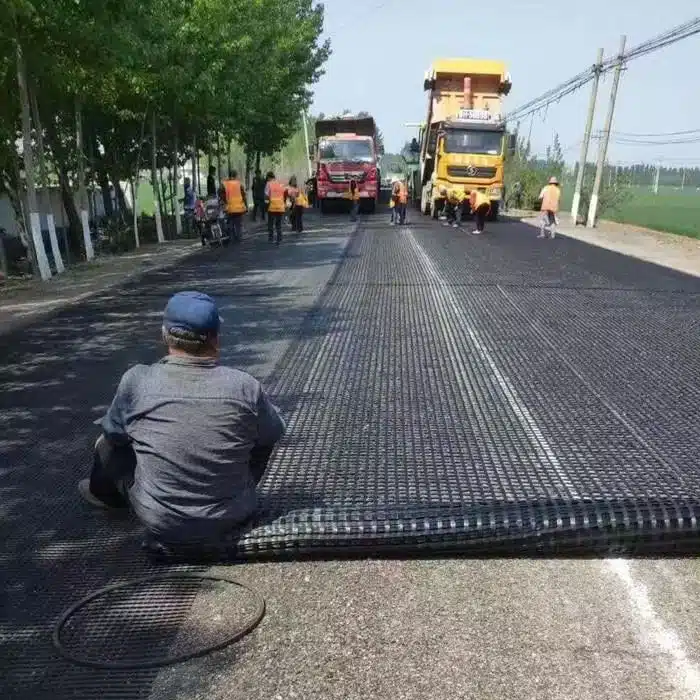
Install basics you can trust
- Prepare a firm, level subgrade. Remove soft pockets.
- Place geogrid flat. Orient strong direction per design.
- Overlap across roll widths 150–300 mm unless mechanically joined.
- Place clean, angular stone in thin lifts (150–200 mm). Compact each lift.
- Keep drainage open. Do not drag stone across exposed grid.
For a geogrid mesh retaining wall or block wall:
- Set the base course true.
- Tie geogrid to the face per the system detail.
- Extend lengths typically 0.7H–1.0H, or per engineering.
How quote and supply from my factory?
– Our factory include full product code and polymer.
– Our factory share stiffness curves at small strains, not only ultimate strength.
– Our factory list junction efficiency and aperture size.
-Our factory confirm roll width and length to reduce seams and waste.
– Our factory provide lot labels, mill certificates, and third-party tests when needed.
– Our factory confirm lead time and Incoterms before you order.
FAQ
Q: Is geogrid fabric the same as geogrid material?
A: People say “fabric,” but geogrid is a grid. Use geotextile fabric for separation and filtration; use geogrid material for reinforcement.
Q: What is geogrid used for near rail lines?
A: Ballast and yard stabilization. The grid restrains aggregate and reduces settlement.
Q: Can I swap biaxial geogrid into a wall?
A: Do not swap without a stamped revision. Walls usually need uniaxial with tested connections.
Q: Does more gsm always mean better?
A: No. Focus on stiffness at small strains, aperture fit, and junction efficiency.
Conclusion
Pick geogrid material by function, soil, and stone. Use biaxial under bases. Use uniaxial in walls and slopes. Keep specs simple, prove stiffness early, and you cut thickness, cost, and risk.


 English
  Spanish
  Arabic