
What Is Geomembrane Used For?
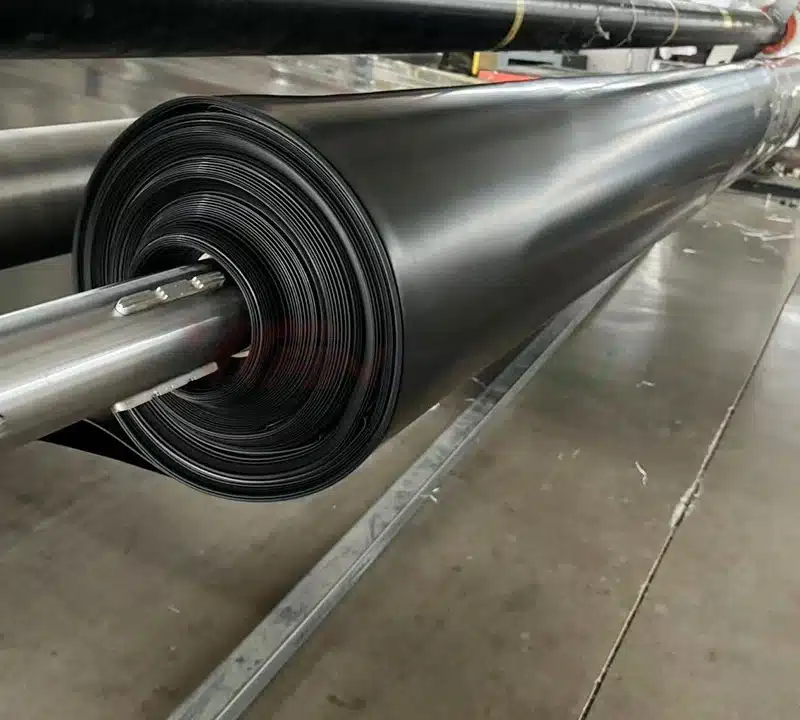
If you need true containment—not just filtration—you need a geomembrane. It’s a factory-made polymer barrier—often specified as an HDPE geomembrane liner (also called geomembrane HDPE or PEHD)—engineered to stop liquids, gases, and contaminants from migrating. In civil and industrial works, it’s the workhorse layer: near-zero permeability, strong chemical and UV resistance, and field-welded seams for long-term security.
Where owners deploy geomembranes (typical use cases):
- Landfills & transfer stations: cell liners, caps, leachate ponds.
- Mining: heap-leach pads, pregnant solution ponds, tailings facilities.
- Water & wastewater: lagoons, digesters, clarifier basins, sludge beds.
- Oil & chemicals: secondary containment, brine/salt ponds, process pads.
- Agriculture & aquaculture: fish/shrimp ponds, irrigation canals, silage pits.
- Infrastructure: tunnel waterproofing, stormwater detention, canals, wetlands.
- Environmental remediation: cut-off barriers, bioreactor caps, contaminated soil cells.
Why Is HDPE Geomembrane Commonly Used?
- Impermeability that lasts. HDPE geomembrane sheet (also called geomembrane HDPE sheet) provides extremely low hydraulic conductivity for long-term containment—ideal as a primary liner HDPE geomembrane in cells and ponds.
- Chemical & UV resistance. Carbon-black–stabilized HDPE geomembrane material resists acids, salts, hydrocarbons, and intense sunlight; it’s the default for exposed service in harsh climates.
- Weldability & QA/QC. Dual-track hot-wedge or extrusion welds create continuous seams; crews can air-channel test and vacuum-box test for production-scale quality control.
- Strength-to-cost advantage. From ~0.5–3.0 mm thickness (20–120 mil), HDPE geomembrane lining offers excellent puncture and tear resistance at a competitive cost per m².
- Surface options for design.
- HDPE smooth geomembrane / smooth HDPE geomembrane: best for lagoons, reservoirs, floating covers, and areas where low friction is acceptable.
- Textured finishes: increased interface friction on side-slopes and geosynthetic stacks.
When U might choose alternatives to HDPE:
- LLDPE (Linear Low-Density PE): higher flexibility and better subgrade conformance; good for settlement-prone foundations and cold installs.
- fPP/TPO (flexible Polypropylene): higher service temperatures, strong weldability; covers and hot-process areas.
- PVC: very flexible, easy detailing; protected or buried works (cover for plasticizer loss and chemicals).
- EPDM/CSPE: elastomeric flexibility for decorative ponds, roofs, specialty water features (usually adhered seams).
- Bituminous geomembranes/composites: hydrocarbon compatibility and self-healing tendencies in certain designs.
A high-resolution cross-section drawing of a landfill side-slope and floor showing, from top to bottom: protective nonwoven geotextile (200–400 gsm), HDPE smooth geomembrane 2.0 mm, geocomposite drain (geonet + geotextile), compacted clay layer (600 mm), prepared subgrade. Labels call out “primary hdpe geomembrane liner (GM13 compliant), welded seam detail with air-channel test port, anchor trench at crest, textured HDPE on slopes (optional), smooth on floor (optional). Arrows indicate leachate flow to collection pipe and sump.”
What Is the Difference Between Geotextiles and Geomembranes?
- Function:
- Geotextiles (woven or nonwoven) are permeable fabrics used for separation, filtration, drainage, and reinforcement.
- Geomembranes are impermeable polymer sheets used for containment of liquids/gases.
- Permeability:
- Geotextiles: allow water to pass while retaining soil fines.
- Geomembranes: designed for near-zero flow (barrier layer).
- Typical materials:
- Geotextiles: PP or PET fibers (needle-punched nonwoven or woven).
- Geomembranes: HDPE (geomembrane HDPE / geomembrane PEHD), LLDPE, fPP/TPO, PVC, EPDM.
- Mechanical role:
- Geotextiles: protect, separate, reinforce; often placed above/below geomembranes as a cushion against puncture.
- Geomembranes: primary liner; rely on geotextiles/geocomposites for protection and drainage.
- Where each goes in a liner system:
- Top to bottom (example pond): cover soil/ballast → protective geotextile → HDPE geomembrane smooth → geocomposite drainage → subgrade.
Quick comparison table
| Property | Geotextile | Geomembrane |
|---|---|---|
| Core purpose | Separation/Filtration/Protection | Containment/Barrier |
| Flow through | Yes (permeable) | No (impermeable) |
| Materials | PP/PET fibers (woven/nonwoven) | HDPE/LLDPE/fPP/PVC/EPDM |
| Typical thickness | 0.8–6 mm (loft) | 0.5–3.0 mm (sheet) |
| Typical tests | Permittivity, AOS, puncture | Tensile, tear, puncture, OIT, density |
| Placement | Above/below liners, under riprap | Primary liner/cap or waterproofing layer |

A split-screen infographic. Left panel: “Geotextile” with a zoomed fiber network showing water arrows passing through; bullet icons labeled “Separation, Filtration, Cushion.” Right panel: “Geomembrane HDPE” with a solid black HDPE geomembrane sheet blocking blue water arrows; bullets labeled “Barrier, Containment, Welded Seams.” A third mini-panel shows a stacked system: soil cover → nonwoven geotextile → geomembrane HDPE liner → drainage geocomposite → subgrade.
Conclusion
If U need dependable containment, specify a hdpe geomembrane as the primary barrier and build the system around it: protective geotextiles for cushioning, drainage geocomposites for leachate/runoff management, and a stable subgrade. Choose HDPE when U want maximum chemical/UV resistance, robust welds, and life-cycle value; consider LLDPE for flexibility, fPP/TPO for higher temperatures, or PVC/EPDM for specialty detailing. Proper material selection, welding, and QA/QC convert a sheet into a safe, long-lived HDPE geomembrane lining system.




 English
  Spanish
  Russian
  Portuguese
  Arabic
  Hindi
Hindi