
Why Choose an HDPE Geomembrane Liner for Your Project?
Leaks can disrupt project timelines and cause unnecessary costs. Do you need a proven method to effectively contain liquids and ensure regulatory compliance?
HDPE geomembrane liners are tough, UV-resistant barriers used to seal landfills and ponds. You get long service life, strong seams, and reliable compliance while effectively reducing your engineering costs.
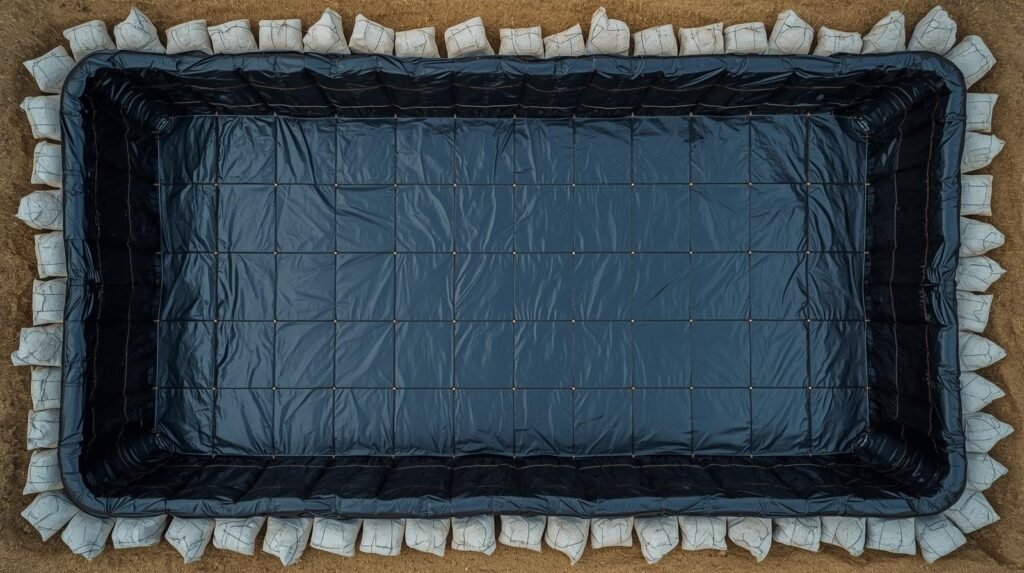
I will keep this practical and direct. Below, U will see where HDPE works best, how to spec it, and what to check before U buy.
What is an HDPE geomembrane liner?
Liners can seem like black plastic sheets. Are they just that? No. The details decide performance.
An HDPE liner is a geomembrane made from high density polyethylene. It forms a continuous, impermeable barrier when seamed. U use it to contain water, leachate, brine, or chemicals in civil and industrial projects.
I treat “HDPE geomembrane liner” as a system, not a single sheet. The resin matters. High density polyethylene gives a high modulus, good chemical resistance, and strong stress-crack performance when formulated well. Carbon black (about 2–3%) blocks UV and keeps the liner stable under sun exposure. Antioxidants protect the polymer during extrusion and in service. The sheet can be smooth on both sides or textured on one or both sides for friction on slopes.
Panels are factory-extruded to consistent width and length. On site, crews place them with an overlap and use hot wedge welding to fuse a double seam with an air channel. That channel supports non-destructive testing. Extrusion fillet welding is used for details and penetrations. When the seams pass testing, U get a continuous geomembrane liner. The result is a barrier that beats clay in permeability by orders of magnitude and holds its shape through temperature swings. In short, an HDPE geomembrane gives U a durable, low-permeability skin that stands up to weather, chemicals, and time.
Why choose high density polyethylene over other liner materials?
PVC, LLDPE, EPDM, or HDPE—U have options. Which one balances cost, strength, and service life?
Choose HDPE when U need a stiff, high-strength, UV-resistant geomembrane liner with proven field history. It handles sun, heat, and many chemicals better than flexible options and delivers strong, testable seams.
I compare materials by the risks they must carry. HDPE geomembrane stands out on three fronts: UV stability, chemical resistance, and seam integrity. Carbon black gives long outdoor life. The polymer backbone resists many acids, salts, and leachates found in landfills, mining, and industrial sites. Hot wedge welding forms robust double seams that U can air-channel test across long runs. That is a big advantage when U must certify every panel join.
LLDPE is softer and more flexible. It can fit tight corners but may give up some stress-crack resistance or stiffness on hot days. PVC is flexible and easy to detail, but its plasticizers can migrate, and UV can age it faster unless protected. EPDM is elastic and useful for ornamental water, yet it lacks the seam testing convenience and chemical breadth that heavy industry expects.
HDPE does have tradeoffs. It is stiffer in cold weather, so crews must stage panels carefully and control wrinkles. Details around small penetrations need experienced installers. But for most containment cells, reservoirs, and caps, the balance tilts to HDPE. The sheet stays stable, the seams prove themselves with tests, and the lifecycle cost is low because the liner lasts. When U weigh compliance risk, downtime, and repairs, HDPE’s durability pays for itself.
| Criterion | HDPE | LLDPE | PVC | EPDM |
|---|---|---|---|---|
| UV resistance | Excellent (carbon black) | Good | Fair–Good (needs cover) | Good |
| Chemical resistance | Broad | Broad–Good | Variable | Moderate |
| Seam QA/QC | Strong (air channel, vacuum) | Strong | Moderate | Moderate |
| Flexibility | Moderate | High | High | Very High |
| Typical use | Landfills, ponds, brine | Ponds, covers | Decorative, some tanks | Ornamental water |
Where are HDPE geomembrane liners used today?
U need examples, not buzzwords. Where does HDPE deliver clear value?
Use HDPE liners for landfill cover solutions, basal landfill cells, process water ponds, fire-water and stormwater storage, heap leach pads, evaporation ponds, and lined canals. U also see them in remediation caps and secondary containment.
![[Image placeholder: Montage with captions: landfill cell, lined farm reservoir, mining heap leach pad, and a remediation cap with soil cover.]](https://geosyntheticsmanufacturer.com/wp-content/uploads/2026/01/Image-placeholder_-Montage-with-captions_-landfill-cell-lined-farm-reservoir-mining-heap-leach-pad-and-a-remediation-cap-with-soil-cover-1024x573.jpg)
I group applications by what the liner must block. In landfills, the liner and leachate collection system must stop contaminated liquids from entering groundwater. HDPE’s low permeability and strong seams make it the default choice. On the surface, landfill cover solutions often combine an HDPE geomembrane with protective geotextile, drainage nets, and vegetated soil to shed rainfall and control gas.
In water containment, an HDPE geomembrane pond liner in 40–80 mil thickness offers clean, inert storage for irrigation, aquaculture, and fire water. The UV package resists sun where ponds sit uncovered for years. For industrial brine and process water, thicker gauges and textured surfaces improve stability on sloped banks. Secondary containment around chemical tanks uses HDPE because it resists many oils and acids, and U can detail sumps and pipe boots with extrusion welds.
Mining places extreme demands. Heap leach pads need chemical resistance to cyanide or acid. HDPE’s track record there is long. Evaporation ponds run hot and salty. High-performance antioxidant packages and proper OIT values matter in specs. In remediation, a thin HDPE geomembrane liner beneath a soil cover isolates legacy waste and reduces vapor emissions. Each case ties back to the same strengths: a stable polymer, testable seams, and a supply chain that can roll out acres of material fast. If U need a barrier that stays in place through sun, wind, and time, HDPE is the standard to beat.
How do U select the right geomembrane liner spec?
I start with function and risk. For quiet ponds or liner under a soil cover, 40–60 mil smooth HDPE may work. For steeper slopes or traffic during cover placement, use textured geomembrane on one or both sides to raise interface friction. Landfills, brine, or aggressive fluids often push thickness to 80–120 mil with dual-textured surfaces on slopes.
Then I check durability markers. Ask for OIT and HP-OIT data that show antioxidant reserves. ESCR (environmental stress crack resistance) gives insight into long-term crack risk. Carbon black content and dispersion must be within spec for UV resistance. If the project sits uncovered in high sun, black is standard; where heat gain is a problem, some owners use white/black co-extruded liners to reduce surface temperature.
Seams drive success. Hot wedge double seams with air channels allow continuous non-destructive testing. Extrusion fillet welds handle details and repairs. Write both into the spec with required destructive peel and shear strengths. Add vacuum box testing for extrusion seams.
Finally, plan the interfaces. Pair the liner with a non woven geotextile cushion where angular subgrade or cover material could puncture. Specify drainage layers above or below the sheet as needed. Include anchor trench depth, wind management, and panel layout drawings. A clear spec avoids field guesswork and reduces change orders. U end up with an HDPE geomembrane liner that fits the loads, the slopes, and the fluid—without buying more sheet than U need.
What are installation best practices for an HDPE liner?
I map the work in four phases. First, prepare the subgrade. Grade smooth, remove sharp stones, and compact to design. Place a geotextile cushion where needed. Stage panels on dunnage and weight the edges with sandbags to stop wind lift. Keep traffic off prepared subgrade to avoid ruts that telegraph through the sheet.
Second, align and place panels. Unroll with the machine direction aligned per the layout. Limit wrinkles by placing in calm conditions and working from the anchor trench downward on slopes. Overlap per spec. Keep overlaps clean and dry. Cut out damaged areas rather than trying to weld through flaws.
Third, weld and test. Use hot wedge welding for primary seams to create a double track with an air channel. Set temperature, speed, and pressure based on trial seams each shift. Perform non-destructive air-channel testing, plus vacuum box on extrusion fillets. Pull coupons for destructive peel and shear at the set frequency. Record parameters, locations, and results.
Fourth, detail and protect. Extrusion weld boots at pipes and sumps. Ballast with sandbags until cover goes down. Place cover materials carefully to prevent gouges. On slopes, sequence cover from the crest downward to avoid dragging. The goal is simple: deliver a continuous, verified barrier with no guesswork. When U respect these basics, U reduce repairs, save time, and hand over a clean package to the owner and regulator.
Where should U buy geomembrane liners and how do U compare suppliers?
I vet suppliers on three axes: quality, capacity, and support. On quality, ask for certificates that align with recognized standards and request current lab data for the exact resin and thickness U plan to buy. Review OIT, ESCR, carbon black dispersion, and thickness tolerances. Confirm that seams meet specified peel and shear when welded with the intended methods. A reliable geomembrane liner manufacturer will share procedures and test ranges without delay.
Capacity and logistics come next. Big cells need acres of sheet on tight schedules. Confirm available roll widths, standard panel sizes, and mapping services that reduce waste. Ask about seasonal peaks and typical lead times. Shipping heavy rolls needs planning; check how they palletize, label, and protect product in transit.
Support is the tiebreaker. U want submittals, a sample box with smooth/textured swatches, installation manuals, and a clear warranty. Make sure they can coordinate with the installer on seam parameters and testing plans. If U are new to HDPE, look for job-start assistance or a field visit option. Finally, balance price against lifecycle. A low quote that comes with weak QA or slow responses will cost more once crews stand idle or a regulator rejects a seam log. U buy the sheet, the data behind it, and the help that keeps the project on track.
Conclusion
HDPE geomembrane liners seal, last, and test well. Pick the right spec, control seams, and partner with a proven supplier to cut risk and total cost.

 English
  Spanish
  Arabic