
Drainage geotextile fails when fabric is chosen by weight alone.
When Should You Use Geotextile for Drainage?
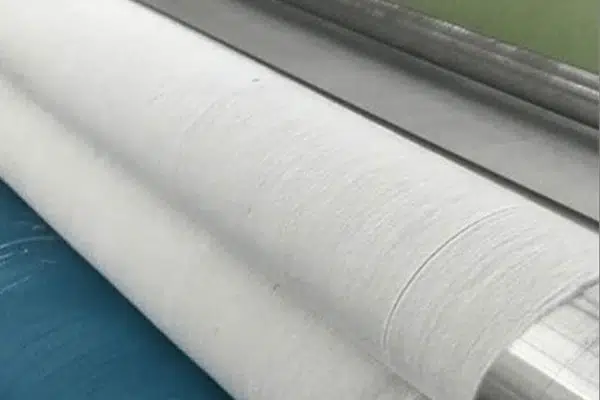
Use geotextile for drainage when water must pass through the fabric while soil particles are retained. Nonwoven geotextile is often selected for drains, retaining walls, roads, and erosion-control layers, but the correct GSM depends on soil, flow, puncture risk, and installation disturbance.
Good drainage fabric selection is a balance between filtration and flow. Apparent opening size helps evaluate the size of openings in the geotextile, while permittivity is used to evaluate water flow through the fabric. [1] [2] These tests do not replace project design, but they keep the buyer from comparing only color, thickness, or price.
For MJY buyers, the common mistake is asking for the heaviest nonwoven geotextile because it looks stronger. Heavier fabric can improve puncture resistance, but it does not automatically improve drainage. If the opening size and soil condition are mismatched, water can slow down or fines can migrate.
Send your soil type, water condition, fabric weight target, and project use to compare nonwoven geotextile options before ordering.
Request a geotextile drainage spec checkNonwoven vs Woven Fabric for Drainage
| Tipo de tela | Mejor ajuste | Main check |
|---|---|---|
| Geotextil no tejido | Drainage, filtration, protection, and separation | Permittivity, apparent opening size, CBR puncture, and GSM |
| Geotextil tejido | Reinforcement and separation with higher tensile demand | Tensile strength, opening size, and soil retention |
| Composite use | Drainage behind walls or under liners | Compatibility with geonet, gravel, or geomembrane layers |
Expert Insight: A drainage layer is not a trash filter. If the fabric is expected to hold back muddy water, construction debris, and poorly graded soil at the same time, clogging risk rises. Better subgrade preparation and graded filter material can be more valuable than simply increasing GSM.
How to Choose GSM Without Overbuying
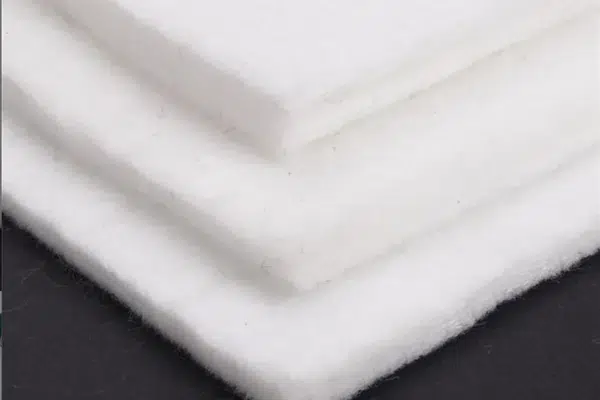
GSM, or grams per square meter, is useful for ordering and comparison, but it is not the full specification. MJY geotextile tables include common weight ranges from 100 to 800 g/m2 for needle-punched and filament geotextiles, with thickness, tensile strength, burst strength, tear strength, sieve size, and permeability data that should be checked together.
For light drainage and separation, a lower GSM fabric may be enough if the soil is stable and puncture risk is low. For rough subgrade, sharp aggregate, landfill protection layers, or heavy construction traffic, a heavier fabric may be justified because handling and puncture resistance matter more.
FHWA guidance on geosynthetics treats product selection as a function-based decision, including separation, filtration, drainage, reinforcement, and protection. [3] That is the right mindset for drainage fabric. First identify the function, then choose the fabric.
Field Note From Supplier Discussions
Field Note: A contractor once asked us for a high-GSM nonwoven fabric behind a retaining wall because the wall had water seepage. After checking the sketch, the real issue was not only fabric weight. The drainage outlet, gravel layer, and fabric wrap detail were unclear. Fabric cannot drain water if the system gives water nowhere to go.
For procurement, ask the supplier to confirm roll width, roll length, unit weight, tensile data, opening size, and permeability. A low price per roll can be misleading if the roll width creates too many overlaps or the fabric weight is unsuitable for site traffic.
Specification Mistakes That Increase Drainage Risk
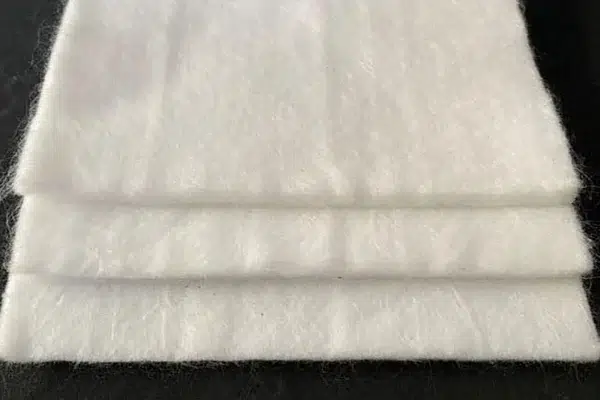
One risky habit is replacing a project specification with a simple sentence such as ‘need 300 gsm geotextile.’ That may be enough for a quick estimate, but it is not enough for a serious drainage order. The supplier still needs to know whether the fabric is being used behind a retaining wall, under stone, around a pipe, above a geomembrane, or below a road base.
Another mistake is ignoring the aggregate or soil placed against the fabric. Sharp crushed stone can create puncture risk. Fine silty soil can create clogging risk. Very open material may need a different wrap detail. If the drainage layer contains recycled aggregate or mixed fill, the buyer should be more careful, not less.
The International Geosynthetics Society explains geosynthetics by engineering functions, which is useful for drainage buyers because it separates filtration, drainage, separation, protection, and reinforcement. [4] A single fabric may perform more than one function, but the dominant function should be clear before price comparison starts.
For export buyers, ask the factory to mark roll weight and roll length clearly on the packing list. Drainage projects often use multiple rolls across a long trench or slope, and poor roll identification can slow site handling. If the installation team opens the wrong weight or roll width first, overlap planning and material control become messy.
This is a small paperwork detail, but it prevents wrong-roll placement on busy sites and keeps installation crews from mixing specifications. It also gives the buyer a clean record if the contractor later asks why two rolls with different weights were supplied for separate drainage zones.
Drainage Fabric Buyer Checklist
| Antes de realizar el pedido | Qué confirmar |
|---|---|
| Tipo de suelo | Clay, silt, sand, aggregate, or mixed fill |
| Camino del agua | Where water enters, moves, and exits the system |
| Fabric function | Drainage, filtration, separation, protection, or combined role |
| Site damage risk | Sharp aggregate, equipment traffic, wrinkles, and installation tolerance |
| cURL Too many subrequests by single Worker invocation. To configure this limit, refer to https://developers.cloudflare.com/workers/wrangler/configuration/#limits | cURL Too many subrequests by single Worker invocation. To configure this limit, refer to https://developers.cloudflare.com/workers/wrangler/configuration/#limits |
Para la selección del producto, compare MJY cURL Too many subrequests by single Worker invocation. To configure this limit, refer to https://developers.cloudflare.com/workers/wrangler/configuration/#limits cURL Too many subrequests by single Worker invocation. To configure this limit, refer to https://developers.cloudflare.com/workers/wrangler/configuration/#limits Aplicaciones de geosintéticos en vertederoscURL Too many subrequests by single Worker invocation. To configure this limit, refer to https://developers.cloudflare.com/workers/wrangler/configuration/#limits cURL Too many subrequests by single Worker invocation. To configure this limit, refer to https://developers.cloudflare.com/workers/wrangler/configuration/#limits.
Conclusión final
cURL Too many subrequests by single Worker invocation. To configure this limit, refer to https://developers.cloudflare.com/workers/wrangler/configuration/#limits
Referencias ##
Referencias
- Método de ensayo estándar ASTM D4751 para determinar el tamaño de apertura aparente de un geotextil ↩
- Métodos de prueba estándar ASTM D4491 para la permeabilidad al agua de geotextiles por permitividad ↩
- Directrices de diseño y construcción de geosintéticos de la FHWA ↩
- Sociedad Internacional de Geosintéticos, recursos educativos sobre geosintéticos. ↩

 Spanish
  English
  Arabic