
Gravel disappears into weak ground when the separation layer is ignored or the wrong fabric is placed below the base.
Geotextile under gravel should be selected by subgrade strength, drainage need, aggregate sharpness, traffic, and installation method. Nonwoven fabric is commonly used for separation and filtration, while woven fabric may suit projects that also need tensile support. Overlap, edge coverage, and damage control matter as much as fabric weight.
The practical decision is not simply which product costs less per square meter. It is which layer can keep working after compaction, rainfall, construction traffic, and the conditions that matter on this site.
Before a purchase order is released, compare the product data sheet with the drawing, site conditions, installation method, and destination logistics. That small check helps a buyer identify whether two quotations truly cover the same material, roll dimensions, test basis, and delivery scope. It also creates a clear record for the contractor, project engineer, and supplier before site work begins. In B2B projects, clarity at this stage is usually less expensive than explaining a substitution after material reaches the site. Ask the supplier to identify any assumption in writing, especially when a drawing, local soil report, or anchor layout is not available at quotation stage. Confirm the proposed roll layout, joining plan, unloading approach, and inspection records as well, because these logistics affect installation quality and can change the actual project cost.

Send subgrade photos, gravel size, traffic type, area, and destination to compare fabric, roll width, and overlap before ordering.
Request a geotextile under gravel specification checkWhat the Fabric Does Below Gravel
Geotextile under gravel is principally a separation and filtration layer. It limits fine subgrade soil moving into the aggregate base while allowing controlled water movement. This preserves aggregate thickness and helps reduce pumping where soft soil and repeated traffic meet.
The important data points are apparent opening size, permibilidad, filtration stability, y CBR puncture resistance. ASTM D4751 covers apparent opening size, and ASTM D4491 covers permeability by permittivity. A high strength number alone does not prove the fabric is the right filter for local soil. [1] [2]
Nonwoven or Woven Fabric Under Gravel
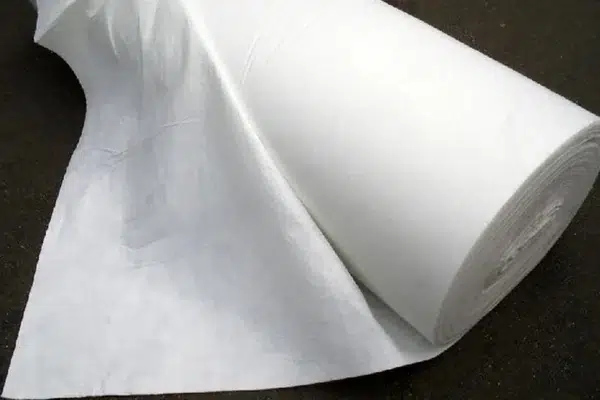
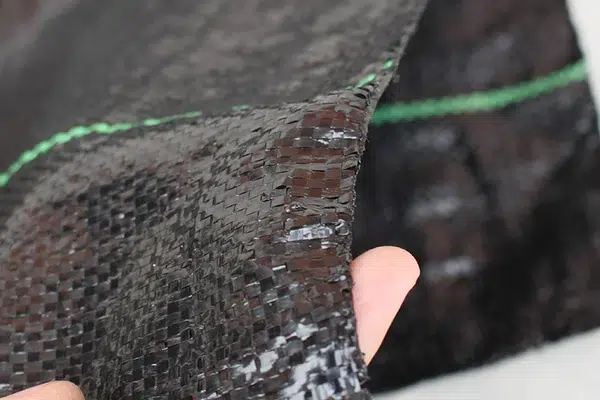
Nonwoven geotextile is commonly chosen for separation, cushioning, and drainage, while woven fabric may be considered where the base also needs tensile reinforcement. A driveway over silty soil, a farm track, and a heavy vehicle yard do not present the same failure risk.
Factory Tip: buyers often compare only GSM. Unit weight is useful but does not replace checking puncture resistance, opening size, roll width, and elongation. A heavier fabric with poor filtration fit can still pump or clog. The specification must match both the subgrade and the stone that will be placed on top.
| Project condition | Fabric focus | Verificación del comprador |
|---|---|---|
| Soft silty subgrade | Separación y filtración | Permittivity, opening size, overlap |
| Sharp crushed stone | Resistencia a perforaciones | CBR puncture and placement method |
| Farm track | Practical separation | Traffic, drainage, roll width |
| Heavy yard | Whole base system | Subgrade, aggregate depth, reinforcement |
Overlap and First-Lift Placement
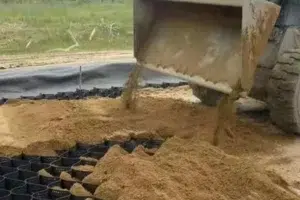
Overlap must keep the separation layer intact while gravel is spread; it is not just a visual detail. The needed overlap changes with soil softness, roll width, equipment movement, and whether the first stone is dumped from the fabric edge.
Field Note: a contractor placed aggregate onto an unpinned lap on wet ground. The first load pulled the fabric apart and mixed fines into the new base. The crew had to remove fresh aggregate before the fabric could be reset. On soft ground, wider laps, pins, and a gentler first lift are often cheaper than rework.
Installation Mistakes That Create Rework
Most under-gravel problems begin with site handling, not a laboratory result. Sharp protrusions, driving on exposed fabric, dragging rolls across rough subgrade, uncovered edges, and high-impact stone placement can puncture or move the layer.
cURL Too many subrequests by single Worker invocation. To configure this limit, refer to https://developers.cloudflare.com/workers/wrangler/configuration/#limits [3]
cURL Too many subrequests by single Worker invocation. To configure this limit, refer to https://developers.cloudflare.com/workers/wrangler/configuration/#limits
cURL Too many subrequests by single Worker invocation. To configure this limit, refer to https://developers.cloudflare.com/workers/wrangler/configuration/#limits cURL Too many subrequests by single Worker invocation. To configure this limit, refer to https://developers.cloudflare.com/workers/wrangler/configuration/#limits
cURL Too many subrequests by single Worker invocation. To configure this limit, refer to https://developers.cloudflare.com/workers/wrangler/configuration/#limits
Detalles de la solicitud de cotización que los compradores deben enviar
cURL Too many subrequests by single Worker invocation. To configure this limit, refer to https://developers.cloudflare.com/workers/wrangler/configuration/#limits cURL Too many subrequests by single Worker invocation. To configure this limit, refer to https://developers.cloudflare.com/workers/wrangler/configuration/#limits
cURL Too many subrequests by single Worker invocation. To configure this limit, refer to https://developers.cloudflare.com/workers/wrangler/configuration/#limits cURL Too many subrequests by single Worker invocation. To configure this limit, refer to https://developers.cloudflare.com/workers/wrangler/configuration/#limits cURL Too many subrequests by single Worker invocation. To configure this limit, refer to https://developers.cloudflare.com/workers/wrangler/configuration/#limits cURL Too many subrequests by single Worker invocation. To configure this limit, refer to https://developers.cloudflare.com/workers/wrangler/configuration/#limitscURL Too many subrequests by single Worker invocation. To configure this limit, refer to https://developers.cloudflare.com/workers/wrangler/configuration/#limits [4]
Mi opinión
cURL Too many subrequests by single Worker invocation. To configure this limit, refer to https://developers.cloudflare.com/workers/wrangler/configuration/#limits
Conclusión
cURL Too many subrequests by single Worker invocation. To configure this limit, refer to https://developers.cloudflare.com/workers/wrangler/configuration/#limits
Preguntas frecuentes
cURL Too many subrequests by single Worker invocation. To configure this limit, refer to https://developers.cloudflare.com/workers/wrangler/configuration/#limits
cURL Too many subrequests by single Worker invocation. To configure this limit, refer to https://developers.cloudflare.com/workers/wrangler/configuration/#limits
cURL Too many subrequests by single Worker invocation. To configure this limit, refer to https://developers.cloudflare.com/workers/wrangler/configuration/#limits
cURL Too many subrequests by single Worker invocation. To configure this limit, refer to https://developers.cloudflare.com/workers/wrangler/configuration/#limits
cURL Too many subrequests by single Worker invocation. To configure this limit, refer to https://developers.cloudflare.com/workers/wrangler/configuration/#limits
cURL Too many subrequests by single Worker invocation. To configure this limit, refer to https://developers.cloudflare.com/workers/wrangler/configuration/#limits
Referencias
- Método de prueba estándar ASTM D4751 para el tamaño de apertura aparente de geotextiles ↩
- Métodos de prueba estándar ASTM D4491 para la permeabilidad al agua de geotextiles por permitividad ↩
- Directrices de diseño y construcción de geosintéticos de la FHWA ↩
- cURL Too many subrequests by single Worker invocation. To configure this limit, refer to https://developers.cloudflare.com/workers/wrangler/configuration/#limits ↩



 Spanish
  English
  Arabic