Wholesale geocell buying is not only about getting a lower price per square meter. Contractors and distributors need stable specifications, reliable packing, clear documentation, and a supplier who can support repeat orders without changing quality.
To buy geocell wholesale, contractors and distributors should confirm project application, HDPE material quality, sheet thickness, cell height, weld strength, weld spacing, surface texture, perforation, order quantity, packing, delivery time, and export documents before comparing prices.

A good wholesale order should reduce project risk and resale risk at the same time. The buyer must think about the jobsite, the end customer, storage, repeat supply, and after-sales claims.
Why Is Wholesale Geocell Buying Different From One-Time Project Buying?
A one-time project buyer mainly cares about one site. A contractor or distributor must think about many jobs, many customers, and repeat supply.
Wholesale geocell buying is different because the buyer must control product consistency, stock planning, customer specification requests, packing, logistics, and long-term supplier reliability. The cheapest order is not always the safest order for repeat business.
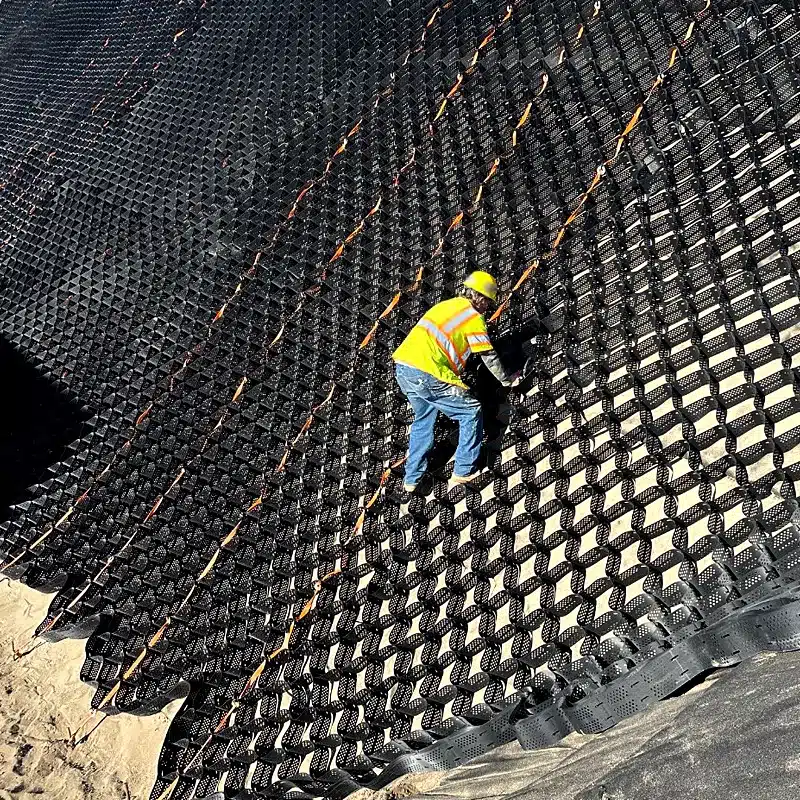
Wholesale buyers carry more risk
A contractor may use geocell directly in road, slope, retaining wall, or erosion-control work. If the product fails, the problem goes straight to the project site.
A distributor faces another layer of risk. The distributor may sell to contractors, local dealers, project buyers, or government-related procurement teams. If the product quality changes between batches, the distributor may receive complaints even when the price was attractive.
This is why wholesale buying needs more control than sample buying. The buyer should not only ask, “How much per square meter?” The buyer should ask, “Can this factory supply the same specification again and again?”
Geocell is a system material
Geocell is a cellular confinement system. It is expanded on site and filled with soil, sand, gravel, aggregate, or concrete. A neutral technical explanation of cellular confinement systems[^1] shows that geocells are used for soil stabilization, erosion control, slope protection, channel protection, load support, and earth retention.
This means buyers need to match the product to the application. A road base project may need stronger weld strength and cell height. A slope project may need perforation and UV resistance. A retaining wall project may need more careful design support.
Wholesale buyers need stable categories
Distributors should build a clear product range. If every order changes specification, the sales team will struggle to explain the product and customers will struggle to reorder.
A practical wholesale range may include several cell heights, sheet thicknesses, surface types, and perforation options. The goal is not to stock every possible size. The goal is to stock the most repeatable and marketable grades.
| Buyer Type | Main Concern | Factory-Side Recommendation |
|---|---|---|
| Contractor | Project fit and site performance | Match geocell to application first |
| Distributor | Repeat supply and resale trust | Build stable product grades |
| Importer | Cost, packing, and customs documents | Confirm export details early |
| Project Buyer | Specification and delivery schedule | Avoid vague quotations |
| Dealer | Easy product explanation | Use clear product labels and data sheets |
For buyers building a wholesale range, it helps to start from the main geocell product category and organize options by application.
What Geocell Specifications Should Wholesale Buyers Confirm First?
Many wholesale buyers ask for price before specification. That creates wrong comparison because different suppliers may quote different products.
Wholesale buyers should confirm material, sheet thickness, cell height, weld spacing, weld strength, panel size, surface texture, perforation, color, packing method, and application before comparing geocell prices. Without these details, square-meter price is not reliable.
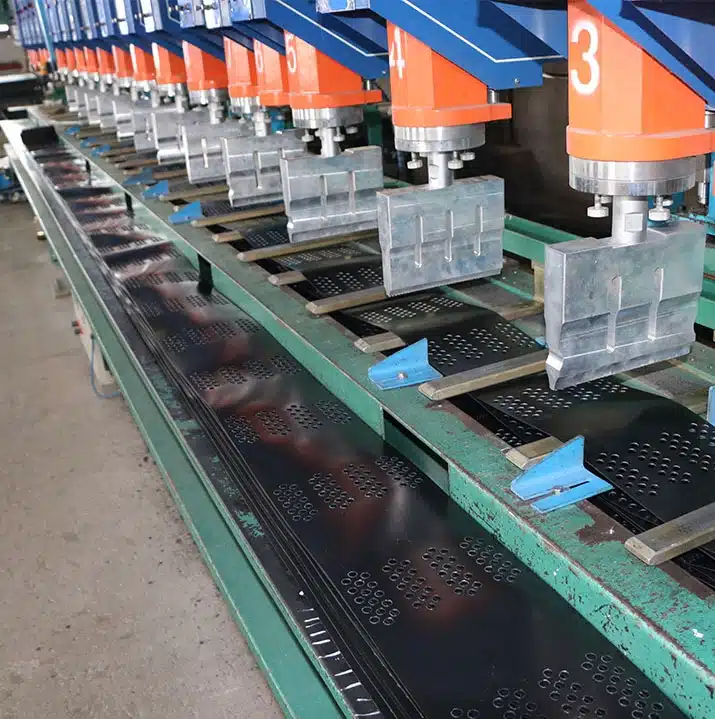
Material must be clear
Most geocell buyers ask for HDPE geocell. That is a good start, but it is not enough. HDPE quality can vary based on resin grade, recycled content, additives, and production control.
For wholesale business, unstable material is dangerous. One batch may feel flexible. The next batch may become brittle or weld poorly. This creates customer complaints and damages resale trust.
The buyer should ask whether the material is suitable for long-term outdoor engineering use. If recycled material is used, the supplier should explain the grade and application limits.
Thickness and cell height must match the market
Sheet thickness affects strength, stiffness, and cost. Cell height affects confinement depth and infill volume.
A distributor should not buy random specifications only because they are cheap. The stock should match the local market. For road base, slope protection, and erosion control, different heights may be needed.
A contractor should match the height and thickness to project load, slope angle, soil condition, and infill material. A distributor should keep clear categories so customers can choose more easily.
Weld strength must be discussed
Weld strength is one of the most important geocell quality points. Geocell strips are welded together to form the honeycomb structure. If the welded joints fail, the cells separate and the confinement function drops.
The wider geosynthetics[^2] category includes geocells, geotextiles, geogrids, geomembranes, and other materials used for reinforcement, filtration, drainage, separation, containment, and stabilization. For geocell, the welded cellular structure is the key product form, so weld quality cannot be ignored.
| Specification | Why It Matters | Wholesale Buying Tip |
|---|---|---|
| Material | Affects durability and flexibility | Confirm HDPE / PP and material grade |
| Sheet Thickness | Affects strength and price | Compare actual thickness, not only nominal value |
| Cell Height | Affects confinement depth | Build stock around common project needs |
| Weld Strength | Affects cell stability | Ask how welding is controlled |
| Weld Spacing | Affects cell size | Match to infill and application |
| Perforation | Helps drainage and vegetation | Stock only when market needs it |
| Surface Texture | Improves friction | Useful for slopes and aggregate fill |
If wholesale customers mainly buy road products, the buyer can also review HDPE geocell options and build a stronger road-focused product line.
How Should Contractors Choose Geocell For Project Use?
Contractors should buy based on site conditions. A geocell that works for a temporary access road may not work for a steep slope or retaining wall.
Contractors should choose geocell based on application, subgrade condition, traffic load, slope angle, water flow, infill material, required service life, and installation method. The correct specification should come before price comparison.
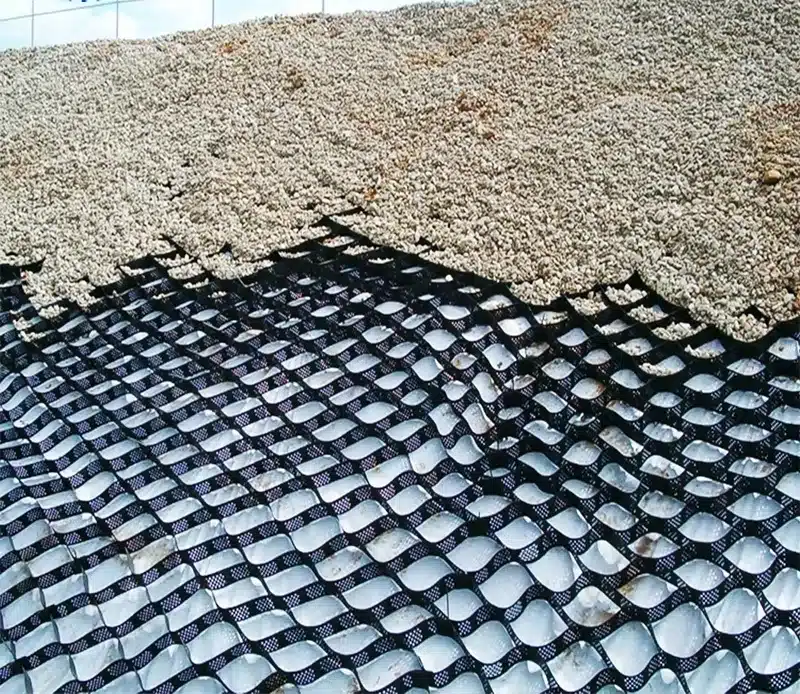
Road projects need load support
For road construction, geocell is usually used to improve base stability and reduce lateral movement of aggregate. The contractor should check cell height, weld strength, sheet thickness, and infill quality.
If the road carries heavy vehicles, a low-cost thin geocell may not be suitable. If the road is temporary and low-load, a lighter grade may be enough. The project decides the specification.
The contractor should also check whether a geotextile layer is needed below the geocell. On soft subgrade, separation can help prevent aggregate from mixing with fine soil. The buyer can review geotextile separation materials when road base contamination is a concern.
Slope projects need anchoring and retention
For slopes, geocell must hold soil, gravel, or concrete in place. The slope angle, rainfall, soil type, and vegetation requirement all affect the choice.
A vegetated slope may need perforated geocell and topsoil. A drainage channel may need gravel or concrete. A steep slope may need stronger anchoring and higher weld strength.
Contractors should not use the same geocell for every slope. The supplier should ask project questions before recommending a product.
Retaining wall projects need design support
For retaining walls, geocell may be used to create a confined earth structure or green wall face. But retaining wall design has higher risk than simple surface protection.
Wall height, backfill type, drainage, surcharge load, foundation condition, and engineering approval are important. The contractor should not rely on product price alone. The geocell must fit the design.
| Project Type | Contractor Should Confirm | Main Risk If Ignored |
|---|---|---|
| Road Base | Load, subgrade, aggregate, cell height | Rutting and settlement |
| Slope Protection | Slope angle, anchor layout, infill | Washout and sliding |
| Erosion Control | Water flow and surface protection | Loss of infill |
| Retaining Wall | Wall height, drainage, backfill | Deformation and pressure risk |
| Temporary Road | Equipment load and reuse need | Fast surface failure |
For market visuals, contractors can review TikTok geocell installation videos[^3]. These videos can show field scenes, but they should not replace project design or factory technical confirmation.
How Should Distributors Build A Wholesale Geocell Product Line?
Distributors should not stock too many random sizes. A good wholesale product line should be easy to explain, easy to reorder, and suitable for local demand.
Distributors should build a wholesale geocell product line around common applications, such as road base, slope protection, erosion control, retaining walls, and temporary access roads. Each product grade should have clear thickness, height, weld spacing, packing, and selling points.
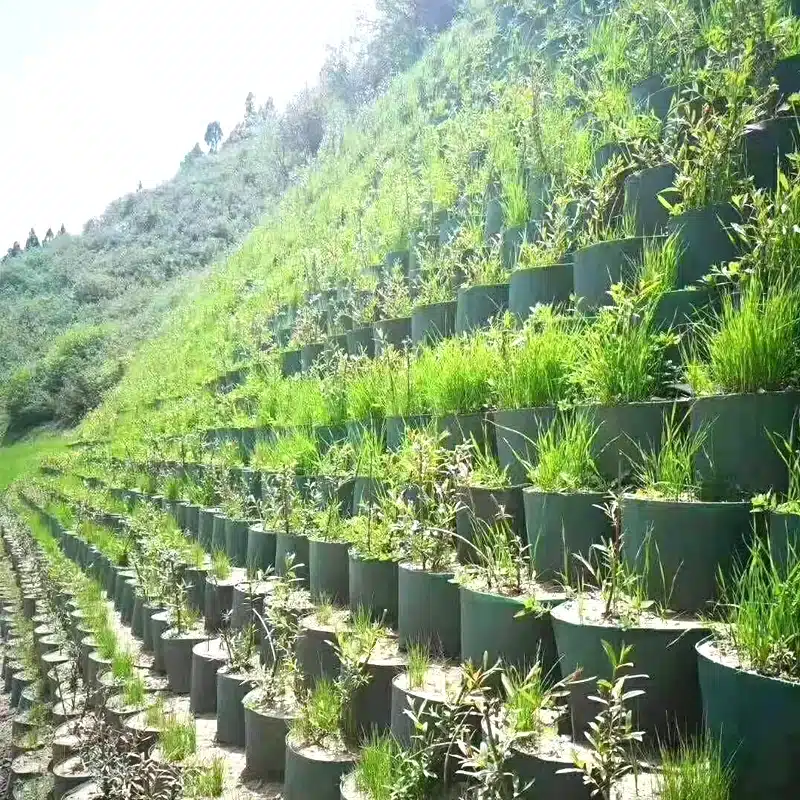
Start with local demand
The distributor should first study the local market. If most buyers are road contractors, the stock should focus on road base geocell. If the market is slope protection, perforated and textured options may be more useful.
A distributor should not copy another country’s product range without checking local conditions. Soil, rainfall, construction habits, budget level, and common project types can all change demand.
A simple product line is often better than a confusing product list. Salespeople need to explain the product clearly. Customers need to reorder without confusion.
Create clear product grades
A practical wholesale range may include basic grade, standard engineering grade, and heavy-duty grade. Each grade should have a clear purpose.
For example:
- Basic grade for temporary access or light-duty use
- Standard grade for normal road and slope projects
- Heavy-duty grade for stronger load or more demanding applications
The exact specification depends on the market and factory production options. The important point is to avoid vague product naming.
Keep technical sheets consistent
Distributors should have a technical data sheet for each grade. The sheet should include material, thickness, cell height, weld spacing, panel size, surface type, perforation, packing, and application.
If a distributor changes supplier often and the data changes each time, customers may lose confidence. Stable documentation supports repeat sales.
| Product Line Point | Why It Matters | Distributor Action |
|---|---|---|
| Local Demand | Prevents wrong stock | Study common project types |
| Grade System | Helps sales explain products | Build basic, standard, heavy-duty grades |
| Clear TDS | Supports customer trust | Use consistent technical data |
| Packing | Affects warehouse and delivery | Confirm roll or bundle size |
| Reorder Stability | Protects repeat business | Keep specification consistent |
| Application Labels | Helps customer selection | Mark road, slope, erosion, wall use |
A distributor should treat geocell as a technical product, not only a plastic commodity. This makes the sales process more professional and reduces after-sales disputes.
What Factory Capability Should Wholesale Buyers Check?
A low quotation does not prove factory reliability. Wholesale buyers need a supplier who can produce stable batches, pack correctly, and support export documents.
Wholesale buyers should check factory capability in raw material control, sheet extrusion, welding control, thickness consistency, panel dimension accuracy, quality inspection, customization, packing, lead time, and export documentation.
Production control matters more in repeat orders
A sample order can look good. The real test is whether the factory can supply the same quality again in larger batches.
Wholesale buyers should ask how the factory controls material, thickness, welding, dimensions, and packing. These details decide whether the product is stable enough for resale or project use.
A factory that changes material or tolerance without notice can create serious problems for distributors.
Customization should be realistic
Some buyers need custom height, spacing, perforation, texture, panel size, color, label, or packaging. A factory should confirm what can be customized and what MOQ applies.
A supplier that promises every custom request without checking production reality may create delivery problems later. Wholesale buyers should prefer clear answers over quick promises.
Export support reduces risk
For contractors and distributors outside China, export support is part of the product. Packing, labels, container loading, production lead time, invoice, packing list, and shipment coordination all matter.
A cheaper supplier with poor packing or weak document handling may create higher total cost. For wholesale business, this can also affect customer delivery dates.
| Factory Capability | What To Check | Why It Matters |
|---|---|---|
| Raw Material Control | Resin and additives | Affects long-term stability |
| Sheet Production | Thickness and surface consistency | Affects strength and weld quality |
| Welding Control | Temperature, pressure, spacing | Affects cell stability |
| Quality Inspection | Dimensions, welds, appearance | Reduces batch risk |
| Customization | Height, perforation, packing | Supports market needs |
| Export Packing | Roll size, label, protection | Reduces delivery problems |
| Documentation | TDS, invoice, packing list | Supports import and resale |
If a supplier cannot explain these points, the buyer should be careful. A wholesale relationship needs more than a low first quote.
How Should Buyers Compare Wholesale Geocell Prices?
Wholesale geocell price should be compared only after the full specification is clear. Otherwise, the cheapest quote may only be a lower specification.
To compare wholesale geocell prices correctly, buyers should compare the same material, thickness, cell height, weld spacing, weld strength, surface type, perforation, panel size, packing, quantity, and trade term. Price is useful only when the product details are equal.
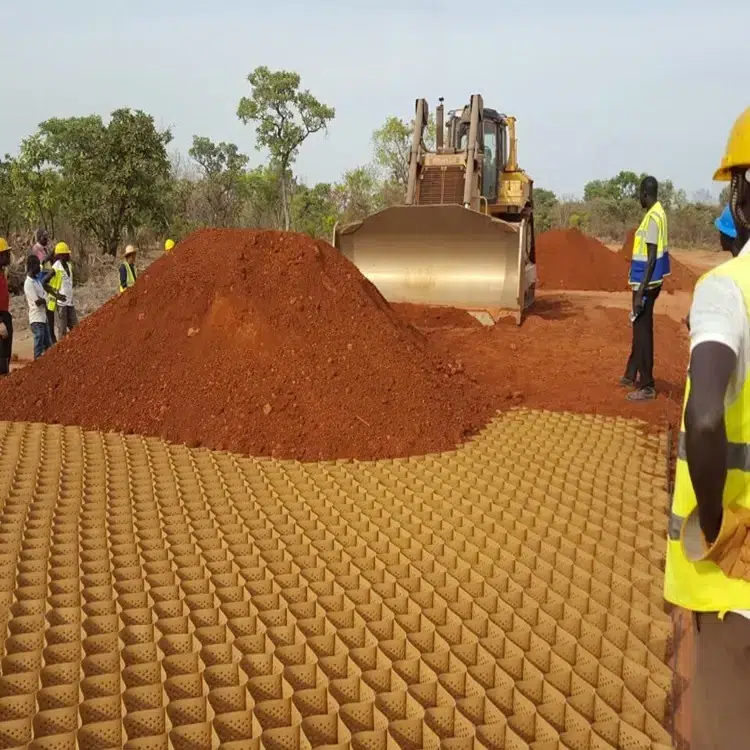
Compare specification before unit price
Two suppliers may both quote “HDPE geocell,” but the products can be very different. One may quote a thinner sheet. One may use lower-grade material. One may exclude perforation. One may pack less efficiently.
The buyer should create a comparison table before making a decision. This helps avoid hidden downgrades.
Check landed cost
Wholesale buyers should not look only at EXW or FOB price. The landed cost includes product price, packing, inland transport, ocean freight, customs, local handling, storage, and possible damage risk.
A supplier with slightly higher factory price may still be better if packing is stronger, container loading is more efficient, and documents are clearer.
Do not ignore after-sales cost
If the product has weak welds, wrong labels, inconsistent size, or poor packing, the buyer may face claims from customers. This cost is not shown in the quotation.
For distributors, after-sales cost can damage reputation. For contractors, poor material can delay the project. That is why price comparison must include risk.
| Price Item | Cheap Quote May Hide | Better Check |
|---|---|---|
| Material | Low-grade resin | Confirm material standard |
| Thickness | Lower actual thickness | Check tolerance |
| Weld Strength | Weak welding control | Ask for weld data or sample |
| Panel Size | Smaller coverage | Confirm expanded size |
| Packing | Loose or weak packing | Confirm roll or bundle details |
| Trade Term | Missing cost items | Compare landed cost |
| Lead Time | Slow delivery | Confirm production schedule |
Buyers can also review Facebook geocell product and installation posts[^4] to understand market presentation and field visuals. Social content is useful for observation, but wholesale price decisions should still be based on specification and factory capability.
What Questions Should Buyers Ask Before Placing A Wholesale Order?
Good questions protect the buyer before money is paid. The goal is not to make the process complicated. The goal is to avoid unclear specifications and unstable supply.
Before placing a wholesale geocell order, buyers should ask about material grade, thickness tolerance, weld strength, cell height, weld spacing, perforation, panel size, packing, MOQ, lead time, export documents, sample policy, and repeat-order consistency.
Ask technical questions first
The buyer should ask the factory to confirm material, thickness, height, spacing, and weld quality. These points define the product.
If the supplier gives vague answers, the buyer should slow down. A reliable factory should be able to explain the product in simple technical language.
Ask business questions second
After the specification is clear, the buyer can ask about MOQ, payment terms, packing, production time, shipping, documents, and private label options.
For distributors, label and packing may matter for resale. For contractors, delivery schedule may matter more than label design.
Ask repeat-supply questions
Wholesale business depends on repeat orders. The buyer should ask whether the same specification can be supplied again, whether the factory keeps production records, and how it controls batch consistency.
A supplier who only cares about one order may not be the best long-term partner.
| Question | Why It Matters | Good Supplier Response |
|---|---|---|
| What HDPE material is used? | Confirms base quality | Clear material explanation |
| What is the thickness tolerance? | Prevents hidden reduction | Measured control range |
| How is weld strength controlled? | Protects cell stability | Process and inspection explanation |
| Can this grade be reordered? | Supports wholesale business | Stable specification control |
| What is the packing method? | Affects shipping and resale | Roll or bundle details |
| What is the lead time? | Affects project delivery | Realistic production schedule |
| Can you support labels? | Helps distributors | Clear OEM / private label options |
A buyer who asks better questions usually receives better support. A factory that does not like technical questions may not be the right wholesale partner.
My View
When I look at wholesale geocell buying, I do not treat it as a simple price competition. Contractors need project safety. Distributors need repeatable quality and clear product grades. Both groups need a supplier that can keep specifications stable.
The biggest mistake is buying a cheap container without building a product standard first. If the buyer does not control material, thickness, cell height, weld strength, packing, and documents, the low price can create future claims.
A good wholesale buyer should build a simple specification system. The system should explain which geocell is for roads, which is for slopes, which is for erosion control, and which is for heavier applications. This makes sales easier and reduces wrong product use.
My advice is clear. Choose a geocell supplier who can support your business model, not only your first order. A reliable factory should help with specification matching, stable production, export packing, and long-term supply.
Conclusion
Wholesale geocell buying should focus on stable specification, factory control, packing, and repeat supply. Contractors and distributors should compare price only after product details are clear.
Footnotes
[^1]: This Wikipedia page is used to support the basic explanation of cellular confinement systems and their common engineering applications.
[^2]: This Wikipedia page is used to explain the wider geosynthetics category and its civil engineering functions.
[^3]: This TikTok search page is included as a social media reference for geocell installation visuals. Buyers should verify technical details with factory data and project requirements.
[^4]: This Facebook search page is included as a social media reference for geocell product and installation posts. It should not replace specification comparison or supplier evaluation.