A retaining wall can be under-reinforced when a grid is selected by mesh appearance or peak strength instead of its working tensile direction.
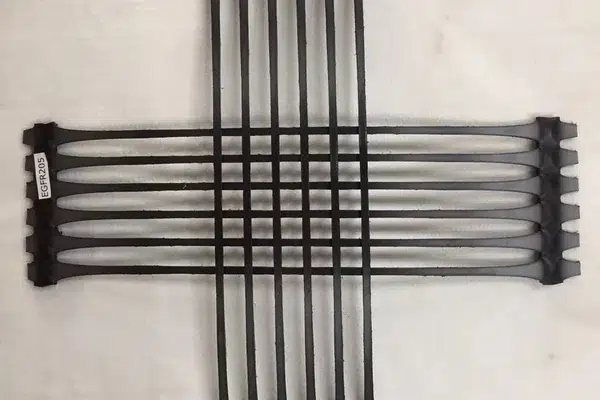
Uniaxial geogrid is designed to carry tensile load mainly in one direction. It is widely used for retaining walls, reinforced soil slopes, embankments, and other applications where reinforcement extends away from a facing or potential failure plane. Selection requires long-term design strength, pullout resistance, wall geometry, backfill quality, layer spacing, and connection details.
Before a purchase order is released, compare the project drawing, site condition, test-data basis, installation method, dimensions, packaging, and delivery scope. This helps project buyers verify that quotations describe the same engineering system rather than materials with similar names but different performance. Confirm receiving inspection, roll identification, storage protection, field handling, panel joining, and acceptance records before shipment. These details reduce avoidable site delays and make it easier to trace the material batch if a project question arises later.
Send wall height, section drawing, backfill type, surcharge, grid length, spacing, required strength, and destination for a reinforcement review.
Request a uniaxial geogrid RFQ checkWhy Tensile Direction Matters
Uniaxial geogrid develops its primary strength in one direction, so its orientation must match the direction of reinforcement required by the structure. Behind a retaining wall, the grid usually runs from the facing back into the reinforced soil zone. Turning the grid the wrong way can remove the intended reinforcement benefit even if the material is strong on paper.
MJY product data lists HDPE and PP uniaxial models from 25 to 150 kN/m, but peak values do not tell the whole design story. Confirm the required strength at relevant strain, the long-term design basis, and the roll direction before pricing. ASTM D6637 is a common tensile-property reference for geogrids. [2]
Retaining Walls and Reinforced Soil Slopes
Uniaxial geogrid is commonly used where soil mass must be reinforced in one principal direction. Retaining walls, reinforced slopes, embankments, and some dam or access structures may require multiple layers that work with compacted fill and a suitable facing. The reinforcement length and spacing are design inputs, not supplier guesses.
FHWA guidance for mechanically stabilized earth walls and reinforced soil slopes explains why geometry, facing, loading, drainage, and backfill are considered as a system. The wall height alone is not enough; surcharge, slope above the wall, water, and foundation condition can change the required reinforcement zone. [1]
| Application | Uniaxial grid role | Key selection variable |
|---|---|---|
| Retaining wall | Reinforce soil behind facing | Long-term strength, length, connection |
| Reinforced slope | Resist lateral soil movement | Tensile direction, anchoring, drainage |
| Embankment | Support reinforced fill zone | Foundation, spacing, compaction |
| Road base | Not always the first choice | Compare biaxial grid for aggregate interlock |

Long-Term Design Strength and Creep
Long-term design strength is more useful than peak tensile strength when the grid carries load for years. Reduction factors can account for creep, installation damage, durability, and other design conditions. Two grids with the same nominal kN/m value may not deliver the same long-term performance.
Factory Tip: when an inquiry asks for a 50 kN uniaxial grid, ask whether that is ultimate tensile strength or required long-term design strength. Confusing those terms can create a costly mismatch. ASTM D6992 is one reference for accelerated tensile creep and creep-rupture evaluation of geosynthetic materials. [3]
Pullout Resistance and Backfill Interaction
Grid strength must be transferred into the soil through interaction with properly selected and compacted backfill. Aperture geometry, rib shape, embedment length, soil gradation, and compaction affect pullout resistance. Weak, poorly compacted, or highly variable fill can limit the benefit of a stronger geogrid.
Field Note: an RFQ once included a high-strength grid but no backfill detail. The actual planned fill was a material with inconsistent fines and moisture. The project team had to revisit the reinforced-zone assumptions because the soil-geogrid interaction was not the same as for the granular backfill originally assumed.

Installation and Facing Connection
Correct orientation, specified layer spacing, adequate embedment, and a compatible facing connection are essential before backfill covers the grid. The grid should be placed flat, tensioned to remove slack without overstressing it, and protected from aggressive equipment movement. Backfill should be placed and compacted according to the project sequence.
Expert Insight: the lowest grid price is not a saving if the roll width, length, or direction creates extra joints or is incompatible with the wall layout. The procurement review should include roll dimensions, facing connection, field cutting, shipping weight, and how the contractor will maintain grid alignment during compaction.
RFQ Details Before Ordering
Send design application, wall or slope geometry, required long-term strength, tensile direction, grid length, layer spacing, backfill description, facing type, surcharge, drainage detail, quantity, and delivery location. A complete RFQ lets suppliers quote the intended reinforcement product.
Review MJY uniaxial geogrid reinforcement products and connect them with soil reinforcement applications. IGS resources are useful for general geosynthetic education. [4]
My View
My view is that uniaxial geogrid is easy to purchase incorrectly because the roll looks simple and strength values are easy to compare. For a retaining wall, the question is not only how strong the grid is, but where that strength acts, how long it remains after design reductions, and whether the chosen backfill can develop pullout resistance. The most useful buyer document is a wall section with grid lengths and layer spacing. It lets the supplier check roll orientation and packing while the engineer retains responsibility for the structural design.
Conclusion
Uniaxial geogrid is a one-direction reinforcement product for retaining walls and reinforced soil. Match tensile direction, long-term design strength, pullout, backfill, layout, and connection to the project.
FAQs
What is uniaxial geogrid used for?
It is commonly used for retaining walls, reinforced soil slopes, embankments, and structures that need reinforcement primarily in one direction.
Is uniaxial geogrid the same as biaxial geogrid?
No. Uniaxial grid carries its main strength in one direction, while biaxial grid is commonly selected for aggregate base stabilization in two directions.
Why is long-term design strength important?
Permanent structures must consider creep and other reductions. Peak tensile strength alone may not represent the strength available over the design life.
References
- FHWA Mechanically Stabilized Earth Walls and Reinforced Soil Slopes Design and Construction Guidelines ↩
- ASTM D6637 Standard Test Method for Determining Tensile Properties of Geogrids ↩
- ASTM D6992 Standard Test Method for Accelerated Tensile Creep and Creep-Rupture of Geosynthetic Materials ↩
- International Geosynthetics Society Education Resources ↩