Choosing between HDPE and PP geocell is not only a material-name decision. If the wrong polymer is used for the wrong project, the buyer may face weak welds, poor flexibility, fast aging, or unstable field performance.
HDPE geocell is usually preferred for long-term roads, slopes, retaining walls, and erosion-control projects because it has good flexibility, chemical resistance, and outdoor performance. PP geocell can be used in some applications where stiffness, lighter weight, or project-specific requirements are more important. The final choice should follow load, climate, soil, drainage, and design needs.

A good buyer should not ask only, “Which one is cheaper?” The better question is, “Which material fits my application, installation condition, and expected service life?”
Why Does Geocell Material Matter For Applications?
Many buyers compare geocell by price, height, and thickness first. These points matter, but polymer choice affects how the product behaves during production, installation, and long-term use.
Geocell material matters because HDPE and PP have different flexibility, stiffness, thermal behavior, chemical resistance, welding response, and aging performance. These differences affect how the geocell performs in roads, slopes, retaining walls, drainage channels, and erosion-control projects.
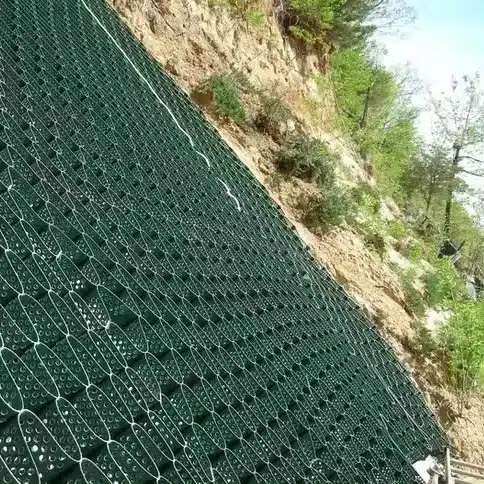
Professional explanation
Geocell is a three-dimensional cellular confinement system. The material is extruded into strips, welded into panels, expanded on site, and filled with soil, gravel, sand, aggregate, or concrete. A neutral geosynthetics reference explains that geocells are polymeric strips welded together and expanded into a flexible cellular mattress that reduces lateral movement of soil particles. geocells as cellular confinement systems[^1]
This means the polymer is not only a raw material. It affects the sheet, weld, cell wall, installation behavior, and final confinement performance.
HDPE and PP are both polyolefin materials, but they do not behave the same. HDPE is known for its high strength-to-density ratio and low branching structure, which gives it stronger intermolecular forces than lower-density polyethylene. HDPE material properties[^2] PP is a thermoplastic polymer with relatively low density and useful mechanical properties, and its properties depend on crystallinity, molecular weight, and polymer structure. polypropylene material properties[^3]
For a factory, these differences affect extrusion, sheet stability, welding, and product consistency. For a buyer, they affect installation, durability, and application fit.
Construction details
In road construction, the geocell must handle expansion, aggregate filling, compaction, and repeated traffic load. A material that cracks, deforms, or separates at welds can reduce the base layer’s performance.
In slope protection, the geocell must hold soil or gravel on an angled surface. Flexibility and weld strength become important because the panel is pulled by gravity and anchoring force.
In retaining walls or erosion-control channels, the material must resist soil pressure, water movement, and long-term environmental exposure. This is where material choice should follow project conditions, not only unit price.
Selection table
| Application Factor | Why It Matters | HDPE Geocell Tendency | PP Geocell Tendency |
|---|---|---|---|
| Flexibility | Helps panel handling and slope contact | Usually stronger advantage | Usually stiffer |
| Stiffness | Helps shape retention in some conditions | Moderate to good | Often higher stiffness |
| Outdoor Use | Affects aging and exposure risk | Common choice with UV additives | Needs proper formulation |
| Welding | Affects cell joint stability | Commonly used in welded geocell | Must be controlled carefully |
| Road Load | Needs confinement and durability | Often preferred | Possible in suitable designs |
| Slope Use | Needs flexibility and anchoring stability | Often preferred | Application-dependent |
For project buyers, the safest starting point is to review standard geocell product options and then confirm whether HDPE or PP better fits the jobsite.
What Are The Main Differences Between HDPE And PP Geocell?
The difference is not only chemical name. HDPE and PP can change the product’s flexibility, stiffness, welding behavior, temperature response, and field handling.
HDPE geocell is generally more flexible and widely used for outdoor civil engineering applications. PP geocell is generally lighter and can be stiffer, but it needs careful matching to project conditions. Buyers should compare material behavior, not just material price.
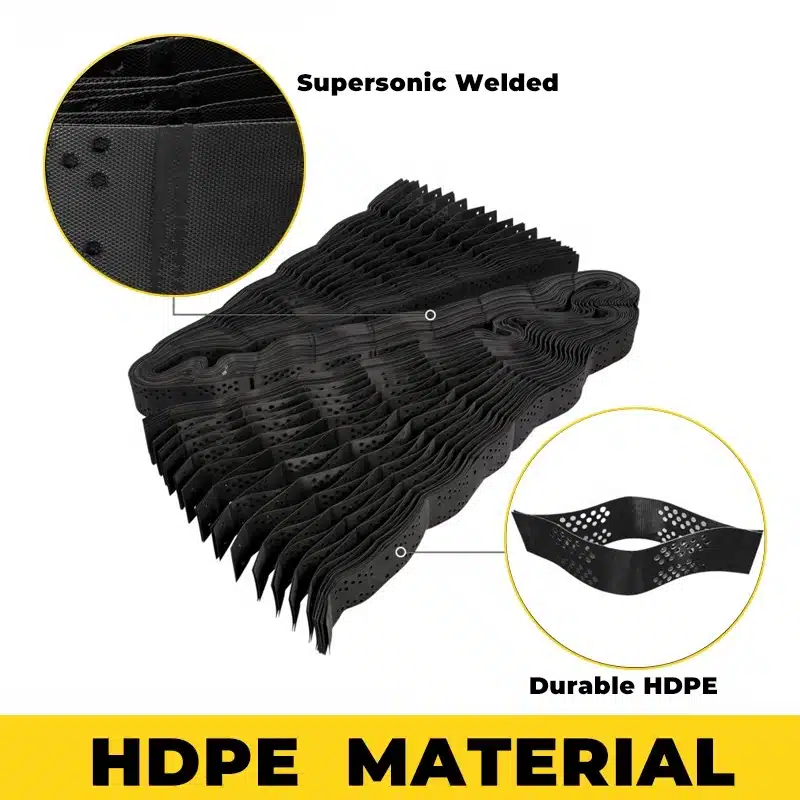
Professional explanation
HDPE is often chosen for geocell because it gives a practical balance of toughness, flexibility, chemical resistance, and field performance. These points are useful for projects where panels are folded, transported, expanded, anchored, filled, and exposed to outdoor conditions.
PP can offer useful stiffness and low density. In some construction products, stiffness can be an advantage. But in geocell applications, too much stiffness can also make handling and slope contact more difficult if the project needs flexibility.
The correct comparison is not “HDPE is always better” or “PP is always cheaper.” The correct comparison is application-based. A road base, a steep slope, a channel lining, and a temporary access road all stress the geocell differently.
A factory should explain these differences before recommending one material. If a supplier only says “both are good,” the buyer still does not have enough information.
Construction details
During installation, HDPE geocell usually handles folding and expansion well when produced with stable material and proper weld control. This is useful for contractors who need site flexibility.
PP geocell may be considered where higher stiffness or specific cost targets are required. But the buyer should pay attention to brittleness risk in low temperature, welding stability, and long-term exposure conditions.
For both materials, weld strength is critical. A good polymer sheet does not help if the welded joint is weak. The buyer should check material and weld quality together.
Selection table
| Comparison Point | HDPE Geocell | PP Geocell | Buyer Judgment |
|---|---|---|---|
| Flexibility | Usually better for folding and slope contact | Usually less flexible | Important for slopes and uneven sites |
| Stiffness | Balanced | Often stiffer | Useful only if project benefits from stiffness |
| Density | Slightly higher than PP | Lower density | Affects weight and handling |
| Cold Behavior | Often more forgiving | Can become brittle under low temperature depending on grade | Important in cold regions |
| Welding Control | Common in geocell production | Needs suitable process control | Ask factory about weld strength |
| Long-Term Outdoor Use | Common choice with UV package | Needs proper additives and formulation | Confirm exposure condition |
If the project also uses reinforcement layers, buyers can compare geocell with geogrid reinforcement products because material choice and structural function are different.
When Should Buyers Choose HDPE Geocell?
HDPE geocell is often the safer default for long-term geotechnical and civil engineering projects. This is especially true when flexibility, outdoor exposure, and weld reliability matter.
Buyers should choose HDPE geocell for road bases, slope protection, retaining walls, channel protection, erosion control, and long-term outdoor projects where flexibility, chemical resistance, UV resistance, and stable welded cell structure are important.
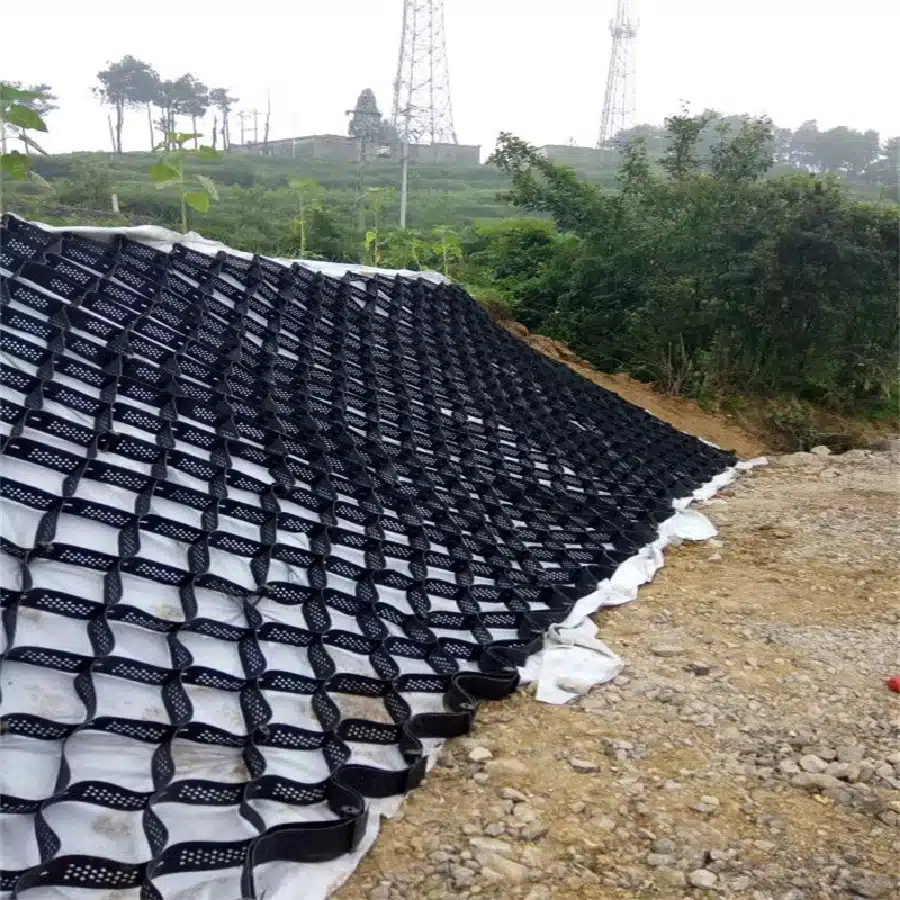
Professional explanation
HDPE geocell is widely used because many civil engineering sites need a material that can be folded for shipping, expanded on uneven ground, anchored on slopes, and filled with aggregate or soil.
For contractors, this flexibility is practical. A road site is rarely perfect. A slope may have small surface variations. A retaining wall face may need panel adjustment. HDPE gives more working tolerance when the product is manufactured correctly.
HDPE also works well in many soil and water environments. But buyers should still ask about resin quality, UV additives, sheet thickness, weld strength, and perforation. The material name alone does not prove the final quality.
Construction details
For road construction, HDPE geocell is often selected because it can confine aggregate and handle installation stress. Buyers should confirm cell height, sheet thickness, weld spacing, and weld strength based on traffic load and subgrade condition.
For slope protection, HDPE geocell can hold topsoil, gravel, or concrete infill. Perforation may help drainage and root growth. Surface texture may help friction with fill.
For retaining walls, HDPE geocell must be matched with design, backfill, drainage, and wall height. Buyers should not choose only by square-meter price because weak welds or wrong cell height can affect the wall system.
Selection table
| HDPE Geocell Application | Main Requirement | Key Specification To Check |
|---|---|---|
| Road Base | Load distribution and aggregate confinement | Cell height, thickness, weld strength |
| Slope Protection | Soil retention and anchoring stability | Perforation, texture, anchors, UV resistance |
| Retaining Wall | Earth retention and long-term stability | Weld strength, cell height, design fit |
| Channel Protection | Water erosion resistance | Infill type, anchor system, perforation |
| Temporary Road | Fast installation and ground support | Thickness, panel size, packing |
| Export Projects | Stable quality and packing | Batch control, labels, container loading |
For slope-related applications, buyers can also review 3D geomat erosion-control products to decide whether the project needs geocell, geomat, or a combined solution.
When Should Buyers Choose PP Geocell?
PP geocell is not wrong by default. It can be suitable when the project needs a lighter or stiffer product and the environment matches the material behavior.
Buyers may choose PP geocell for selected applications where stiffness, lighter weight, controlled exposure, and project-specific cost targets are important. But PP geocell should be checked carefully for low-temperature use, long-term exposure, weld strength, and application fit.
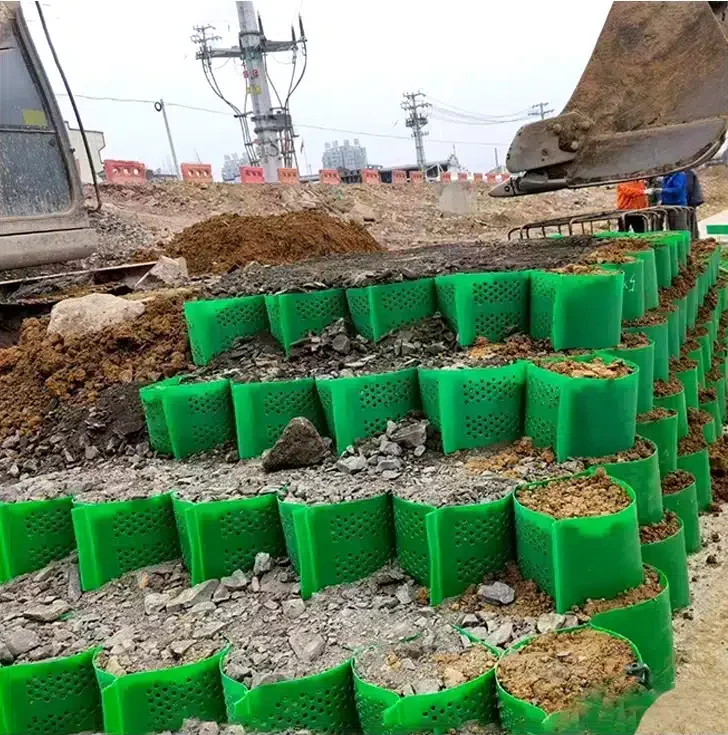
Professional explanation
PP has its own advantages. It has low density and useful stiffness. In some applications, stiffness can help the product maintain shape. PP is also used widely in many engineering and industrial products.
But PP geocell should not be selected only because the buyer wants a lower price. Material performance still depends on the grade, additives, sheet production, welding process, and project environment.
The key point is application control. If the project has severe cold, strong UV exposure, difficult installation, or high long-term load, the buyer should check whether PP is really suitable. A responsible factory should explain limits clearly.
Construction details
For temporary or controlled-use projects, PP geocell may be considered if the load and environment are not too demanding. It may also be considered where stiffness gives a practical advantage.
For outdoor slopes and long-term road projects, the buyer should be more careful. The product must be tested or confirmed according to project conditions. The factory should explain whether UV resistance, weld strength, and sheet performance meet the requirement.
PP geocell may also require stricter communication during ordering. The buyer should confirm climate, service life, infill, installation method, and expected exposure before finalizing the specification.
Selection table
| PP Geocell Use Case | When It May Fit | What Buyers Must Confirm |
|---|---|---|
| Temporary Access | Shorter service period | Load, soil, reuse need |
| Controlled Exposure | Limited UV or covered quickly | UV package and cover plan |
| Light-Duty Stabilization | Lower project demand | Cell height and weld strength |
| Stiffness-Focused Use | Shape retention matters | Handling and installation method |
| Cost-Sensitive Project | Budget is limited | Do not reduce critical specs |
| Distributor Stock | Local demand exists | Clear grade and application labels |
For buyers comparing different geosynthetic functions, MJY geosynthetic materials can help organize geocell, geotextile, geogrid, geomembrane, and drainage products by application.
How Should Buyers Compare HDPE And PP Geocell For Projects?
The correct comparison should start with project conditions, not material preference. A good factory should ask what the geocell will do before recommending HDPE or PP.
Buyers should compare HDPE and PP geocell by application, load level, slope angle, climate, UV exposure, soil condition, infill type, weld strength, service life, installation method, export packing, and total project risk.
Professional explanation
A professional comparison starts with the jobsite. Is the geocell used for a road, slope, wall, channel, landfill access, or temporary platform? What load will it carry? Will it be exposed to sunlight? Will it face cold weather? What infill will be used?
After these details are clear, the factory can recommend the material. This is more reliable than choosing HDPE or PP based on price alone.
The buyer should also check supplier capability. A factory must control raw material, sheet thickness, welding, dimensions, packing, and batch inspection. If the supplier cannot control production, the polymer name will not protect the project.
Construction details
For roads, compare cell height, thickness, weld strength, aggregate type, and traffic load. HDPE is often used, but PP may be considered in some controlled cases.
For slopes, compare flexibility, anchoring, perforation, UV exposure, and infill. HDPE often has better field tolerance, especially on uneven surfaces.
For retaining walls, compare long-term stability, weld strength, backfill, drainage, and design requirements. Material choice should follow engineering design.
For distributors, compare market demand. If local buyers recognize HDPE geocell more clearly, HDPE may be easier to sell. If PP has a specific local demand, then the distributor should build a separate grade with clear application limits.
Selection table
| Project Question | If The Answer Is Yes | Safer Material Direction |
|---|---|---|
| Is it a long-term outdoor road or slope? | UV and durability matter | Usually HDPE |
| Is the site uneven or sloped? | Flexibility matters | Usually HDPE |
| Is the project temporary? | Long service life is less critical | HDPE or PP depending on design |
| Is stiffness more important than flexibility? | Shape holding may matter | PP may be considered |
| Is the climate cold? | Brittleness risk matters | Check material grade carefully |
| Is the buyer comparing only price? | Hidden risk is high | Reconfirm full specification first |
| Is export repeat supply needed? | Batch consistency matters | Choose factory with stable QC |
Buyers can also review TikTok geocell installation videos[^4] and Facebook geocell application posts[^5] to observe how geocell is installed and presented in the market. These platforms can help with visual understanding, but technical decisions should still come from design requirements and factory data.
My View
When I compare HDPE and PP geocell for buyers, I do not start with which material is cheaper. I start with application, climate, load, slope condition, infill, and service life.
HDPE is usually the safer and more common choice for long-term road, slope, retaining wall, and erosion-control projects. It gives good flexibility and field tolerance when the factory controls resin, sheet thickness, welding, and UV package.
PP geocell can still be useful in selected cases. But buyers should not choose it only because the quotation looks lower or the sheet feels stiffer. Stiffness is not always better. Low price is not always lower risk.
My direct suggestion is simple. If the project is long-term, exposed, sloped, or load-bearing, check HDPE first. If the project has a special reason to use PP, ask the factory to explain the material grade, welding control, exposure limit, and application fit before ordering.
Conclusion
HDPE and PP geocell can both serve construction projects, but they are not interchangeable in every application. Buyers should choose by project condition, not material name or price alone.
FAQs
Is HDPE geocell better than PP geocell?
HDPE geocell is usually preferred for long-term outdoor roads, slopes, retaining walls, and erosion-control projects because it offers good flexibility and field performance. PP geocell may fit selected applications where stiffness, weight, or cost targets matter.
Can PP geocell be used for road construction?
PP geocell can be used in some road applications if the project load, climate, exposure, weld strength, and design requirements match the material. For heavy-duty or long-term road projects, buyers should compare it carefully with HDPE.
Which geocell material is better for slope protection?
HDPE geocell is often the safer choice for slope protection because flexibility, anchoring behavior, UV resistance, and weld strength are important. PP may work in controlled conditions, but the factory should confirm project fit.
Does geocell material affect weld strength?
Yes. Material quality, sheet consistency, welding temperature, pressure, and process control all affect weld strength. A stable polymer sheet helps the factory produce more consistent welded joints.
Should buyers choose geocell by price first?
No. Buyers should confirm application, material, thickness, cell height, weld strength, perforation, texture, and packing before comparing price. A lower price can hide weaker material or lower specification.
Footnotes
[^1]: This Wikipedia page is used to support the basic explanation that geocells are polymeric strips welded together and expanded into a cellular confinement structure.
[^2]: This Wikipedia page is used to support the basic material background of HDPE, including its high strength-to-density ratio and material characteristics.
[^3]: This Wikipedia page is used to support the basic material background of polypropylene, including its thermoplastic nature and mechanical-property considerations.
[^4]: This TikTok search page is included as a social media reference for geocell installation visuals. Buyers should verify technical choices with project design and supplier data.
[^5]: This Facebook search page is included as a social media reference for geocell application posts. It should not replace engineering judgment or factory specification confirmation.