A slope can fail even when the geocell material is acceptable. The common causes are weak anchoring, poor surface preparation, wrong infill, poor drainage, and a geocell specification that does not match the slope condition.
To install geocell on a slope, trim and compact the slope surface, place geotextile if needed, fix the geocell at the top, expand the panels downward, anchor the cells, connect adjacent panels, fill the cells with soil, gravel, or concrete, and finish the surface based on erosion-control or vegetation needs.

Geocell slope installation means placing expanded HDPE geocell panels over a prepared slope surface, fixing them with anchors or pins, filling the cells with soil, aggregate, gravel, vegetation soil, or concrete, and finishing the surface based on the project design.
The purpose is not only to cover the slope. The real purpose is to hold the surface layer in place, reduce erosion, and help the infill material resist gravity, rainfall, and runoff.
This guide focuses only on slope installation. I will explain the real site sequence, anchoring logic, infill choice, common mistakes, and what buyers should confirm with a factory before ordering.
Why Does Slope Geocell Installation Need More Control?
A flat road base mainly deals with traffic load and compaction. A slope must deal with gravity, runoff, soil movement, and sometimes vegetation growth.
Slope geocell installation needs more control because the panel, infill, and surface layer are pulled downward by gravity. Anchoring, cell height, weld strength, drainage, and infill choice decide whether the system can hold soil or aggregate in place.
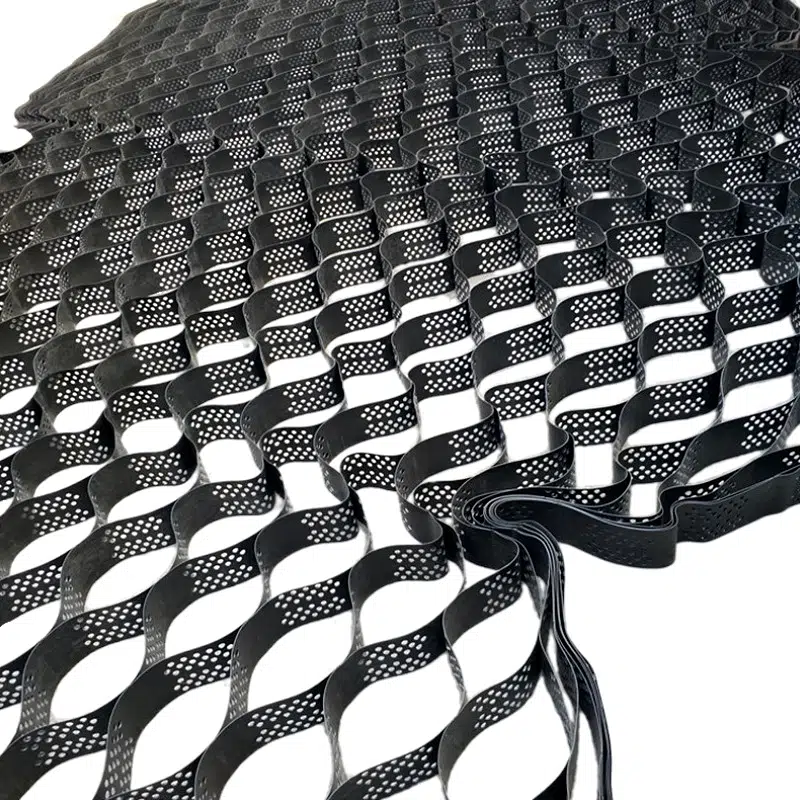
Slope stress is different from road stress
On a road, geocell is usually placed flat. The main job is to confine aggregate and improve load distribution. On a slope, the cell layer is placed at an angle. Gravity pulls the infill downward before the surface becomes stable.
This is why slope installation needs stronger attention to anchoring. If the top fixing is weak, the whole panel can shift during filling. If the middle anchors are too few, some sections may bulge or slide.
From a technical view, geocell works because the expanded honeycomb structure confines the infill inside each cell. This limits lateral movement and helps the filled layer behave more like a stable composite system.
For slope projects, this confinement is important because gravity keeps pulling soil, gravel, or concrete downward. The geocell cell wall, weld strength, infill friction, and anchor layout must work together. If one part is weak, the system may still move even when the geocell material looks good.
A neutral explanation of cellular confinement systems[^1] describes geocells as honeycomb-like structures expanded on site and filled with soil, rock, gravel, or concrete. For slopes, this honeycomb structure only works well when it is fixed firmly to the slope surface.
Water is a major risk
Rainwater can wash soil from the cells before vegetation grows. Runoff can move gravel if the cell height is too low or if the anchoring is weak. In channel or drainage areas, water flow can create even stronger force.
The buyer should not treat drainage as a small detail. Slope geocell should be selected together with water-control thinking. In some projects, perforated geocell, geotextile, drainage outlets, or gravel infill may be needed.
If the site has strong rainfall, water discharge, seepage, or surface runoff, the installation team should check drainage before filling. Otherwise, water may move under the geocell layer or wash infill from the cells.
Geocell must match the slope purpose
A green slope, a road embankment, a riverbank, and a drainage ditch do not need the same installation plan.
A green slope usually needs soil infill and plant growth. A high-flow drainage area may need gravel or concrete. A steep embankment may need stronger anchors, higher cell height, and better weld strength.
| Slope Condition | Main Installation Risk | Better Control Point |
|---|---|---|
| Gentle green slope | Soil washout before roots grow | Soil quality and surface finishing |
| Steep embankment | Panel sliding | Stronger top and middle anchoring |
| Rainy area | Surface erosion | Drainage and perforation planning |
| Gravel-filled slope | Aggregate movement | Cell height and anchor spacing |
| Channel slope | Hydraulic force | Stronger infill and edge fixing |
For buyers choosing materials before installation, the first step is to check the correct geocell product specification instead of asking only for a low square-meter price.
How Should You Prepare The Slope Before Installing Geocell?
Slope preparation decides whether the geocell layer can sit tightly on the surface. A clean, shaped, and stable slope gives the panel a better base.
Before installing geocell on a slope, remove loose soil, stones, roots, debris, and soft pockets. Then trim the slope to the design line, compact the surface where possible, repair unstable areas, and install geotextile if separation or filtration is needed.
Remove weak surface material
The slope surface should not have loose soil, large stones, roots, or construction debris. These materials can create voids under the geocell layer.
If the geocell is placed over loose material, the filled cells may settle later. If sharp stones remain, they can damage the sheet during installation or compaction.
The surface does not need to look perfect, but it must be stable enough to support the filled system.
Trim and shape the slope
The slope should follow the project design. If the surface is uneven, the geocell panel may not expand evenly. Some cells may carry more fill. Other cells may remain loose.
This creates uneven stress. On a slope, uneven stress can lead to local movement and washout.
The installation team should also check the top edge, toe area, and side boundaries. These edges often need stronger fixing because water and gravity affect them more.
Use geotextile when the soil needs support
A geotextile layer may be used under geocell when the slope has fine soil, weak soil, or filtration needs. It can help reduce soil migration and support separation between the base soil and the geocell infill.
The wider geosynthetics[^2] category includes geotextiles, geogrids, geomembranes, geocells, and related products used for stabilization, drainage, filtration, separation, reinforcement, and erosion control. On slopes, geocell and geotextile often work together because one provides confinement and the other can support separation or filtration.
Geocell mainly controls the surface layer. It should not be treated as a replacement for deep slope stability design. If the slope has cracking, seepage, deep sliding risk, or unstable foundation soil, the project should be reviewed by a qualified engineer before installation.
This is especially important for highway embankments, mining slopes, riverbanks, landfill covers, and other high-risk projects.
| Preparation Step | Why It Matters | Factory-Side Note |
|---|---|---|
| Remove loose material | Prevents settlement and voids | Do not install over unstable soil |
| Trim slope surface | Helps panels sit evenly | Follow design slope line |
| Compact where possible | Improves support below cells | Avoid soft pockets |
| Check water flow | Reduces future erosion | Plan drainage before filling |
| Place geotextile | Helps separation and filtration | Use when soil condition requires it |
If the slope needs a filter or separation layer, buyers should review geotextile materials before installation planning.
What Is The Step-By-Step Process To Install Geocell On A Slope?
Slope geocell installation should follow a controlled sequence. The panel should be fixed before filling, not corrected after movement happens.
The basic process is: prepare the slope, place geotextile if needed, fix the top edge, expand the geocell downward, connect adjacent panels, install anchors, fill the cells from top to bottom or as designed, compact or finish the infill, and protect the surface.
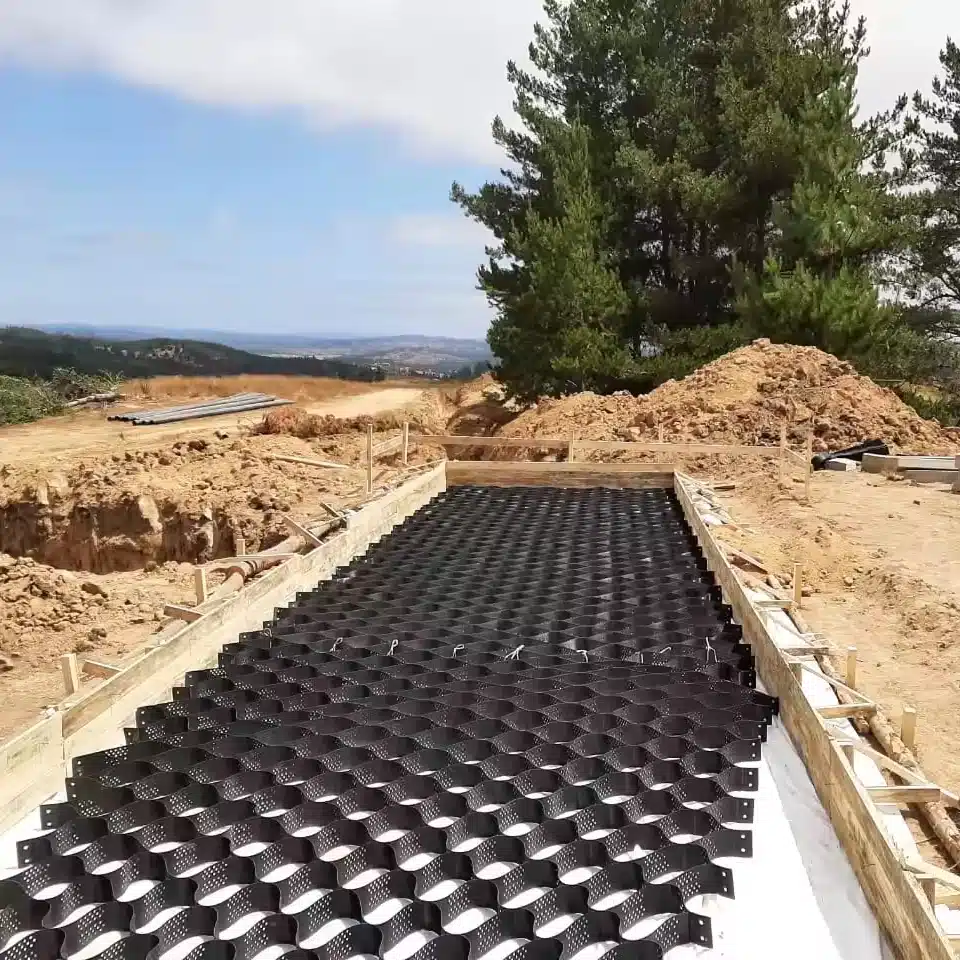
Step 1: Set the top fixing line
The top of the slope should be fixed first. This can be done with anchor trenches, stakes, pins, or other project-approved methods.
The top fixing line matters because it stops the panel from sliding before the cells are filled. If this point is weak, the panel can move during expansion and filling.
For steep slopes, the top line should be treated as a key structural detail, not just a temporary holding point.
If the design requires an anchor trench, the trench should be prepared before panel expansion. The upper edge of the geocell can be fixed into the trench or secured with approved anchors. This crest fixing point is part of the slope protection system.
Step 2: Expand the geocell downward
After the top is fixed, the panel is expanded down the slope. The cells should open evenly. The panel should not be overstretched because overstretching changes the cell size and may stress the welds.
Workers should check alignment as they expand each panel. Adjacent panels should meet correctly so the system can work as one continuous layer.
If panels are not aligned, infill may collect unevenly. Water may also find weak paths between panels.
The panel should be expanded to the designed size. It should not be pulled beyond the intended opening. Overstretching can change the cell shape, reduce dimensional uniformity, and add unnecessary stress to the weld points.
Step 3: Connect adjacent panels
Panel connections are important on slopes. If adjacent panels separate, soil or gravel can move through the gap.
Connections should follow the project or supplier recommendation. Common connection methods include staples, cable ties, clips, or factory-recommended connectors.
The goal is to create a continuous surface protection system. Loose panel edges can become weak points after rainfall.
Step 4: Anchor the cells
Anchors should be installed according to slope angle, soil type, cell height, panel size, and expected water flow. Steeper slopes usually need closer and stronger anchoring.
Buyers should avoid using one universal anchor spacing for every slope. A low green slope and a steep channel bank do not carry the same risk.
The anchor layout should also consider the top edge, side edges, panel joints, and slope toe. These areas often become the first weak points when water and gravity act together.
Step 5: Fill and finish the surface
The cells can be filled with soil, topsoil, gravel, crushed stone, or concrete. The filling method should avoid pulling the panel downward.
Filling should normally move from the top of the slope downward. Infill should be placed carefully, not dumped aggressively from excessive height. Heavy equipment should not drive directly over empty geocell panels because empty cells and weld joints can be damaged before they are supported by infill.
For vegetated slopes, soil should be placed carefully and finished for seeding or planting. For gravel slopes, the material should be leveled and checked for empty cells. For concrete-filled systems, placement and curing should follow project requirements.
| Installation Step | Key Control Point | Common Mistake |
|---|---|---|
| Top fixing | Secure panel before expansion | Weak top anchor |
| Expansion | Open cells evenly | Overstretching panels |
| Panel connection | Join sections tightly | Leaving gaps between panels |
| Anchoring | Match anchor spacing to slope | Using too few anchors |
| Filling | Place infill carefully | Dumping material too aggressively |
| Surface finishing | Protect final layer | No erosion protection before vegetation grows |
This process is simple in theory, but the details should change with slope angle, rainfall, soil type, and infill material.
What Anchor System Should Be Used For Slope Geocell?
Anchoring is one of the most important parts of slope geocell installation. Without proper anchoring, the cells can move before they begin to function.
The anchor system for slope geocell should be selected according to slope angle, soil strength, panel size, water flow, infill weight, and project design. Common options include steel pins, J-hooks, U-pins, anchor stakes, tendons, anchor trenches, staples, fixing clips, and edge fixing systems.
The top anchor carries early stress
The top edge usually takes strong tension during expansion and filling. This is why many projects use a top anchor trench or strong top pinning system.
If the top edge fails, the panel can slide. This can damage the cells and create unsafe working conditions.
A buyer should ask the installer or project engineer how the top fixing will be handled. The geocell supplier can help discuss material compatibility, but the final anchor layout should match site design.
Middle anchors control panel movement
Middle anchors help keep the geocell in close contact with the slope. They also reduce bulging and panel lift.
The number of middle anchors depends on the site. Steeper slopes need more anchors. Loose soil may need longer anchors. Strong water flow may need extra fixing near flow paths.
A factory can give general guidance, but real anchor layout should consider project conditions.
Toe and side edges need attention
The toe of the slope can collect water and soil movement. The side edges can become weak points if water enters under the panel.
These areas should be fixed carefully. A common mistake is anchoring the middle but ignoring the edges. Once water or soil starts moving from the edges, the system can weaken.
| Anchor Area | Function | Buyer Should Confirm |
|---|---|---|
| Top edge | Prevents downward panel sliding | Anchor trench or strong pinning |
| Middle slope | Keeps cells close to surface | Anchor spacing and length |
| Side edges | Stops edge lifting and water entry | Edge fixing method |
| Slope toe | Controls lower boundary movement | Toe support and drainage |
| Panel joints | Prevents separation between panels | Connection and anchor pattern |
For contractors and distributors, anchor accessories should be discussed before shipment. A geocell order without an anchor plan can create site delays.
What Infill Material Should Be Used On A Geocell Slope?
The infill material decides whether the slope becomes green, drained, hard-protected, or erosion-resistant. The geocell only provides the confinement structure.
Common infill materials for slope geocell include topsoil, planting soil, local soil, gravel, crushed stone, and concrete. Soil is used for vegetated slopes, gravel is used for drainage and erosion resistance, and concrete is used for high-flow or severe erosion areas.
The same geocell panel can perform differently when the infill changes. A green landscaping slope may use topsoil and seed. A road embankment may use aggregate for stronger drainage and surface protection. A drainage channel, ditch, or spillway may need concrete when water force is strong.
Soil is used for vegetated slopes
Topsoil or planting soil is common when the slope needs a green surface. The geocell holds the soil while grass or plants establish roots.
The soil should not be too loose or too easy to wash out. It should support vegetation and hold enough moisture without becoming unstable.
For green slopes, perforated geocell may help water movement and root interaction. The buyer should confirm this before ordering the product.
Gravel is used for stronger surface protection
Gravel and crushed stone are useful when the slope needs drainage and stronger surface protection. They are often used on road embankments, drainage areas, and erosion-control slopes.
The stone size should match the cell opening. If the stone is too large, the cell may not fill well. If the material has too many fines, drainage can become worse.
Concrete is used for high-flow areas
Concrete-filled geocell can be used in channels, ditches, and severe erosion zones. The geocell helps form a confined structure, while concrete creates a hard protective surface.
This option is stronger but more expensive. It also removes the green slope effect. Buyers should use it when the site has strong water force or requires a hard lining.
| Infill Material | Best Application | Main Risk |
|---|---|---|
| Topsoil | Green slope and vegetation | Washout before root growth |
| Local soil | Low-cost surface filling | Poor compaction or erosion |
| Gravel | Drainage and surface protection | Wrong size may reduce stability |
| Crushed stone | Stronger erosion control | Higher cost |
| Concrete | Channels and severe water flow | Less flexible and more expensive |
| Soil + seed mix | Ecological slope projects | Needs maintenance during growth |
The correct infill should be chosen before geocell specification is finalized. Cell height, perforation, surface texture, and anchoring all depend on the infill plan.
What Mistakes Should Buyers Avoid When Installing Geocell On A Slope?
Most slope geocell mistakes happen because the buyer treats the product as a simple surface cover. Geocell is a confinement system, so installation details decide the result.
Buyers should avoid installing geocell over loose soil, using weak anchors, choosing the wrong cell height, ignoring weld strength, using unsuitable infill, skipping drainage planning, and comparing suppliers only by price before checking factory quality.
Mistake 1: Installing over unstable soil
Geocell cannot perform well if the soil below it is already moving. Loose soil, soft pockets, and poor grading should be corrected before installation.
If the slope surface is not stable, the geocell layer may deform after filling. This is a site preparation problem, not only a product problem.
Mistake 2: Using too few anchors
Weak anchoring is one of the fastest ways to create slope failure. The panel may shift before filling, or it may move after rainfall.
Anchor spacing should match the slope condition. Steep slopes, loose soil, heavy infill, and water-flow areas need stronger anchoring.
Mistake 3: Choosing only by price
A cheaper geocell may look similar in photos, but differences in resin quality, sheet thickness, weld strength, carbon black dispersion, UV resistance, and dimensional stability can affect field performance.
For B2B buyers, a small saving in material cost can become expensive if the slope needs repair after one rainy season.
For slope projects, weld strength matters because the geocell panel is pulled during expansion, anchoring, and filling. If the weld points are weak, the cells may separate before the system reaches stable performance.
Mistake 4: Ignoring drainage
Water can move soil out of the cells and create pressure behind the system. If drainage is not planned, the slope can still erode.
Drainage planning may include perforated geocell, geotextile, gravel zones, channels, or outlets.
| Mistake | Possible Result | Better Practice |
|---|---|---|
| Poor slope preparation | Settlement or uneven surface | Trim and stabilize slope first |
| Weak top fixing | Panel slides downward | Strengthen top anchor line |
| Too few middle anchors | Bulging and movement | Adjust spacing to slope angle |
| Wrong infill | Washout or poor vegetation | Match infill to project purpose |
| Weak weld strength | Cell separation | Check factory welding control |
| No drainage plan | Erosion and pressure build-up | Plan water paths before filling |
| Lowest-price sourcing | Repair cost after rainfall | Check resin, thickness, weld strength, and UV resistance |
For site visuals, buyers can review TikTok geocell slope installation videos[^3] or Facebook geocell slope protection posts[^4]. These sources can show application scenes, but they should not replace project design or factory technical confirmation.
What Should Buyers Confirm Before Ordering Geocell For A Slope?
Good slope installation starts before the material leaves the factory. If the wrong specification is ordered, the installer may not be able to fix the problem on site.
Before ordering geocell for a slope, buyers should confirm slope angle, slope height, soil condition, rainfall or water flow, infill material, vegetation requirement, sheet thickness, cell height, weld strength, perforation, surface texture, anchor plan, quantity, packing, and destination port.
Confirm the slope condition
The factory needs to know the slope angle and project use. A road embankment, a riverbank, a landfill slope, and a landscape slope do not need the same product.
The buyer should also share the expected infill material. Soil, gravel, and concrete affect cell height and anchoring differently.
Confirm product specification
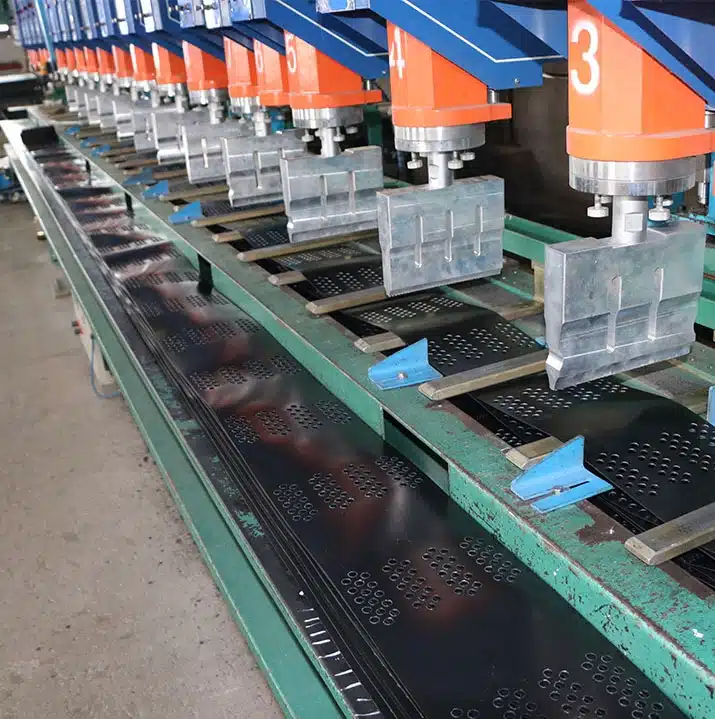
The buyer should check HDPE material quality, thickness, cell height, weld spacing, weld strength, surface texture, perforation, and expanded panel size.
For slope use, weld strength is important because the panel is pulled during expansion and filling. UV resistance can also matter if the geocell will remain exposed.
| Selection Factor | What To Check | Why It Matters |
|---|---|---|
| Cell height | 50 mm, 75 mm, 100 mm, 150 mm, 200 mm, or project-specific | Deeper cells give stronger confinement for steeper slopes or thicker infill |
| Weld spacing | Distance between welded joints | Controls cell opening size and confinement behavior |
| Sheet thickness | Smooth or textured sheet thickness | Affects strength, durability, and handling |
| Surface type | Smooth, textured, perforated, or non-perforated | Affects friction, drainage, and infill interaction |
| Weld strength | Seam strength and node quality | Weak welds may break during expansion, filling, or service |
| UV resistance | Carbon black and aging resistance | Important for outdoor storage and exposed conditions |
| Anchor system | J-pins, U-pins, tendons, anchor trench | Keeps the system stable on the slope |
| Infill type | Topsoil, aggregate, concrete | Determines erosion resistance and final performance |
Confirm packing and export support
For overseas orders, packing should be confirmed early. Roll or bundle size affects container loading, storage, and site handling.
A reliable factory should also confirm labels, production time, documents, and shipment plan. Poor export preparation can delay installation even when the product quality is good.
| Buyer Information | Why It Matters | Factory Can Confirm |
|---|---|---|
| Slope angle | Affects anchoring and cell height | Suitable grade and anchor discussion |
| Soil condition | Affects base support | Need for geotextile |
| Water condition | Affects erosion risk | Perforation and drainage advice |
| Infill type | Affects cell size and height | Soil, gravel, or concrete suitability |
| Vegetation need | Affects perforation and topsoil depth | Green slope option |
| Quantity | Affects production and price | MOQ and lead time |
| Destination port | Affects delivery cost | Packing and shipping plan |
If buyers want to compare the full slope protection system, they can also review 3D geomat erosion-control products and decide whether the project needs geocell, geomat, geotextile, or a combined solution.
My View
When I look at slope geocell installation, I do not start with the panel price. I start with slope angle, water flow, soil condition, and infill type.
The biggest mistake is installing geocell like a simple surface mat. Geocell is a cellular system. It needs top fixing, middle anchoring, correct filling, and drainage planning. If any one of these points is ignored, the slope may still fail.
A good slope geocell system is not only a geocell panel. It is a system made of product specification, slope preparation, anchoring, infill, drainage, and installation control.
For buyers, the product should be selected before the site team begins work. The factory should know whether the geocell will hold topsoil, gravel, or concrete. It should also know the slope condition and expected exposure.
My advice is simple. Confirm the slope condition first. Confirm the geocell specification second. Plan anchoring and infill third. Compare price last. This order reduces wrong product selection and installation risk.
Conclusion
Geocell slope installation works when the surface is stable, the panel is anchored correctly, and the infill matches the project. A good slope system starts before ordering.
The basic process is clear. Prepare the slope, fix the top edge, expand the geocell downward, connect and anchor the panels, fill the cells carefully, and finish the surface based on the project purpose.
For contractors, distributors, and project buyers, the better choice is not always the cheapest geocell. The better choice is the product that matches the slope condition, installation method, and long-term performance requirement.
FAQs
1. Can geocell be installed on a steep slope?
Yes, geocell can be installed on steep slopes, but the slope angle must be reviewed carefully. Steeper slopes usually need stronger anchoring, suitable cell height, better drainage, and the correct infill material. For high-risk slopes, a geotechnical engineer should review the project before installation.
2. What is the best infill for geocell slope protection?
The best infill depends on the project. Topsoil is suitable for vegetated slopes. Gravel or crushed stone is better for drainage and stronger erosion resistance. Concrete is used for channels, spillways, or areas with strong water flow.
3. Should geotextile be placed under geocell on a slope?
Geotextile is often useful when the slope has fine soil, weak soil, or filtration needs. It helps with separation, filtration, and soil retention. The final decision should follow the project design and site drainage requirement.
4. Can workers drive equipment over geocell before filling?
No. Heavy equipment should not drive directly over empty geocell panels. Empty cells can deform, and weld points may be damaged. The cells should be filled first, then compacted according to project requirements.
5. How do you choose the right geocell height for a slope?
Geocell height depends on slope angle, infill type, soil condition, erosion risk, and anchoring design. Common heights include 50 mm, 75 mm, 100 mm, 150 mm, and 200 mm. Steeper slopes or stronger erosion conditions usually need deeper cells.
6. Is geocell enough to stop a landslide?
No. Geocell mainly supports surface stabilization and erosion control. If the slope has deep sliding risk, groundwater pressure, cracking, or structural instability, the project needs geotechnical review before material selection.
Footnotes
[^1]: This Wikipedia page is used to support the basic explanation of cellular confinement systems and their honeycomb structure filled with soil, gravel, rock, or concrete.
[^2]: This Wikipedia page is used to explain the broader geosynthetics category and its civil engineering functions, including stabilization, filtration, drainage, reinforcement, and erosion control.
[^3]: This TikTok search page is included as a social media reference for geocell slope installation visuals. Buyers should verify technical decisions with project design and supplier data.
[^4]: This Facebook search page is included as a social media reference for geocell slope protection posts. It should not replace engineering design, anchoring calculation, or factory confirmation.