
A geotextile bag can control erosion only when fabric, seam, fill, placement, and water force are treated as one system.
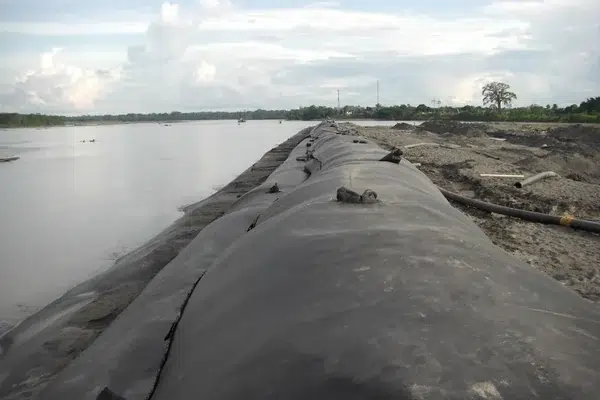
Geotextile bags, often searched in Spanish as bolsas de geotextil, are filled geotextile units used for coastal protection, riverbank support, temporary flood works, and erosion control. Their performance depends on fabric filtration, tensile and seam strength, fill material, filling pressure, placement geometry, ultraviolet exposure, and hydraulic loading.
Before placing an order, compare the project drawing, site condition, installation method, roll or bag dimensions, and delivery scope. This confirms that competing quotations cover the same system rather than products with similar names but different field performance. Confirm the test-data basis, inspection responsibility, and packaging details before the shipment is released, because these points directly affect site handling and acceptance.
Send bank slope, water condition, fill material, target bag size, required service life, and destination for a fabric and seam review.
Request a geotextile bag erosion-control specification checkWhere Geotextile Bags Work
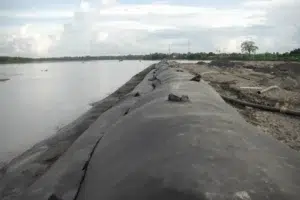
Geotextile bags are used where a filled textile unit can provide flexible mass, filtration, and surface protection. Common uses include riverbank protection, coastal revetments, temporary flood barriers, scour control, and slope toe support. The correct application depends on hydraulic conditions and the stability of the foundation beneath the bags.
They are not a universal replacement for rock armour, sheet piles, or engineered revetments. Coastal and river projects should consider wave action, current velocity, expected water-level change, abrasion, and toe stability. The USACE Coastal Engineering Manual is a useful reference for the wider coastal engineering context. [1]
Fabric, Opening Size, and Filtration
The fabric must hold the selected fill while allowing controlled water passage without losing fine particles. Apparent opening size, permeability, and filtration stability must be considered against the fill and the adjacent soil. A bag filled with sand behaves differently from one filled with dewatered sediment or granular material.
Factory Tip: do not select a bag fabric by unit weight alone. Ask what will be pumped or placed inside, whether slurry conditioning is used, and what the bag will contact outside. A fabric that is strong but poorly matched to the fill can clog or lose fines, which changes both drainage and bag shape.
| Aplicación | cURL Too many subrequests by single Worker invocation. To configure this limit, refer to https://developers.cloudflare.com/workers/wrangler/configuration/#limits | Specification focus |
|---|---|---|
| Riverbank protection | Toe scour and flow movement | Fill, seam, placement geometry |
| Revetment costero | Wave abrasion and UV | Exposure, layout, sacrificial protection |
| Flood-control work | Rapid filling and handling | Bag size, seams, site access |
| Dewatering or sediment fill | Fines loss and clogging | Opening size, permeability, fill conditioning |
Seam Strength and Filling Pressure
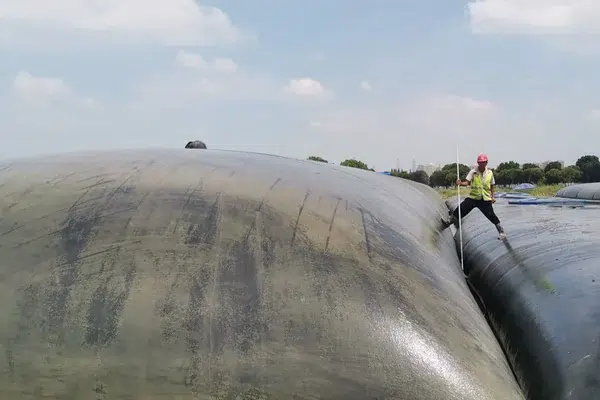
Seams are a critical strength line because the bag is filled, handled, stacked, and exposed to movement. The correct sewing pattern, seam allowance, thread, and closure detail depend on bag size and filling method. ASTM D4884 covers strength of sewn or bonded geotextile seams. [3]
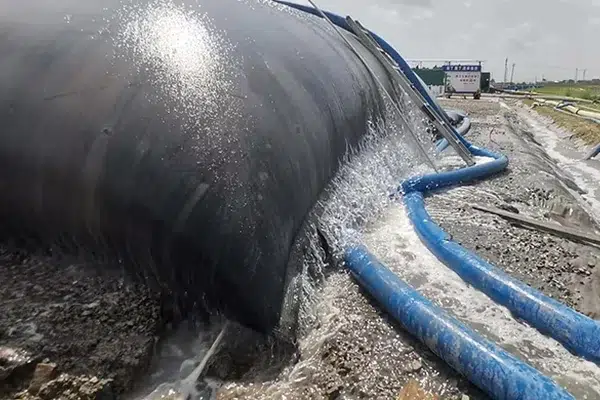
QC Check: review seam test information before comparing prices. A low-cost bag that opens during filling can create a difficult cleanup, loss of fill, and a restart of the placement operation. Filling pressure should be controlled so the bag reaches its intended shape without overstressing seams.
Placement Geometry and Foundation
Bag placement needs a stable foundation and an arrangement that resists sliding, displacement, and scour. On a bank or shoreline, the toe often determines whether the visible upper layer remains in place. The placement pattern, overlap, bag orientation, and access method should follow the project design.
Field Note: a buyer once requested only a bag volume and fabric weight for a riverbank job. The more consequential question was how the first row would be keyed into the toe. Without that detail, flowing water could undermine the front edge even if every bag met the requested textile strength.
UV, Abrasion, and Service Life
Sunlight, abrasion, debris, and repeated hydraulic movement can control the service life of exposed geotextile bags. The bag should be matched to the expected exposure and maintained where the project design requires it. ASTM D4595 provides a wide-width strip tensile method relevant to fabric comparison. [2]
Expert Insight: a higher fabric strength does not automatically solve an exposed coastal problem. The project may require a protective cover, an outer sacrificial layer, different fill, or a revised layout. Evaluate the water and abrasion environment before assuming a standard bag can deliver a long-term revetment.
Detalles de la solicitud de cotización que los compradores deben enviar
cURL Too many subrequests by single Worker invocation. To configure this limit, refer to https://developers.cloudflare.com/workers/wrangler/configuration/#limits cURL Too many subrequests by single Worker invocation. To configure this limit, refer to https://developers.cloudflare.com/workers/wrangler/configuration/#limits
cURL Too many subrequests by single Worker invocation. To configure this limit, refer to https://developers.cloudflare.com/workers/wrangler/configuration/#limits cURL Too many subrequests by single Worker invocation. To configure this limit, refer to https://developers.cloudflare.com/workers/wrangler/configuration/#limits cURL Too many subrequests by single Worker invocation. To configure this limit, refer to https://developers.cloudflare.com/workers/wrangler/configuration/#limits cURL Too many subrequests by single Worker invocation. To configure this limit, refer to https://developers.cloudflare.com/workers/wrangler/configuration/#limitscURL Too many subrequests by single Worker invocation. To configure this limit, refer to https://developers.cloudflare.com/workers/wrangler/configuration/#limits [4]
Mi opinión
cURL Too many subrequests by single Worker invocation. To configure this limit, refer to https://developers.cloudflare.com/workers/wrangler/configuration/#limits
Conclusión
cURL Too many subrequests by single Worker invocation. To configure this limit, refer to https://developers.cloudflare.com/workers/wrangler/configuration/#limits
Preguntas frecuentes
cURL Too many subrequests by single Worker invocation. To configure this limit, refer to https://developers.cloudflare.com/workers/wrangler/configuration/#limits
cURL Too many subrequests by single Worker invocation. To configure this limit, refer to https://developers.cloudflare.com/workers/wrangler/configuration/#limits
cURL Too many subrequests by single Worker invocation. To configure this limit, refer to https://developers.cloudflare.com/workers/wrangler/configuration/#limits
cURL Too many subrequests by single Worker invocation. To configure this limit, refer to https://developers.cloudflare.com/workers/wrangler/configuration/#limits
cURL Too many subrequests by single Worker invocation. To configure this limit, refer to https://developers.cloudflare.com/workers/wrangler/configuration/#limits
cURL Too many subrequests by single Worker invocation. To configure this limit, refer to https://developers.cloudflare.com/workers/wrangler/configuration/#limits
Referencias
- cURL Too many subrequests by single Worker invocation. To configure this limit, refer to https://developers.cloudflare.com/workers/wrangler/configuration/#limits ↩
- cURL Too many subrequests by single Worker invocation. To configure this limit, refer to https://developers.cloudflare.com/workers/wrangler/configuration/#limits ↩
- cURL Too many subrequests by single Worker invocation. To configure this limit, refer to https://developers.cloudflare.com/workers/wrangler/configuration/#limits ↩
- cURL Too many subrequests by single Worker invocation. To configure this limit, refer to https://developers.cloudflare.com/workers/wrangler/configuration/#limits ↩



 Spanish
  English
  Arabic