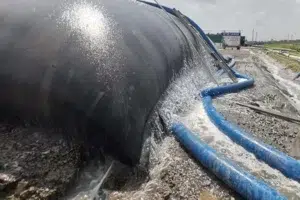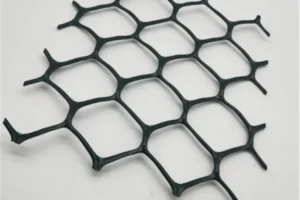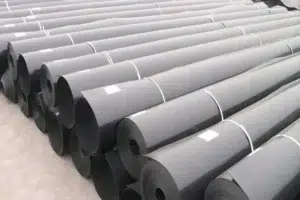
Geocell road construction works when the layer is designed as a confined base, not a decorative sheet.
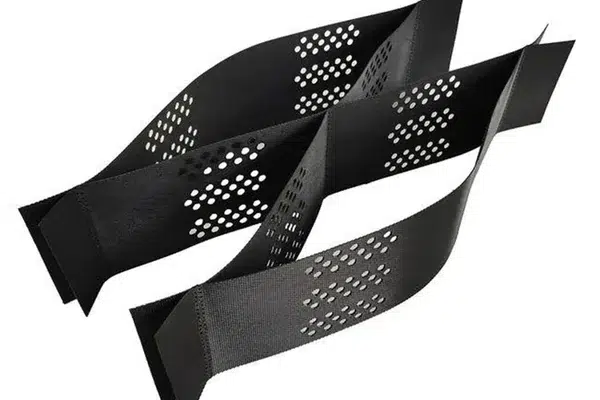
How Does Geocell Road Construction Work?
Geocell road construction works by opening HDPE panels over the prepared subgrade, filling the cells with aggregate or suitable local material, and compacting the layer so the cell walls limit lateral movement. The result is better load distribution and less rutting when the design matches traffic and soil conditions.
Geocell is commonly discussed for load support and subgrade improvement in roadway projects. ASTM D8269 frames geocells around applications, support mechanisms, design principles, material properties, and project-specific engineering judgment. [1]
From a buyer’s view, geocell road construction has three decisions: the cell depth, the infill, and the installation quality. If one is wrong, the other two cannot fully rescue the project.
Send your traffic load, soil condition, and available aggregate size to check whether geocell can reduce rutting or base repair risk.
Get a road base geocell checklistLayer Design Factors Buyers Should Confirm
| Design factor | What to confirm | Risk if ignored |
|---|---|---|
| Subgrade condition | Soft clay, sand, wet soil, or compacted base | Settlement and pumping under traffic |
| Cell depth | Panel height matched to load and infill | Low confinement or unnecessary material cost |
| Infill | Angular aggregate, crushed stone, or approved local material | Poor interlock and surface rutting |
| Separation layer | Need for geotextile below the geocell | Contamination of aggregate by fine soil |
Expert Insight: Thicker geocell is not always better. If the subgrade is already firm and traffic is light, a very deep panel may only increase infill volume. If the subgrade is weak and turning traffic is heavy, a shallow panel may save money on paper and lose it in maintenance.
Why Separation and Drainage Still Matter
Geocell confines aggregate, but it does not automatically stop fine soil from migrating upward into the base. When the subgrade is wet, silty, or soft, a nonwoven or woven geotextile may be needed below the geocell as a separation layer. The wider geosynthetics function map published by industry education resources is useful here: reinforcement, separation, filtration, drainage, and containment are different jobs. [3]
On a road job, poor drainage can quietly destroy the benefit of good panels. Water softens the subgrade, carries fines, and makes the base pump under repeated wheel loads. The buyer may blame geocell when the real issue is the missing drainage path or the wrong separation layer.
For reinforced soil and geosynthetic construction, FHWA guidance repeatedly points to the need for material verification, construction control, and suitable site preparation. [2] That principle applies directly to geocell road bases: the installation crew needs a stable working surface, correct panel expansion, controlled filling, and compaction in the right sequence.
Installation Checks That Prevent Rework
Good road performance starts before the panel is opened. Remove soft spots, level the surface, control water, and place any separation geotextile required by the design. Then expand the geocell fully so the cell geometry is uniform before filling.
Do not dump aggregate from height directly into loose cells. It can fold the walls, shift the panel, or create uneven fill. Use staged filling and keep equipment movement controlled until the cells are filled and compacted.
FHWA geosynthetic guidance for reinforced systems repeatedly brings attention back to construction control and material verification. That is a useful reminder for geocell road bases: the product only performs when the layer is installed as designed. [4]
Factory QC Points for Road Projects
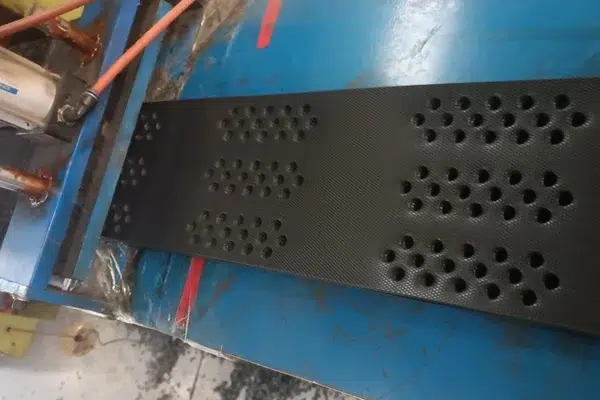
QC Check: Before shipment, ask the factory for strip thickness tolerance, weld spacing, panel dimensions, surface texture, perforation pattern, and packing count per bundle. For long roads, inconsistent panel geometry can slow installation and create awkward overlaps at the site.
For repeated wheel loads, weld quality matters. A panel with weak welds may open or deform during filling, especially when the installer is rushing. The factory should be comfortable explaining how weld consistency is controlled during production.
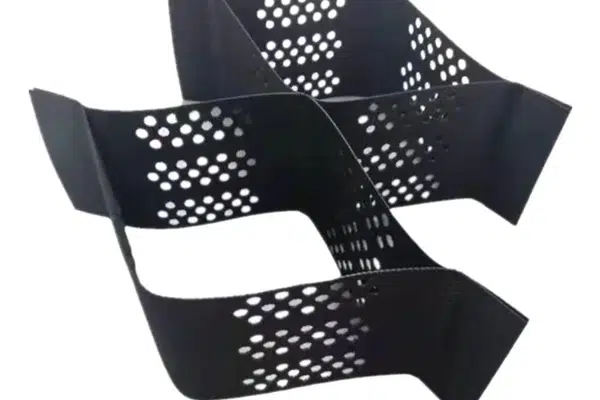
A small but important ordering detail is panel layout. If the road is narrow, curved, or built in stages, panel dimensions affect trimming waste and connection work. A low price per square meter can become less attractive if the panel format creates too many cuts, loose edges, or connection points along the wheel path.
For export projects, I also recommend confirming bundle weight and unloading method. Geocell is lighter than many hard construction materials, but large bundles still need practical handling. If the site has no forklift access, the packing plan should be discussed before production, not when the container arrives.
Benefits and Limits of Geocell Road Bases
| Benefit | Where it helps most | Limit |
|---|---|---|
| Reduced rutting | Access roads and weak subgrades | Still needs drainage and compaction |
| Better aggregate use | Remote sites with limited crushed stone | Infill must still be suitable |
| Faster installation | Temporary roads and working platforms | Crew must know panel expansion and fixing |
| Improved confinement | Turning areas and low-volume roads | Not a substitute for full pavement design |
A common mistake is selling geocell as a way to ignore base preparation. It is better to treat geocell as a risk-control layer. It can improve the behavior of the base, but it cannot turn mud, standing water, and ungraded fill into a reliable road by itself.
For B2B road projects, compare MJY HDPE geocell panels with your expected traffic and available infill. If the project also needs separation under the base, review geotextile separation fabric. For broader road applications, see geosynthetics application guidance.
Final Takeaway
Geocell road construction is strongest when the buyer treats it as a designed base layer. Confirm subgrade, cell depth, infill, drainage, and installation method before ordering panels.
## References
References
- ASTM D8269-21 Standard Guide for the Use of Geocells in Geotechnical and Roadway Projects ↩
- FHWA GEC 011 Design and Construction of Mechanically Stabilized Earth Walls and Reinforced Soil Slopes ↩
- International Geosynthetics Society: Geosynthetics Education Resources ↩
- FHWA Geosynthetic Design and Construction Guidelines ↩