
Retaining walls can fail even when geogrid is installed, if the wrong grid type carries the load.
Geogrid for retaining walls is usually selected by tensile direction, long-term design strength, embedment length, soil interaction, wall height, surcharge, and drainage condition. Uniaxial geogrid is often used for wall reinforcement, while biaxial geogrid is more common for base stabilization.
The product name alone is not enough. A retaining wall needs reinforcement that works in the direction the design requires, not just a grid that looks strong.
Send wall height, backfill type, slope, surcharge, and required strength to compare uniaxial and biaxial geogrid before ordering.
Request a retaining wall geogrid checkWhy Tensile Direction Matters
Retaining walls usually need reinforcement strength running from the wall face back into the compacted fill. Geosynthetic design guidance treats reinforcement function and soil interaction as design issues, not simple product labels. [1]
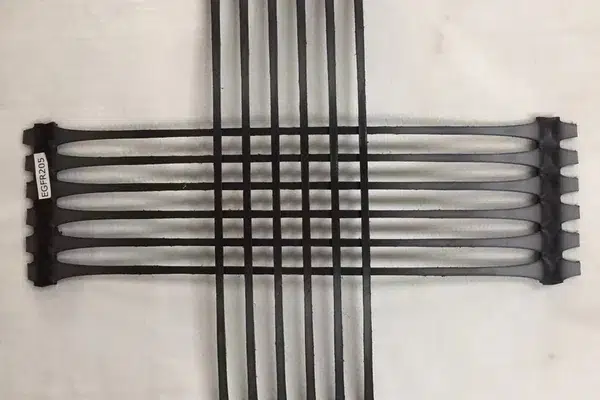
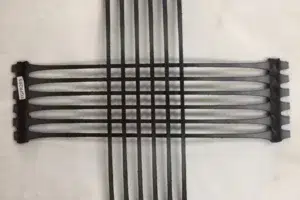
Uniaxial geogrid is designed with dominant strength in one direction. That is why it is often used in walls, steep slopes, and reinforced soil structures. If the strong direction is installed sideways, the wall may have geogrid in the soil but not the reinforcement the design expected.
Factory Tip: When we prepare geogrid shipments for wall projects, roll direction and label clarity matter. A crew should know which direction is the machine direction before the first roll is cut. Confusion at this step can turn a good product into a bad installation.
Uniaxial vs Biaxial Geogrid
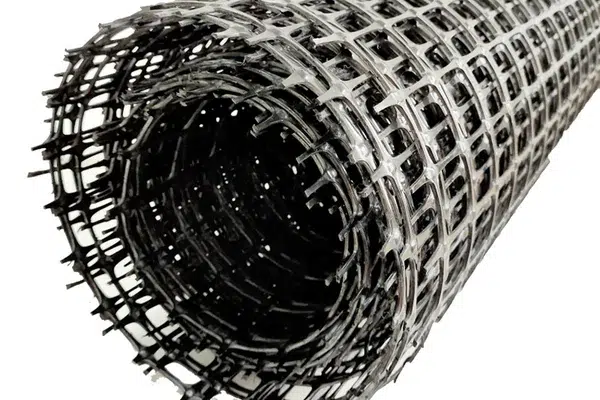
Uniaxial and biaxial geogrids solve different reinforcement problems. Uniaxial geogrid is usually chosen where the main tensile demand is one-way. Biaxial geogrid distributes strength in two directions and is widely used in road base, platform, and aggregate stabilization work.
| Geogrid type | Typical strength direction | Better fit | Retaining wall warning |
|---|---|---|---|
| Uniaxial geogrid | One primary direction | Retaining walls, slopes, reinforced soil | Install strong direction away from wall face |
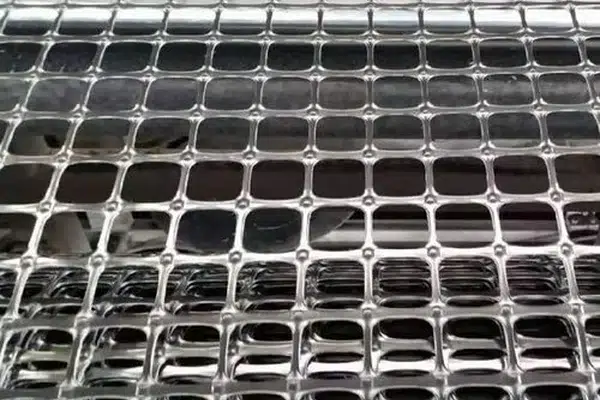
| Biaxial geogrid | Two main directions | Road base and aggregate stabilization | May not match wall design demand |
| PET geogrid | High tensile reinforcement | Soil reinforcement and asphalt applications | Check coating, creep, and design strength |
| Fiberglass geogrid | Low elongation grid | Asphalt reinforcement | Not a normal retaining wall soil reinforcement choice |
Design Inputs Buyers Should Not Guess
Wall height, backfill, surcharge, slope condition, and drainage decide the geogrid requirement. A short garden wall and a commercial retaining wall behind a road are not the same buying problem.
FHWA reinforced soil wall guidance shows why reinforced systems depend on layout, soil, facing, drainage, and long-term behavior. [2] A buyer should not replace a specified geogrid with a cheaper grid only because the aperture looks similar.
Field Note: A contractor once asked for ‘the same black geogrid but cheaper’ for a wall with vehicle surcharge. The drawing required a strength direction and embedment length. Our answer was that color and aperture were not the specification. The quote had to follow the design strength, or the buyer needed engineer approval.
Long-Term Strength and Pullout Resistance
Retaining wall geogrid must keep useful strength over time and interact properly with backfill. The key terms are long-term design strength, creep reduction factor, pullout resistance, aperture stability, and soil-geogrid interaction.
ASTM D6637 is commonly referenced for tensile properties of geogrids, but a wall design also needs reduction factors and project-specific checks. [3] A catalog value is not automatically the allowable long-term design value.
Expert Insight: Do not over-focus on peak tensile strength alone. A grid with a high short-term number can still be the wrong choice if long-term creep, connection detail, backfill friction, or installation direction is not controlled.
Installation Mistakes That Reduce Wall Safety
Most site mistakes are simple: wrong direction, short embedment, poor backfill, loose placement, and weak drainage. These mistakes can cause bulging, settlement, face movement, or inspection rejection.
| Mistake | What can happen | Buyer or site check |
|---|---|---|
| Wrong roll direction | Main tensile strength is not mobilized | Mark machine direction before cutting |
| Short geogrid length | Reinforced soil mass becomes too small | Follow wall design embedment length |
| Poor backfill | Weak soil-geogrid interaction | Use specified granular fill when required |
| No drainage plan | Hydrostatic pressure increases wall load | Add drain stone, pipe, and outlet details |
| Damaged grid | Reduced reinforcement continuity | Limit equipment traffic before cover |
RFQ Details for Retaining Wall Geogrid
A good quote needs design information, not only square meters. Send wall height, wall type, drawings, specified tensile strength, roll direction, backfill type, slope angle, surcharge load, spacing, embedment length, and delivery destination.
For product selection, review MJY geogrid reinforcement products. For wall and slope projects, connect the geogrid choice with soil reinforcement applications. If drainage or separation is needed behind the wall, add geotextile fabric to the system instead of treating the wall as geogrid alone.
The International Geosynthetics Society also provides general education resources that help buyers understand geosynthetics by function. [4] This is useful when comparing product categories, but final wall design should still follow project documents.
My View
My view is that retaining wall geogrid should never be purchased like a commodity mesh. The wall does not care whether the grid looks heavy; it cares whether the correct strength is placed in the correct direction inside compacted, drained backfill. If a buyer wants to reduce cost, the right place to start is layout, roll width, waste reduction, and specification confirmation. Replacing the grid type without design approval is a poor saving.
Conclusion
For retaining walls, choose geogrid by tensile direction, long-term strength, embedment, backfill, drainage, and design approval. Uniaxial and biaxial geogrids are not interchangeable just because they look similar.
FAQs
Is uniaxial geogrid better for retaining walls?
Often yes, because many retaining walls need primary tensile strength running away from the wall face. Final selection must follow the project design.
Can biaxial geogrid be used in a retaining wall?
Sometimes, but it is more common for base stabilization. Do not substitute it for uniaxial geogrid unless the design allows it.
How far should geogrid extend behind a retaining wall?
It depends on wall height, soil, surcharge, slope, spacing, and design method. A universal length is not reliable for engineering use.



 English
  Spanish
  Arabic