Many liner systems fail on paper before installation because geotextile and geomembrane are treated as the same layer.
Geotextile and geomembrane are different geosynthetics: geomembrane provides containment, while geotextile usually provides filtration, drainage, separation, reinforcement support, or liner protection. The right choice depends on water control, soil movement, puncture risk, and project acceptance requirements.
The Spanish search term geotextil y geomembrana often appears when buyers compare both materials. The important question is not which one is better; it is which function the project needs.
Send project use, soil condition, water depth, liner thickness, and drainage requirement to check whether you need geotextile, geomembrane, or both.
Request a geosynthetic layer checkThe Core Difference Is Function
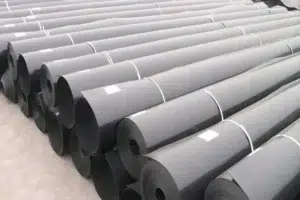
Geomembrane is used when the project needs a low-permeability barrier; geotextile is used when the project needs a permeable engineering fabric. HDPE geomembrane specifications such as GRI GM13 focus on liner properties for containment. [1]
A landfill cell, wastewater pond, mining pond, or farm reservoir usually needs a geomembrane to stop seepage. A road base, drainage trench, retaining wall, or liner protection layer often needs geotextile to separate, filter, drain, or cushion.
Factory Tip: In quotations, I watch for one dangerous sentence: ‘Can we use geotextile instead of geomembrane to save cost?’ If the project needs waterproofing, that substitution can remove the barrier function completely.
Where Geotextile Works Better
Geotextile works better when water must pass while soil particles are controlled. Apparent opening size and permittivity are important because drainage and filtration depend on soil-fabric compatibility, not only fabric weight. [2] [3]
| Project need | Better layer | Why it matters |
|---|---|---|
| Drainage behind wall | Nonwoven geotextile | Allows water flow while limiting soil migration |
| Road separation | Woven or nonwoven geotextile | Reduces aggregate and subgrade mixing |
| Pond waterproofing | HDPE geomembrane | Creates the containment barrier |
| Liner puncture protection | Nonwoven geotextile plus geomembrane | Cushions the liner against rough subgrade |
| Landfill containment | Geomembrane system with protection layers | Controls leakage risk and installation damage |

Where Geomembrane Is Non-Negotiable
Geomembrane is non-negotiable when the project requires containment. A geotextile may look dense, but it is not a waterproof liner. It can protect the liner, but it should not be sold as the barrier layer for ponds, leachate, wastewater, or chemical containment.
Expert Insight: A thicker geotextile can still let water through. That is not a defect; it is the function. The purchasing mistake is asking a permeable product to do an impermeable job, then blaming the material after seepage appears.
For commercial projects, this mistake can create pump-out, liner replacement, and earthwork rework. The direct material saving is small compared with draining a filled pond or reopening a compacted liner area.
In factory quotation review, the risk usually appears in one of three places: the buyer requests only GSM, the drawing calls for a liner but the RFQ asks for fabric, or the installer wants one roll type for every layer. Those shortcuts can reduce the whole system to its weakest function.
When You Need Both Layers
Many real projects need both layers because containment and protection are different jobs. A geomembrane can stop seepage, while a geotextile underlay or cover layer can reduce puncture, abrasion, and soil contact damage.
Common combinations include pond liner plus geotextile underlay, landfill liner plus geotextile protection, drainage geocomposite plus geotextile filter, and composite geomembrane systems for seepage control. The design must also consider hydrostatic pressure, puncture resistance, seam strength, interface friction, and filtration stability.
Quote Comparison Mistakes
The biggest quote mistake is comparing one supplier’s geomembrane system against another supplier’s single fabric roll. The square-meter price may look lower, but the quoted scope is not the same.
Ask whether the price includes the barrier layer, protection layer, roll width, overlap allowance, welding support, test documents, and export packing. If one quotation includes geomembrane plus geotextile protection and another only includes geotextile, the cheaper quote is not a saving; it is an incomplete system.
For export orders, also check whether the supplier priced the same roll width and packing plan, because extra seams and poor unloading can create avoidable site cost.
RFQ Checklist Before Ordering
A useful RFQ should describe function first and product name second. Buyers should send application, water or chemical condition, soil type, subgrade roughness, liner thickness, geotextile weight, drainage direction, roll width, quantity, and destination.
For containment projects, compare MJY HDPE geomembrane liner specifications. For drainage, separation, and protection layers, review geotextile fabric options. For full project use, connect both materials with landfill geosynthetics applications or pond and reservoir liner systems.
The International Geosynthetics Society is useful for understanding product categories by function, but the final selection should still follow the project condition and engineering documents. [4]
My View
My view is that buyers should stop asking whether geotextile or geomembrane is better. That question creates bad specifications. The right question is: what failure are we preventing? If the failure is leakage, use a geomembrane. If the failure is soil migration, clogging, puncture, or layer mixing, use the right geotextile. If the project has both risks, use both and specify each layer clearly.
Conclusion
Geotextile and geomembrane are not interchangeable. Choose by function: containment needs geomembrane; filtration, drainage, separation, and protection usually need geotextile.
FAQs
Can geotextile replace geomembrane?
No, not when the project needs waterproofing or containment. Geotextile is usually permeable and cannot replace a geomembrane liner.
Why are geotextile and geomembrane used together?
They are used together when the project needs both containment and protection, such as HDPE liner with nonwoven geotextile underlay.
Is geotextil y geomembrana the same product?
No. The Spanish phrase compares two different product types: geotextil is geotextile, and geomembrana is geomembrane.