Direct Manufacturer vs. Trading Company
When sourcing materials for a cellular confinement system (CCS), one of the biggest risks is unknowingly buying from a middleman. I’ve seen site engineers blow their budgets and compromise on quality simply because they didn’t partner with a direct geocell manufacturer. Sourcing directly from the source changes the entire dynamic of your project.
The Factory-Direct Cost Benefit
Working directly with a geocell factory eliminates the trading company markup. You get competitive wholesale pricing that keeps your soil stabilization project under budget. Every dollar saved on material costs can be reallocated to installation and site management.
Complete Customization Capabilities
A reliable geocell supplier with an integrated manufacturing facility gives you absolute control over the product specifications. Middlemen push whatever standard sizes they have in stock; a true manufacturer builds exactly what your site demands.
- Tailored Dimensions: Easily customize cell height (from 50mm to 300mm) and welding distance to match your specific load support or slope erosion control requirements.
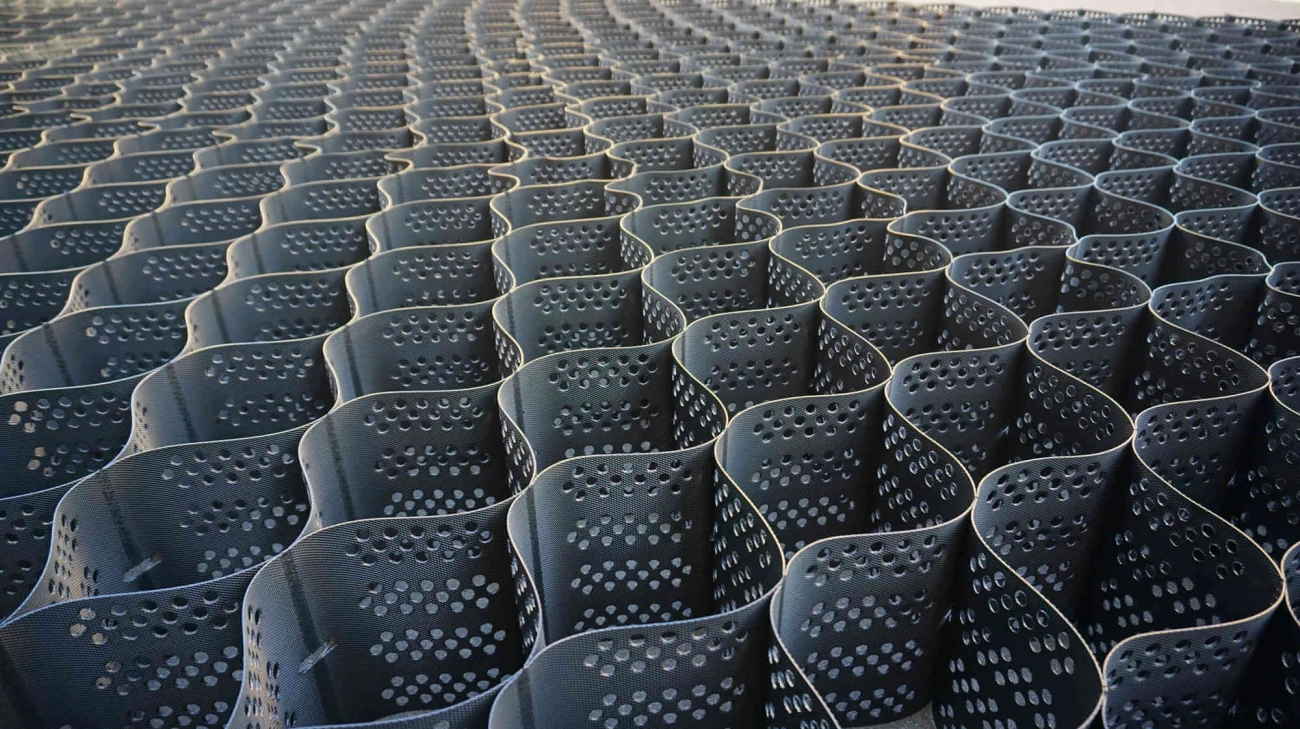
- Surface Texture: Specify smooth, textured, or perforated walls depending on the friction and drainage needed for your specific infill material.
- Supply Chain Transparency: You know exactly where your HDPE geocell material comes from. Direct sourcing ensures you are getting virgin resins rather than a mystery mix of recycled plastics.
Integrated Manufacturing Consistency
When a single facility handles the entire production process, batch-to-batch consistency is guaranteed. You don’t have to worry about one shipping container meeting engineering specs while the next one fails under heavy loads. An integrated factory environment ensures uniform cell wall thickness, reliable seam strength, and a high-performance product delivered every single time.
Technical Benchmarks: Evaluating Product Quality
When figuring out how to choose a geocell manufacturer, you have to look past the sales pitch and examine the actual technical specifications. The physical properties of the product dictate how well it will perform on your job site. Here is exactly what we look for when evaluating product quality.
Raw Material Integrity
The foundation of any durable cellular confinement system (CCS) is the plastic itself. Always demand virgin HDPE geocell material. While some suppliers mix in recycled plastics to cut costs, this drastically lowers the environmental stress cracking resistance (ESCR). Virgin high-density polyethylene ensures the material won’t turn brittle and fail under pressure or temperature shifts.
Welding Technology and Seam Strength
The joints are the most vulnerable part of the grid. A reliable geocell manufacturer relies on advanced ultrasonic welding technology to fuse the strips together. You need to verify the seam peel strength. The factory should provide testing data proving their welds meet or exceed ASTM standards for geosynthetics, specifically ASTM D2844.
Dimensional Stability
Consistency is everything when laying down acres of material. Whether your project involves slope erosion control or heavy-duty structure foundation support, the cell wall thickness and height must remain uniform across massive batches. Inconsistent dimensions lead to uneven load distribution and installation headaches.
UV Protection
Since these materials sit out in the sun, UV degradation is a real threat. Check the carbon black content in the spec sheet. A standard of 1.5% to 2% carbon black is required to give the plastic long-term outdoor durability and prevent it from breaking down under harsh UV rays.
Quick Quality Evaluation Checklist
| Technical Benchmark | What to Look For | Why It Matters |
|---|---|---|
| Material | 100% Virgin HDPE | Maximizes environmental stress cracking resistance. |
| Welding | Ultrasonic Welding Strength | Prevents seam failure under heavy loads (ASTM D2844). |
| Dimensions | Uniform thickness & height | Ensures predictable load support and soil stabilization. |
| UV Resistance | 1.5% – 2.0% Carbon Black Content | Prevents the plastic from degrading in direct sunlight. |
Essential Certifications and Compliance
When figuring out how to choose a geocell manufacturer, verifying their paperwork is non-negotiable. I always tell project managers that certifications are the clearest proof of a facility’s true capabilities. It shows they aren’t just making empty claims, but are actively enforcing strict Quality Control (QC) Procedures on the production floor.
Here are the core credentials you need to look for before placing a bulk order:
- ISO 9001:2015 Quality Management: Partnering with an ISO 9001 Certified Factory guarantees consistency across large batches. It means their entire operation, from raw material intake to final shipping, follows a standardized, heavily audited process.
- ASTM and GRI Compliance: For projects in the United States, meeting ASTM Standards for Geosynthetics and GRI (Geosynthetic Institute) guidelines is an absolute requirement. This ensures the cellular confinement system will actually hold up to local soil stabilization and load support demands.
- Third-Party Testing Reports: A reliable geocell manufacturer will never hesitate to share independent lab results. Always ask for recent batch reports from GAI-LAP accredited labs, SGS, or TRI Environmental to verify seam peel strength and environmental stress cracking resistance.
- CE Marking: If your firm handles international contracts, ensuring the geocell supplier carries CE marking is crucial. It proves the product meets stringent health, safety, and environmental protection standards for global deployment.
Skipping this verification step is a massive risk. Proper, verifiable documentation is the baseline for any serious geocell factory.
Production Capacity and Lead Times
When I advise contractors on how to choose a reliable geocell manufacturer for your project, I always emphasize that evaluating production capacity is just as critical as checking material specs. A superior product is useless if it arrives a month late and stalls your entire job site. You need a partner who actually has the bandwidth to keep up with your strict construction schedule.
Here is what we prioritize to ensure smooth operations from the factory floor to your site:
- Massive Daily Output: Can the geocell supplier actually meet large-scale project deadlines? For heavy highway, municipal, or major commercial builds, high daily production volume is non-negotiable. We make sure the factory can scale up instantly to handle bulk orders without bottlenecking.
- Strategic Inventory Management: A well-run geocell factory does not wait for an order to start producing the basics. They must maintain a deep inventory of standard sizes, specifically ranging from 50mm to 300mm heights. Having these standard dimensions ready to ship drastically cuts down your wait times.
- Global Logistics Expertise: Getting the material to a US job site involves a lot of moving parts. Your manufacturer must be highly experienced in navigating customs clearance, managing ocean and rail freight, and handling the specific nuances of local delivery networks.
Mastering these logistics and lead times is what separates a true manufacturing partner from a basic vendor, ensuring you secure competitive wholesale pricing without the headache of unpredictable shipping delays.
Value-Added Services: Why a Reliable Geocell Manufacturer Offers More Than Just Plastic
When you are deciding how to choose a geocell manufacturer, the product itself is only half the story. A truly reliable geocell manufacturer acts as an extension of your engineering team, providing the technical backing necessary to ensure your project’s success. We don’t just ship material; we provide the expertise to make sure it performs under pressure.
Technical Engineering Support
I believe that a factory should provide more than just a price list. We offer comprehensive engineering support, including:
- Design Calculations: Tailored math to ensure the geocell meets your specific load-bearing requirements.
- CAD Drawings: Detailed schematics for easy integration into your project plans.
- Application Expertise: Helping you understand exactly what geocell is used for in various soil conditions to prevent costly over-engineering.
Installation Guidance and Field Support
The best material in the world will fail if it isn’t installed correctly. To guarantee performance, we provide:
- Detailed Manuals: Step-by-step guides on subgrade preparation, cell expansion, and infill techniques.
- On-Site Supervision: For large-scale or complex infrastructure projects, we offer on-site technical assistance to oversee the deployment of the cellular confinement system (CCS).
Physical Sample Policy
I never expect a client to buy blind. A physical inspection is the only way to truly verify the quality of the HDPE geocell material. We maintain a transparent sample policy that allows you to:
- Test the ultrasonic welding strength and seam peel resistance.
- Verify the cell wall texture and perforation patterns.
- Confirm the material thickness and carbon black content before committing to a bulk wholesale order.
Red Flags to Watch Out For When Choosing a Geocell Manufacturer
When evaluating a geocell supplier, knowing what to avoid is just as critical as knowing what to look for. As someone deep in the geosynthetics industry, I have seen project timelines derail and budgets inflate simply because buyers ignored early warning signs. If you are figuring out how to choose a geocell manufacturer, keep a close eye out for these dealbreakers.
- The “Too Good to Be True” Price Trap
If a geocell factory offers pricing that drastically undercuts the market average, proceed with extreme caution. This is almost always the “recycled material” trap. While recycled plastics have their place, heavy-duty load support requires premium virgin HDPE geocell material. Cheap, degraded plastics severely compromise the structural integrity and environmental stress cracking resistance of the entire system. - Ghost Facilities and Hidden Operations
You want a direct manufacturer, not a middleman posing as one. A reliable geocell manufacturer will proudly showcase their facility. If a supplier cannot provide a verifiable physical address, refuses to share live production videos, or dodges requests for a virtual factory tour, you are likely dealing with a trading company. This setup adds unnecessary markups and makes accountability nearly impossible if something goes wrong. - Inconsistent Batch Testing Results
Strict Quality Control (QC) procedures are non-negotiable. If a supplier provides test reports showing wild variations in seam peel strength, cell wall thickness, or carbon black content from one batch to the next, walk away immediately. Consistency is the backbone of any successful site prep. Whether you are laying down cellular confinement systems or installing complementary base layers like geotextile fabric for subgrade separation, every single unit delivered to your site must meet exact project specifications without exception.
Frequently Asked Questions (FAQs)
When figuring out how to choose a geocell manufacturer, a few common questions always pop up from project managers and engineers. Here are the straight answers you need before placing a bulk order.
What is the average lead time when ordering directly from a geocell manufacturer?
Logistics and lead times depend heavily on your order volume and the facility’s production capacity. Generally, a reliable geocell manufacturer can produce a standard container load within 7 to 14 days. Ocean freight shipping to the United States typically adds another 3 to 5 weeks. I always recommend factoring in a 4 to 6-week total turnaround time to keep your job site schedule on track.
How can I verify a geocell supplier’s ASTM compliance and testing reports?
Never just take a supplier’s word for it. To confirm they actually meet ASTM Standards for Geosynthetics, ask the geocell supplier for recent, third-party testing reports from accredited independent labs like TRI Environmental, GAI-LAP, or SGS. You want to see documented, verifiable proof of their material’s tensile strength, environmental stress cracking resistance, and UV stability.
Can a factory customize dimensions and seam peel strength for my project?
Absolutely. Sourcing from a direct geocell factory means you get full control over the final product specifications. Whether you need a specific cell depth, unique weld spacing, or a higher geocell seam peel strength for heavy-duty load support, a true manufacturer can adjust their production lines to match your exact engineering requirements. If your site demands strict material properties, exploring customizable HDPE geocell options is the best way to ensure long-term soil stabilization and project success.