
A landfill liner is a layered containment system, so choosing one material by price alone can leave critical interfaces unprotected.
A landfill liner commonly combines an HDPE geomembrane barrier with geotextile protection, drainage, and sometimes a geosynthetic clay liner (GCL). The correct layer sequence depends on the design, waste and leachate conditions, subgrade, slopes, loads, drainage layout, and local regulations.
Before a purchase order is released, compare the section drawing, site condition, material function, performance basis, dimensions, installation method, packaging, delivery scope, and acceptance documents. This helps buyers confirm that quotations describe the same engineering system rather than products that merely share a similar name.
Send the section drawing, cell dimensions, slope, subgrade, expected load, liquid type, and destination. We can help organize the material information needed for an RFQ review.
Request a landfill liner specification checklistWhat Each Landfill Liner Layer Does
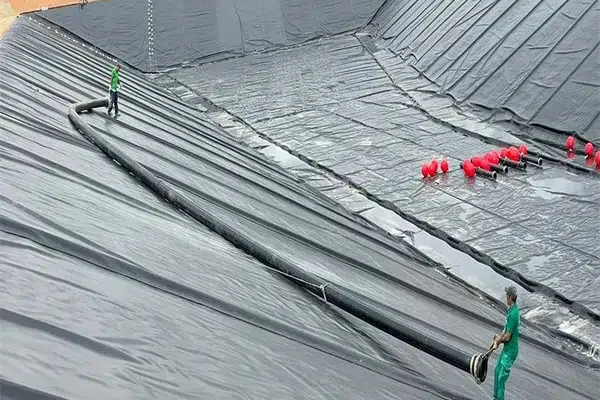
Each layer has a different job: the geomembrane limits liquid migration, a GCL can provide a low-permeability mineral barrier, and geotextiles protect, separate, filter, or cushion adjacent materials. Treating these products as interchangeable is a common purchasing error.
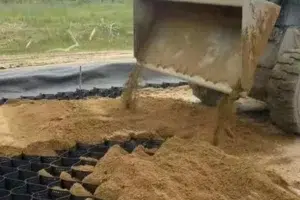
A typical system can also include drainage geonets, granular drainage media, pipes, and protective cover. The exact sequence is an engineered design decision. United States municipal solid-waste landfill criteria illustrate why composite liner and leachate-collection functions are addressed as a system rather than as one roll of material. [1]
HDPE Geomembrane Is the Primary Liquid Barrier
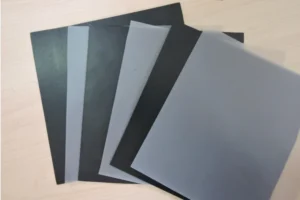
HDPE geomembrane is often selected as the main liquid barrier because it can be supplied in a range of thicknesses and surface finishes for containment work. Smooth and textured surfaces are not simply price options; texture may be relevant where interface friction is part of the slope design.
Our product data lists smooth HDPE geomembrane from 0.2 to 3.0 mm, while textured models in the available range start at 1.0 mm. Those ranges are product options, not a landfill design recommendation. Many landfill specifications use GRI GM13 as a reference framework, but a buyer should request the project-required properties and test basis rather than assume that a nominal thickness alone decides suitability. [2] [3]
| الطبقة | الوظيفة الأساسية | فحص المشتري قبل الطلب |
|---|---|---|
| الغشاء الجيوميمبراني من HDPE | Liquid barrier | Thickness, surface, test basis, panel layout |
| GCL (طبقة طينية جيوسنتيتية) | Mineral barrier | Overlap, hydration, confinement, compatibility |
| نسيج جيوتكستايل | Protection, separation, filtration | Interface risk, puncture requirement, roll width |
| Drainage layer | Leachate collection or drainage | Flow under load, filter, outlet detail |
GCL Adds a Mineral Barrier but Needs Protection
A geosynthetic clay liner uses bentonite between carrier layers to form a mineral barrier when hydrated and confined, but it is not a substitute for checking hydration, overlap, confinement, and chemical compatibility. Its role must be evaluated with the full liner system.
A GCL can simplify handling compared with importing large quantities of compacted clay, yet it is sensitive to project conditions. The buyer should confirm panel overlap, temporary weather protection, subgrade smoothness, cover sequence, and whether the liquid chemistry is compatible with the design assumptions. ASTM D5887 is one reference for measuring index flux through saturated GCL specimens; it should not be read as a field-performance guarantee. [4] The procurement schedule should also state how rolls will be stored, kept dry before placement where required by the project procedure, and covered before the next layer is installed. Those logistics details affect whether the specified overlap and surface condition can be maintained at the working face.
Geotextile Protection Is Not an Optional Detail
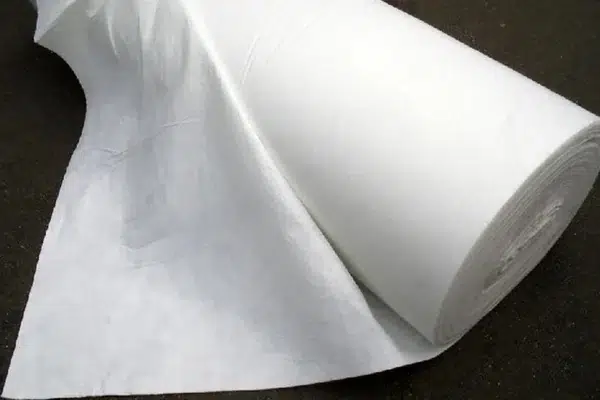
Geotextiles can reduce localized puncture and abrasion risk at interfaces, but the required protection level depends on subgrade texture, stones, drainage aggregate, cover loading, and installation traffic. A heavier fabric is not automatically the right answer.
Procurement Perspective: two quotations may both list an HDPE liner but omit the protection layer, leaving the contractor to solve a puncture-risk question on site. We recommend that the RFQ identify each interface, the geotextile function, unit weight or performance requirement, roll width, and any seam or overlap requirement. This makes the quote comparable before delivery rather than after material has reached the cell.
Seams, Slopes, and Drainage Change the Material Decision
Seaming, slope geometry, drainage, and installation access can change a liner system more than a small difference in material price. Long, narrow panels may create unnecessary seams; heavy rolls may not suit the available lifting equipment; and a drainage layer without a defined outlet cannot perform as intended.
QC Check: ask for the panel layout, seam direction, proposed welding method, seam-test plan, anchor-trench detail, and repair procedure before finalizing roll dimensions. A low unit price can become expensive when it causes extra seaming, difficult handling, repeated testing, or a delayed inspection. The engineer and regulatory authority retain responsibility for the final system design and acceptance.
What to Put in a Landfill Liner RFQ
A usable landfill liner RFQ should state the liner section, application, dimensions, slopes, subgrade, material functions, required properties, roll or panel dimensions, documentation, quantity, and delivery destination. This prevents vague quotes that cannot be compared fairly.
For product context, review MJY HDPE geomembrane liner materials, cURL Too many subrequests by single Worker invocation. To configure this limit, refer to https://developers.cloudflare.com/workers/wrangler/configuration/#limits، و landfill geosynthetic applications. Include the drawings and project specification with the inquiry whenever available.
الخاتمة
A landfill liner should be purchased as a coordinated system. Confirm every layer, interface, seam, drainage path, and required document before comparing prices.
الأسئلة الشائعة
cURL Too many subrequests by single Worker invocation. To configure this limit, refer to https://developers.cloudflare.com/workers/wrangler/configuration/#limits
cURL Too many subrequests by single Worker invocation. To configure this limit, refer to https://developers.cloudflare.com/workers/wrangler/configuration/#limits
cURL Too many subrequests by single Worker invocation. To configure this limit, refer to https://developers.cloudflare.com/workers/wrangler/configuration/#limits
cURL Too many subrequests by single Worker invocation. To configure this limit, refer to https://developers.cloudflare.com/workers/wrangler/configuration/#limits
cURL Too many subrequests by single Worker invocation. To configure this limit, refer to https://developers.cloudflare.com/workers/wrangler/configuration/#limits
cURL Too many subrequests by single Worker invocation. To configure this limit, refer to https://developers.cloudflare.com/workers/wrangler/configuration/#limits
المراجع
- cURL Too many subrequests by single Worker invocation. To configure this limit, refer to https://developers.cloudflare.com/workers/wrangler/configuration/#limits ↩
- معهد الجيوسينثيتيك GRI GM13 مواصفة لأغشية HDPE ↩
- ASTM D5199 طريقة اختبار قياسية لقياس السماكة الاسمية للجيوسينثيتيك ↩
- cURL Too many subrequests by single Worker invocation. To configure this limit, refer to https://developers.cloudflare.com/workers/wrangler/configuration/#limits ↩


 Arabic
  English
  Spanish