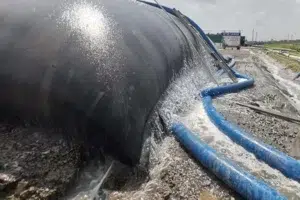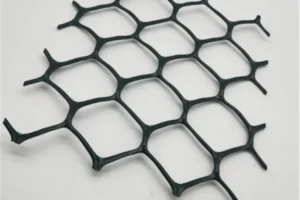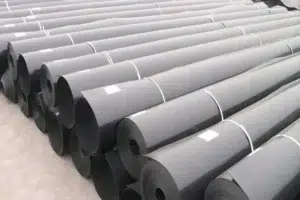
Choosing a geocell grade is not only a price decision. A light landscape path, a commercial road base, and a high-load access route do not need the same sheet thickness, cell depth, weld strength, or accessories.
The right geocell product grade depends on application load, soil condition, cell depth, sheet thickness, weld strength, panel size, UV resistance, infill type, and installation accessories. Buyers should match standard, commercial, or heavy-duty geocell grades to real project conditions before comparing price.

A useful geocell grade system should help buyers reduce mistakes. It should make it clear which product works for light-duty ground stabilization, which product fits commercial traffic, and which product is suitable for heavier project conditions.
Standard Residential vs. Commercial and Military Grade

The first buying mistake is treating all geocells as the same product. A standard grade may work for light-duty applications, but it should not be used blindly for commercial or heavy-load projects.
Standard geocell grades are usually used for light-duty ground stabilization, landscaping, and low-load access areas. Commercial and heavy-duty grades require stronger sheet thickness, weld strength, cell depth, UV resistance, and production control for roads, haul routes, working platforms, and demanding site conditions.
Professional Explanation
Geocell grade is a way to separate products by expected duty level. It is not only a marketing label. A proper grade should reflect material quality, sheet thickness, cell depth, weld strength, panel size, surface texture, perforation, and quality control.
Standard or residential-grade geocell is usually used where load is light and risk is lower. Typical examples include landscape paths, garden slopes, small parking edges, private access areas, and light erosion-control surfaces.
Commercial grade should be stronger because the site usually carries more traffic, more construction equipment, or more public use. This grade is more suitable for access roads, parking areas, road shoulders, embankments, and contractor projects.
Military grade is a term buyers often use for very heavy-duty or tactical access applications. It should not be accepted as a vague label. The buyer should ask what makes the grade stronger. Is the sheet thicker? Is the weld strength higher? Is the cell depth larger? Is the resin more stable? Does the factory have relevant technical data?
Cellular confinement systems have been used for load support, slope erosion control, channel lining, and earth-retention applications, and early development included military access and soft-ground trafficability work. [1] For B2B buyers, this history matters because high-load geocell should be judged by specification, not by the word “military.”
Construction Details
For standard-grade projects, installation usually focuses on surface stabilization and basic erosion control. The buyer still needs proper ground preparation, correct infill, and stable anchoring, but the load requirement is usually lower.
For commercial-grade projects, the base should be prepared more carefully. The contractor should check subgrade condition, drainage, aggregate quality, compaction method, and possible geotextile separation.
For heavy-duty or “military-grade” requests, the buyer should provide site load information. This includes vehicle type, wheel load, traffic frequency, soil condition, service period, and whether the road is temporary or permanent.
If the site has weak subgrade, buyers may need to combine geocell with geotextile materials to reduce aggregate contamination and improve separation.
| Grade Type | Typical Use | Buyer Risk If Misused |
|---|---|---|
| Standard Grade | Landscape areas, light slopes, low-load paths | May deform under vehicle load |
| Residential Grade | Private access, garden works, small drainage areas | Not suitable for heavy commercial traffic |
| Commercial Grade | Parking, access roads, road shoulders, contractor sites | Needs proper infill and compaction |
| Heavy-Duty Grade | Haul roads, weak ground access, working platforms | Requires stronger material and weld control |
| Military Grade | Tactical roads, temporary heavy access, high-risk soft ground | Must be defined by real technical specifications |
Selection Table
| Selection Factor | Standard Grade Focus | Commercial / Heavy-Duty Focus |
|---|---|---|
| Cell Depth | Moderate confinement | Higher confinement for load support |
| Sheet Thickness | Practical cost control | Stronger cell wall performance |
| Weld Strength | Basic stability | Higher joint strength under stress |
| Infill | Soil or light aggregate | Well-graded aggregate or project-approved fill |
| UV Resistance | Depends on exposure | Important for outdoor storage and exposed sites |
| Factory Documents | Basic TDS | Clear specification and QC records |
For buyers comparing geocell products, it is better to start with geocell specifications and applications instead of choosing a grade by name alone.
Matching Cell Dimensions to Project Applications
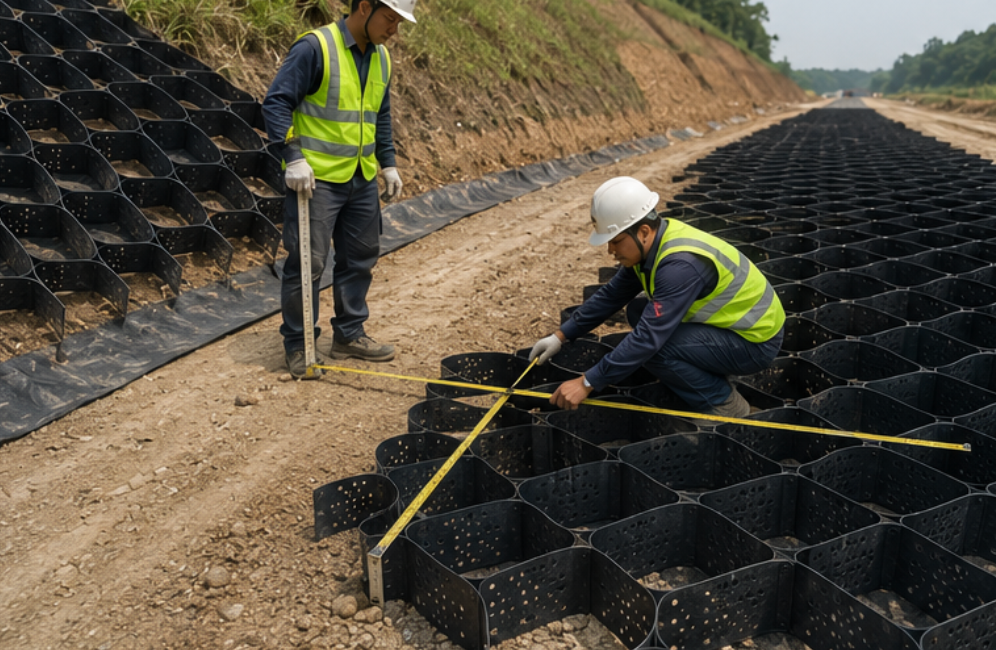
Cell dimensions decide how much infill the geocell can hold and how well the material can be confined. Wrong dimensions can create over-spending or under-performance.
Geocell cell dimensions should be matched to the application. Cell depth affects confinement volume, weld spacing affects cell opening size, and panel dimensions affect coverage and installation efficiency. Roads, slopes, drainage channels, and earth-retention projects require different dimension logic.
Professional Explanation
Cell depth is usually the first dimension buyers ask about. It controls the vertical height of the cell and the depth of confined infill. Higher cells can hold more material and provide stronger confinement, but they also increase product cost and filling quantity.
Weld spacing affects the size of each cell opening after expansion. If the cell opening is too large, the infill may not be held effectively. If it is too small, filling and compaction can become less efficient.
Panel dimensions affect site coverage, labor, and packing. Larger panels can reduce connection work, but they may be difficult to control on slopes or narrow channels. Smaller panels are easier to move, but they can create more joints.
ASTM D8269-21 covers basic considerations for geocell use in geotechnical and roadway projects, including load support for pavements, subgrade improvement, slope stability, retaining walls, earth retention, and slope and channel protection. [2] This reinforces the point that dimensions should follow application, not only stock availability.
Construction Details
For roadway load support, cell depth should match traffic load, subgrade strength, and aggregate thickness. A heavier road usually needs stronger confinement. The buyer should also check weld strength and sheet thickness because cell depth alone does not prove performance.
For slope protection, cell dimensions should match slope angle, soil depth, vegetation requirement, and infill type. A green slope may need enough depth to hold topsoil. A gravel-filled slope may need a cell opening that fits the stone size.
For channel protection, cell depth and opening size should match water flow and infill. Gravel or concrete-filled channels may need stronger edge fixing and more careful panel alignment.
For distributors, a simple dimension range is easier to sell. Too many random sizes create stock confusion. It is better to build a clear product line by application.
| Application | Dimension Priority | Practical Reason |
|---|---|---|
| Light landscape slope | Moderate cell depth | Holds soil and controls surface erosion |
| Road base | Higher confinement depth | Reduces aggregate movement under load |
| Haul road | Stronger depth and weld stability | Handles repeated heavy traffic |
| Drainage channel | Cell depth and edge fit | Holds stone or concrete under water flow |
| Green slope | Soil depth and perforation | Supports vegetation growth |
| Distributor stock | Standardized panel dimensions | Easier quotation and repeat sales |
Selection Table
| Dimension Item | What It Controls | Buyer Checkpoint |
|---|---|---|
| Cell Depth | Infill depth and confinement volume | Match to load, slope, or water condition |
| Weld Spacing | Cell opening size | Match to infill size and compaction need |
| Expanded Panel Length | Installed coverage | Match to site layout |
| Expanded Panel Width | Road or slope coverage | Reduce cutting and connection waste |
| Folded Size | Packing and storage | Confirm container loading and warehouse handling |
| Panel Connection | System continuity | Confirm connector or fastening method |
For projects where the buyer also needs tensile reinforcement, geogrid reinforcement products may be compared with geocell because geogrid and geocell solve different structural problems.
Essential Geocell Accessories and Components
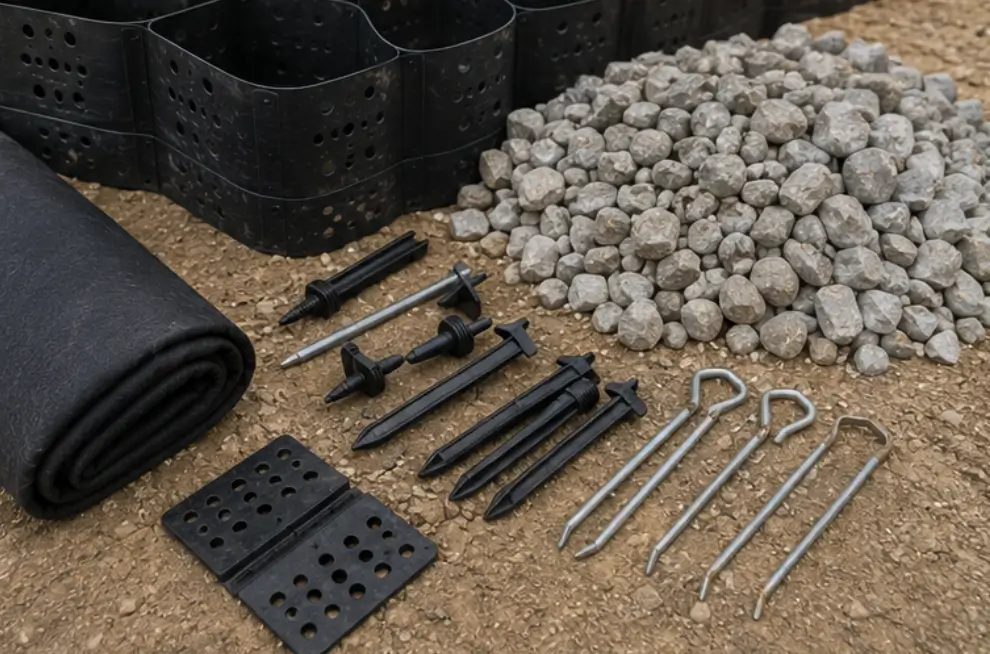
A geocell panel alone is not always enough. Accessories can decide whether the system stays in place during installation, filling, and long-term service.
Essential geocell accessories and components include anchors, stakes, J-hooks, tendons, connectors, clips, geotextile underlayers, drainage materials, infill, and edge-fixing systems. The right accessory choice depends on slope angle, road load, water flow, soil condition, and installation method.
Professional Explanation
Many buyers focus on the geocell panel but forget the accessories. This is a common sourcing mistake. A panel may have good material and strong welds, but if the anchoring system is weak, the installation can still fail.
Anchors hold the geocell in position before and during filling. Connectors help join adjacent panels. Tendons or cables may be used in some slope or load-support applications. Geotextile can support separation and filtration under the geocell. Drainage materials may be needed where water pressure or flow is a concern.
GRI GS-15 covers geocells made from high-density polyethylene strips and provides a specification context for required properties and testing frequency. [3] For buyers, this is a reminder that geocell quality should be checked as a system, not only as a plastic sheet.
Construction Details
For road bases, accessories may be simple. Anchors are used to hold panels during filling. Geotextile may be used under the geocell when the subgrade is weak or fine. Aggregate quality is often more important than complex accessories.
For slopes, accessories become more important. Top anchors, middle anchors, side fixing, and toe fixing all affect stability. The steeper the slope, the more important the anchor plan becomes.
For channels, edge fixing is critical. Water can attack the side and toe areas first. If water enters under the system, it can lift the panel or wash out infill.
For export buyers, accessories should be included in the order discussion early. If anchors or connectors are sourced separately after the geocell arrives, installation can be delayed.
| Accessory / Component | Main Function | Where It Matters Most |
|---|---|---|
| Stakes / Pins | Hold panels during installation | Roads and flat areas |
| J-Hooks | Improve fixing on slopes | Slope protection |
| Tendons / Cables | Add restraint in selected systems | Steeper slopes or special designs |
| Connectors / Clips | Join adjacent panels | Large-area installation |
| Geotextile | Separation and filtration | Soft subgrade and drainage areas |
| Drainage Material | Controls water pressure | Channels, slopes, retaining areas |
| Infill | Creates final system performance | All applications |
Selection Table
| Project Condition | Accessory Focus | Buyer Checkpoint |
|---|---|---|
| Flat road base | Temporary fixing during filling | Basic stakes or pins |
| Steep slope | Strong anchoring and edge fixing | Anchor type, spacing, and length |
| Riverbank | Edge and toe protection | Water-flow resistance |
| Soft subgrade | Separation layer | Geotextile specification |
| Drainage channel | Infill and edge stability | Stone, concrete, and outlet design |
| Export project | Complete installation package | Confirm accessories before shipment |
Buyers should treat accessories as part of the system cost. A lower panel price is not useful if the project later needs extra anchors, connectors, or drainage materials that were not included in the procurement plan.
My View
When I help buyers choose a geocell product grade, I do not start with grade names. I start with the project duty level.
A standard grade may be enough for light-duty landscaping or low-load stabilization. A commercial grade should be selected for roads, parking areas, contractor access, and more serious public-use projects. A heavy-duty or military-style requirement should be supported by real specifications, not only a strong-sounding label.
The most useful buying method is simple. Confirm the application, load, soil, water condition, cell dimensions, accessories, and factory quality control before comparing price.
For distributors, I suggest building a clear grade system. Each grade should have a defined use, cell depth, sheet thickness, weld strength, panel size, packing, and accessory recommendation. This makes the product easier to sell and easier to reorder.
Conclusion
Choosing the right geocell product grade requires more than selecting a name from a catalog. Buyers should match grade, cell dimensions, accessories, and quality control to the real project application.
FAQs
What is the difference between standard and commercial geocell grade?
Standard geocell grade is usually used for light-duty stabilization and landscape applications. Commercial grade is designed for stronger site demands such as access roads, parking areas, road shoulders, and contractor projects.
What does military-grade geocell mean?
Military-grade geocell usually refers to very heavy-duty access or soft-ground support requirements. Buyers should not accept the term alone. They should confirm sheet thickness, cell depth, weld strength, material quality, and test data.
How do I choose the right cell depth?
Cell depth should be selected by load, soil condition, infill material, slope angle, and project use. Deeper cells provide stronger confinement but also increase material and filling cost.
Are geocell accessories necessary?
Accessories are often necessary for correct installation. Anchors, connectors, geotextile, drainage materials, and edge fixing can affect final performance, especially on slopes, channels, and weak subgrade.
Can one geocell grade fit all applications?
No. A single geocell grade should not be used for every project. Roads, slopes, channels, and earth-retention projects need different specifications and accessory plans.
Key Takeaways
- Geocell product grade should be selected by project duty level, not by grade name alone.
- Standard-grade geocell is suitable for lighter use, while commercial and heavy-duty grades require stronger specifications and quality control.
- Cell depth, weld spacing, panel dimensions, and weld strength must match the project load, infill, and installation method.
- Accessories such as anchors, connectors, geotextile, and drainage materials can decide whether the system performs correctly on site.
- A reliable supplier should explain the technical difference between grades and support buyers with clear specifications, packing, and repeat-order consistency.