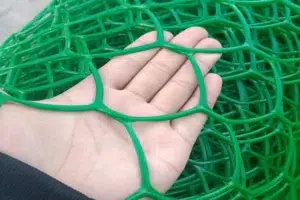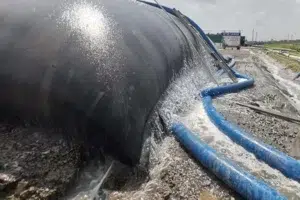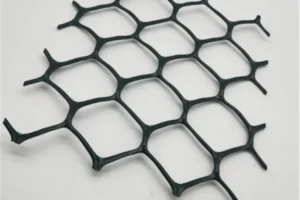
Geocell systems are used when a project needs soil confinement, better load distribution, or stronger surface protection. For engineering procurement buyers, the real value is not only the honeycomb shape, but how the system helps reduce movement in road bases, slopes, channels, and earth-retention structures.
The primary applications of geocell systems include base stabilization and roadway load support, slope reinforcement and erosion control, channel protection, and earth retention. Geocells work by confining soil, gravel, sand, or concrete within a three-dimensional cellular structure, helping reduce lateral movement and improve project stability.

A good geocell buying decision should start with the application. A road base, a green slope, a drainage channel, and an earth-retention project do not create the same stress on the material. The buyer should match cell height, sheet thickness, weld strength, infill, drainage, and anchoring to the real site condition.
Base Stabilization and Roadway Load Support
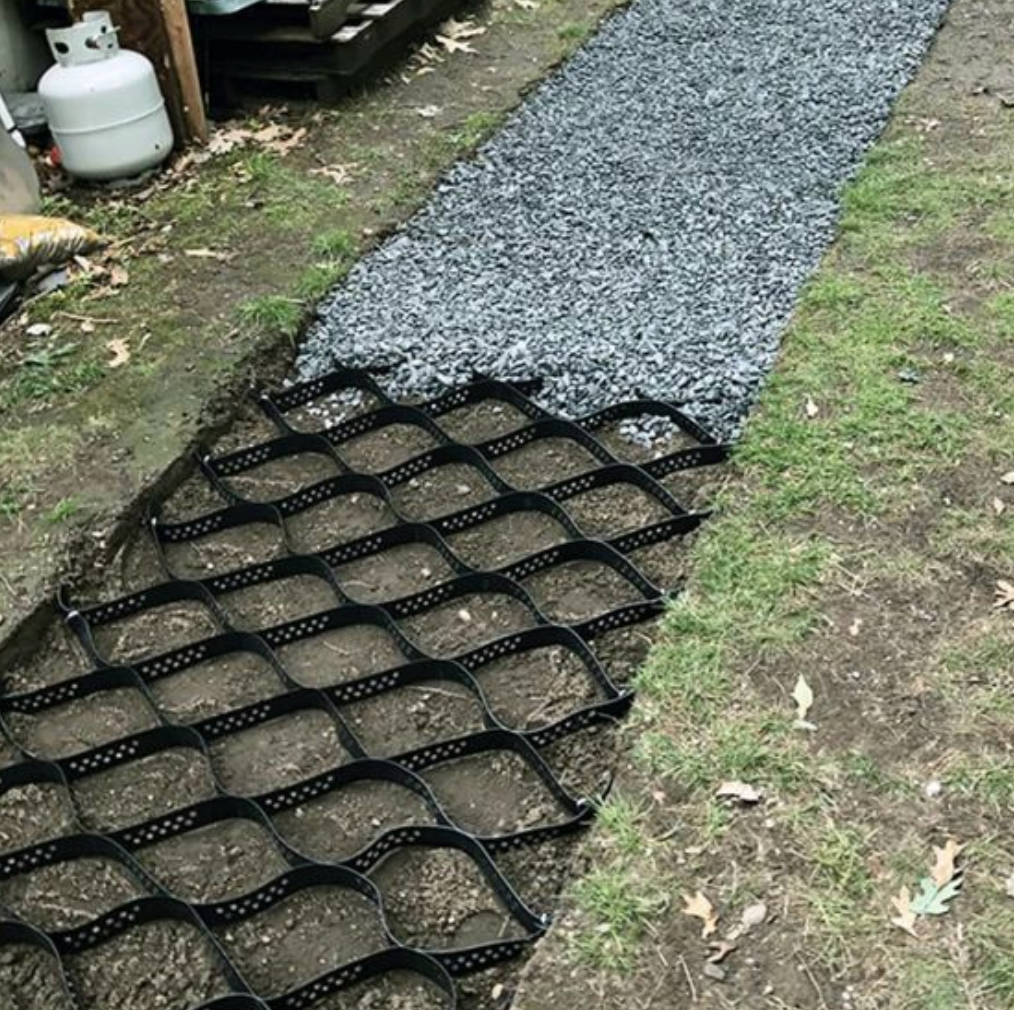
Road base problems often start below the visible surface. Aggregate moves sideways, weak subgrade loses support, and the road begins to rut or settle under repeated traffic load.
Geocell systems are used for base stabilization and roadway load support because they confine aggregate inside each cell, reduce lateral spreading, and help distribute load over a wider area. This makes them useful for access roads, haul roads, rural roads, parking areas, and soft ground construction.
Professional Explanation
In roadway construction, loose aggregate does not only carry vertical pressure. It also moves outward under wheel load. When the aggregate spreads, the base layer loses thickness and the road surface becomes weaker.
Geocell changes this behavior by creating a confined aggregate layer. The cell walls hold the infill in place. The compacted aggregate and geocell work together as a reinforced base. Geocells are described as three-dimensional honeycombed cellular structures that form a confinement system when filled with compacted soil. This confinement reduces lateral movement and helps distribute loads over a wider area. [1]
For contractors, this application is useful when roads are built over weak subgrade, temporary construction access areas, or sections where aggregate loss is common. For distributors, roadway load support is also a strong wholesale category because the buyer problem is clear: the road needs stronger base behavior without relying only on thicker aggregate layers.
Construction Details
A road geocell system usually starts with subgrade preparation. The base should be cleared, graded, compacted, and drained. If the subgrade is soft or fine-grained, a geotextile separation layer may be placed below the geocell to reduce mixing between subgrade soil and aggregate.
After the base is prepared, workers expand the geocell panels, fix them with anchors, connect adjacent sections, fill the cells with aggregate, and compact the layer. Well-graded crushed stone is usually preferred for load-support roads because it compacts better and provides stronger interlock inside the cells.
For buying decisions, road type matters. A temporary site road may need fast installation and practical cost control. A haul road may need stronger weld strength and heavier cell confinement. A parking area may need better drainage and stable surface support.
Buyers can review suitable geocell product specifications before comparing square-meter price.
| Road Application | Main Site Problem | Geocell Selection Focus |
|---|---|---|
| Temporary access road | Fast support over weak ground | Practical cell height and fast installation |
| Haul road | Heavy repeated wheel load | Strong weld strength and stable HDPE sheet |
| Rural road | Rutting and aggregate movement | Suitable cell height and compactable infill |
| Parking area | Surface deformation and drainage demand | Base stabilization and drainage planning |
| Construction platform | Equipment load over soft soil | Geotextile plus geocell system |
Selection Table
| Specification | Why It Matters For Roadway Load Support | Buyer Checkpoint |
|---|---|---|
| Cell Height | Controls confinement depth | Match to traffic load and base design |
| Sheet Thickness | Affects stiffness and durability | Confirm actual thickness tolerance |
| Weld Strength | Keeps cells connected under filling and traffic stress | Ask how welding is controlled |
| Weld Spacing | Controls cell opening size | Match to aggregate size |
| Infill Material | Decides load behavior | Use compactable aggregate where possible |
| Geotextile Layer | Reduces aggregate and soil mixing | Use when subgrade is soft or fine-grained |
Slope Reinforcement and Erosion Control

Slope protection is different from road base stabilization. A slope must resist gravity, rainfall, runoff, and surface soil loss before the surface becomes stable.
Geocell systems are used for slope reinforcement and erosion control because they hold soil, gravel, or concrete on the slope surface. The cellular structure helps reduce washout, support vegetation, control shallow surface movement, and improve slope surface stability.
Professional Explanation
A slope fails differently from a road. In road construction, the main issue is repeated load. On a slope, the main risks are downward movement, rainfall erosion, surface runoff, and loose soil loss.
Geocell helps by dividing the slope surface into many small confined units. Each cell holds infill and reduces the chance that the entire surface layer will move at once. If the project uses topsoil, the cells can hold soil while vegetation develops. If the project uses gravel or concrete, the cells can support stronger erosion resistance.
Geosynthetics are widely used in civil engineering for functions such as stabilization, reinforcement, separation, filtration, drainage, containment, and erosion control. [2] In slope work, geocell often works with anchors, geotextile, drainage layers, and vegetation systems.
For project buyers, slope angle is one of the first details to confirm. A gentle green slope, a highway embankment, a landfill slope, and a riverbank do not need the same geocell specification.
Construction Details
Slope geocell installation usually starts from the top. The panel is fixed along the upper edge, expanded downward, connected with adjacent panels, anchored across the slope face, and then filled.
Anchoring is one of the most important parts of slope installation. If anchors are too weak or too far apart, the panel can shift during filling or after rainfall. The anchor layout should follow slope angle, soil condition, water flow, panel size, and infill weight.
Infill selection also changes the result. Topsoil works for vegetation. Gravel helps drainage and surface protection. Concrete can be used in severe erosion zones or high-flow drainage slopes.
If the project also needs separation or filtration, buyers can combine geocell with geotextile materials.
| Slope Application | Main Site Risk | Geocell Selection Focus |
|---|---|---|
| Road embankment | Rainfall erosion and surface soil loss | UV resistance, anchoring, cell height |
| Green slope | Soil loss before vegetation develops | Perforation and topsoil depth |
| Riverbank | Water movement and edge erosion | Strong anchoring and suitable infill |
| Landfill slope | Surface stability and drainage demand | Geotextile and drainage planning |
| Drainage slope | Concentrated runoff | Gravel or concrete infill |
Selection Table
| Specification | Why It Matters On Slopes | Buyer Checkpoint |
|---|---|---|
| Cell Height | Holds soil or aggregate depth | Match to slope angle and infill type |
| Perforation | Supports drainage and root interaction | Useful for vegetated slopes |
| Surface Texture | Improves friction with infill | Useful on steeper surfaces |
| UV Resistance | Protects exposed material | Important before vegetation cover develops |
| Weld Strength | Prevents cell separation under tension | Check factory welding control |
| Anchor System | Holds panel on slope face | Match anchor spacing to site risk |
Channel Protection and Earth Retention
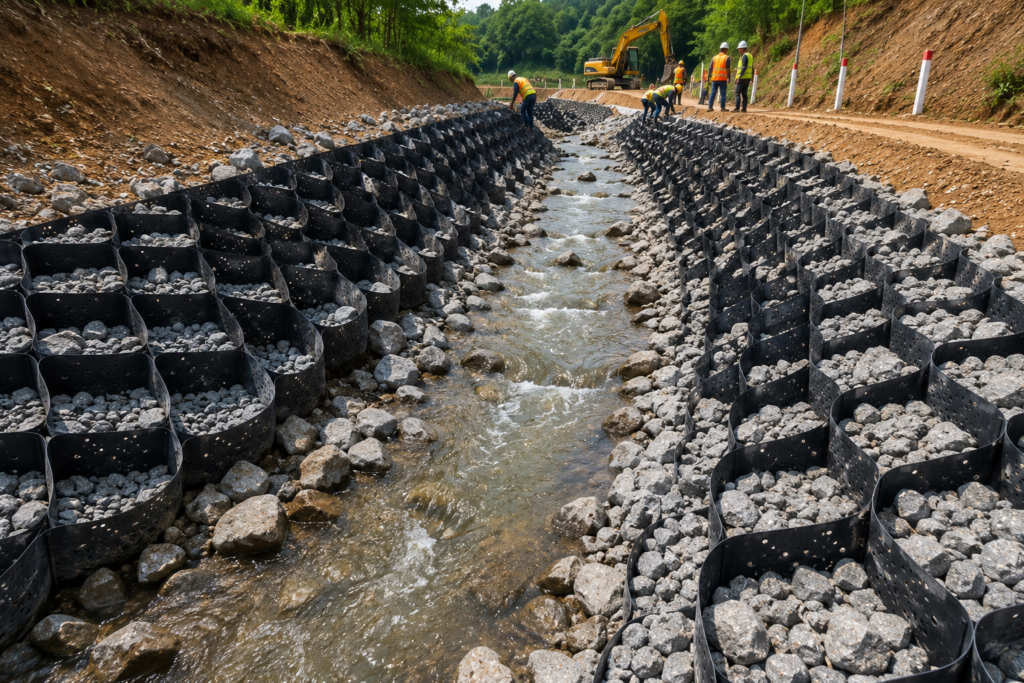
Channel protection and earth retention place stronger pressure on the edges, drainage system, infill, and long-term structural behavior. The system must resist water flow or soil pressure, not just cover the surface.
Geocell systems are used for channel protection and earth retention by confining stone, soil, gravel, or concrete within a cellular structure. This helps protect channel surfaces, reduce erosion, support flexible lining systems, and improve stability in riverbanks, drainage channels, embankment edges, and low retaining structures.
Professional Explanation
Channel protection is more demanding than basic surface stabilization because water can attack weak points. It can enter from the edge, move under the panel, wash out infill, or create local failure near transitions.
Geocell helps by holding the lining material in place. Gravel or stone can support drainage and erosion resistance. Concrete-filled geocell can provide a harder lining for stronger flow conditions.
Earth retention is a related application, but it requires more design control. Geocell can help form a confined soil or aggregate mass for low retaining structures, green wall faces, and embankment edges. But retaining applications must still consider wall height, backfill, drainage, surcharge load, and foundation condition.
FHWA guidance on geosynthetic reinforced soil systems explains the wider engineering principle that compacted fill and geosynthetic reinforcement should work together as a system. [3] This system thinking is useful when buyers evaluate geocell for channels and retention.
Construction Details
For channel projects, the base should be shaped according to the channel profile before geocell placement. The panels should follow the channel geometry, and the toe, side edges, and transition areas should be fixed carefully because these areas often fail first.
The infill should match water force. Soil may work for low-flow vegetated channels. Gravel and stone work better for drainage and moderate erosion. Concrete is used when the project needs a harder lining.
For earth-retention use, buyers should confirm design requirements before ordering. Geocell can help confine fill, but it should not replace proper engineering design. Weld strength, cell height, drainage, and backfill compaction are important.
For projects where tensile reinforcement is the main requirement, buyers may compare geocell with geogrid reinforcement products because geogrid and geocell solve different structural problems.
| Application | Main Site Stress | Geocell Selection Focus |
|---|---|---|
| Drainage channel | Water flow and surface erosion | Infill type and edge anchoring |
| Riverbank | Flow, wet-dry cycles, and soil loss | Anchor layout and stable infill |
| Concrete-lined channel | High erosion force | Cell depth and concrete placement |
| Low retaining wall | Soil pressure | Design fit and weld strength |
| Embankment edge | Edge movement and washout | Panel connection and drainage |
| Green wall face | Soil and vegetation retention | Perforation and soil depth |
Selection Table
| Specification | Why It Matters In Channels And Earth Retention | Buyer Checkpoint |
|---|---|---|
| Infill Type | Controls erosion resistance and surface weight | Soil, gravel, stone, or concrete |
| Cell Height | Holds required infill depth | Match to channel or wall design |
| Weld Strength | Keeps the cellular structure stable | Important under water or soil pressure |
| Edge Anchoring | Prevents boundary failure | Strengthen top, toe, and side edges |
| Drainage Design | Reduces water pressure | Use filter layers and outlets where needed |
| Surface Texture | Improves interaction with infill | Useful for gravel and soil retention |
My View
When I evaluate geocell applications, I first separate the project by function.
A road base needs load support. A slope needs surface retention. A channel needs water-flow resistance. An earth-retention project needs design stability and drainage.
This is where many procurement mistakes happen. Buyers ask for one geocell price and expect one product to fit every site. That is not a safe way to buy geocell for engineering projects.
A better method is to define the application first, then confirm material, cell height, sheet thickness, weld strength, infill, and installation conditions. After that, price comparison becomes meaningful.
Conclusion
Geocell systems are used in roads, slopes, channels, and earth-retention projects because they confine infill and reduce movement. The best result comes from matching the specification to the application.
FAQs
What are the main applications of geocell systems?
The main applications include base stabilization, roadway load support, slope reinforcement, erosion control, channel protection, earth retention, embankment support, and soft ground improvement.
How does geocell improve roadway load support?
Geocell confines aggregate inside a three-dimensional cellular structure. This reduces lateral spreading, improves load distribution, and helps stabilize the base layer over weak or variable subgrade.
Can geocell be used for slope reinforcement?
Yes. Geocell can hold soil, gravel, or concrete on slope surfaces. It helps reduce erosion and surface movement when the panel is properly anchored and filled.
What infill material is used with geocell?
Common infill materials include crushed stone, gravel, sand, topsoil, local soil, and concrete. The right material depends on load support, vegetation, drainage, erosion control, or hard lining needs.
How should buyers choose geocell for different applications?
Buyers should confirm project type, load level, slope angle, water flow, soil condition, infill material, cell height, sheet thickness, weld strength, perforation, and packing before ordering.
Key Takeaways
- Geocell systems should be selected by application, not by one standard product grade for every project.
- Roadway load support depends on cell height, weld strength, compactable aggregate, subgrade preparation, and possible geotextile separation.
- Slope reinforcement needs anchoring, drainage planning, UV resistance, infill matching, and correct cell geometry.
- Channel protection and earth retention require careful control of water flow, edge fixing, drainage, and long-term deformation.
- A reliable geocell supplier should help buyers confirm material, thickness, weld strength, cell geometry, packing, and application fit before quotation.