Geocell quality is not judged by appearance alone. For engineering buyers, the real value comes from cell depth, panel size, sheet thickness, weld strength, resin quality, UV resistance, and whether the specification matches the project.
Geocell specifications and material quality directly affect load capacity, installation efficiency, durability, and project risk. Buyers should check cell depth, sheet thickness, weld spacing, panel dimensions, resin quality, weld strength, UV resistance, testing documents, and relevant ASTM or project compliance before placing bulk orders.
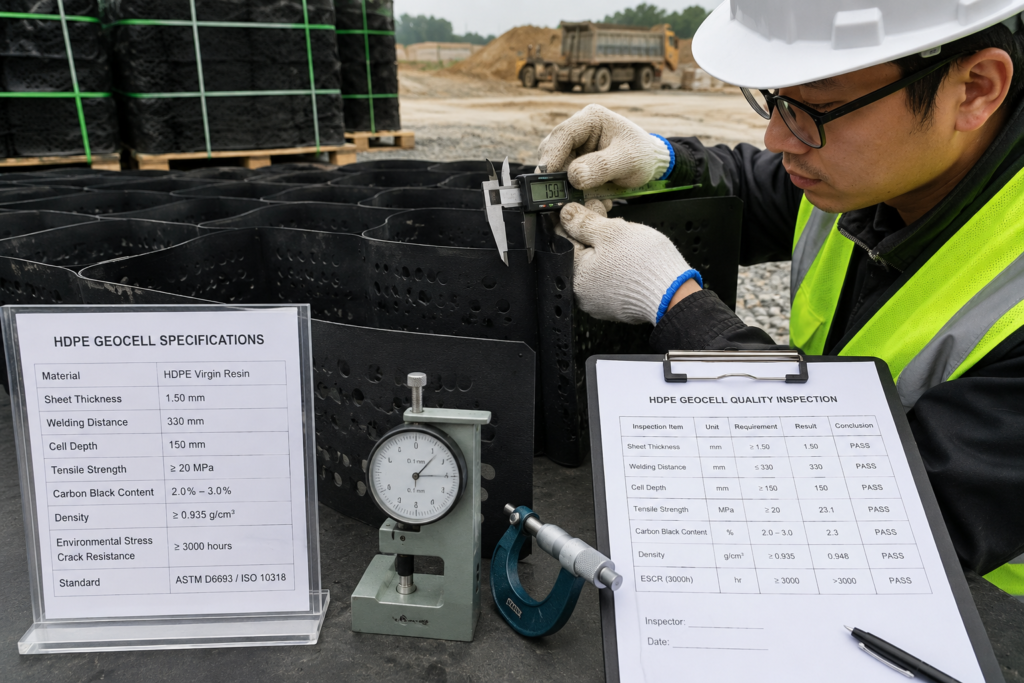
A low-price geocell can look acceptable in photos, but the hidden differences may appear during expansion, filling, compaction, or long-term exposure. This is why serious procurement should compare technical specifications before comparing unit price.
Cell Depth and Load Capacity

Cell depth is one of the first specifications buyers ask about. But the correct cell depth depends on the project load, subgrade condition, infill material, and expected service life.
Cell depth affects geocell load capacity because deeper cells hold more infill and provide stronger confinement. For road bases, soft subgrade, haul roads, and working platforms, buyers should match cell depth with traffic load, aggregate quality, base thickness, and design requirements.
Professional Explanation
Cell depth means the vertical height of the geocell strip after the panel is expanded. It controls how much soil, gravel, sand, or concrete can be confined inside the cell.
A deeper cell usually provides stronger confinement because it holds more infill depth. This can help reduce lateral movement of aggregate and improve base stability. But deeper is not always better. It also increases material use, infill quantity, shipping weight, and project cost.
Cellular confinement systems are used in load support, soil stabilization, slope protection, channel protection, erosion control, and earth retention. They are expanded on site into a honeycomb-like structure and filled with soil, gravel, rock, sand, or concrete. [1]
For a contractor, the cell depth should follow site demand. A temporary access road may only need practical ground support. A heavy haul road needs stronger confinement. A slope protection project may need enough depth to hold soil or gravel, but not the same logic as a road base.
Construction Details
For road base projects, cell depth should be selected together with aggregate size and compaction method. If the cell is too shallow for the load, the aggregate may still move under traffic. If the cell is too deep for a light-use project, the buyer may pay for unnecessary material and filling cost.
For soft ground, a geotextile layer may be placed below the geocell. This helps reduce the mixing of fine subgrade soil with aggregate. Buyers can review geotextile materials when separation or filtration is part of the road design.
For slope protection, the cell depth should match slope angle, erosion risk, and infill type. Soil-filled green slopes need enough depth to hold planting soil. Gravel-filled slopes need enough depth to reduce stone movement. Concrete-filled channels may need depth based on hydraulic and lining requirements.
| Application | Cell Depth Logic | Buyer Risk If Chosen Wrong |
|---|---|---|
| Temporary access road | Practical support and fast installation | Over-specification increases cost |
| Rural road | Moderate confinement for aggregate | Shallow cells may allow rutting |
| Heavy haul road | Stronger confinement under repeated load | Weak depth may reduce base stability |
| Green slope | Soil retention for vegetation | Soil may wash out before roots grow |
| Channel lining | Infill retention under water movement | Infill may move under flow |
| Working platform | Load distribution over weak soil | Surface may deform under equipment |
Selection Table
| Specification Point | Why It Matters | Factory-Side Buying Check |
|---|---|---|
| Cell Depth | Controls confinement volume | Match to road load, slope angle, or channel condition |
| Sheet Thickness | Supports cell wall strength | Confirm actual thickness tolerance |
| Weld Strength | Keeps cells connected under stress | Ask how weld quality is controlled |
| Infill Size | Must fit inside cells | Match aggregate or soil type to cell opening |
| Compaction Method | Affects final base stability | Do not damage empty cells during filling |
| Geotextile Need | Supports separation and filtration | Use when subgrade is soft or fine-grained |
A reliable factory should not recommend one depth for every buyer. It should ask about the project first, then match the cell depth to the load and site condition.
Panel Dimensions and Coverage Options

Panel dimensions affect installation speed, coverage calculation, container loading, and site handling. Many buyers check price per square meter but forget to confirm expanded panel size and actual coverage.
Geocell panel dimensions define the expanded coverage area, cell opening size, transport size, and installation efficiency. Buyers should confirm folded size, expanded size, cell depth, weld spacing, panel connection method, and packaging before comparing price.
Professional Explanation
A geocell panel is supplied folded. On site, workers expand it into a honeycomb structure. The final coverage depends on the expanded length, expanded width, cell size, and how panels connect in the field.
This matters because two suppliers may quote the same square-meter price but provide different expanded coverage, different weld spacing, or different package sizes. If the buyer does not check panel dimensions, the actual installed cost may be higher than expected.
For distributors, panel dimensions also affect storage, handling, labeling, and resale. A clear product range is easier to sell. A confusing panel size can create mistakes during reorders.
For contractors, panel size affects installation speed. Larger panels can reduce connection time, but they may be harder to handle on slopes or narrow channels. Smaller panels can be easier to move, but they may increase connection work.
Construction Details
For road projects, panel dimensions should match road width and installation crew capacity. A practical panel size can reduce cutting and overlap waste.
For slopes, panel size should match slope length, anchor layout, and worker handling ability. A very large panel may be difficult to control on steep slopes. The top edge, side edges, and panel joints need careful fixing.
For channels, panel dimensions should match the channel profile. A narrow channel may require more cutting or smaller panels. A wide channel may allow larger expanded panels. Edge fixing is critical because water can attack weak boundaries.
Buyers can review geocell product specifications before confirming final panel dimensions.
| Dimension Item | What It Controls | Buyer Should Confirm |
|---|---|---|
| Expanded Length | Installed coverage | Match road section or slope layout |
| Expanded Width | Panel coverage width | Match site width and installation plan |
| Folded Size | Storage and shipping | Check container loading and handling |
| Weld Spacing | Cell opening size | Match infill and design requirement |
| Cell Depth | Infill depth | Match load, slope, or channel use |
| Panel Connection | Continuous system behavior | Confirm connection method and accessories |
Selection Table
| Buyer Type | Dimension Priority | Better Decision Logic |
|---|---|---|
| Contractor | Installation speed and site fit | Choose panel size based on crew and layout |
| Distributor | Storage and repeat sales | Keep clear standard sizes |
| Road Project Buyer | Road width and coverage | Reduce cutting and connection waste |
| Slope Project Buyer | Slope length and anchor plan | Avoid panels too large to control |
| Channel Buyer | Channel profile and edge fixing | Match panel size to channel shape |
| Export Buyer | Container loading and packing | Confirm bundle size and loading quantity |
Panel dimension is not only a logistics detail. It affects labor, waste, coverage accuracy, and installation quality.
ASTM Compliance, UV Resistance, and Certifications

Many buyers ask whether geocell is “ASTM compliant.” This is a useful question, but it must be asked correctly. ASTM can guide applications and testing, but buyers still need to confirm the exact project requirements.
ASTM compliance, UV resistance, and certifications help buyers verify geocell quality, but they should not replace project-specific specification review. Buyers should confirm relevant ASTM guidance, HDPE resin quality, UV additive package, weld strength, sheet thickness, density, test data, and factory quality control records.
Professional Explanation
ASTM D8269-21 is a standard guide for the use of geocells in geotechnical and roadway projects. Its scope includes basic considerations for geocell use in applications such as load support for pavements, subgrade improvement, slope stability, retaining walls, earth retention, and slope and channel protection. [2]
This is important because buyers often use “ASTM” as a general quality word. But a standard guide is not the same as a product certification. A factory should explain which test data, product properties, or project requirements are being discussed.
GRI GS-15 also provides a specification related to geocells made from high-density polyethylene strips, including requirements such as formulated sheet density of 0.940 g/cc or higher. [3]
For procurement buyers, this means the supplier should provide more than a sales claim. The buyer should ask for technical data, material description, quality control process, and available test information.
Construction Details
UV resistance matters because geocell is often stored outside, installed in open areas, or exposed before full covering. On slopes, channels, and green projects, some cell edges may remain exposed longer than expected.
If the UV package is weak, the material may age faster. The sheet can lose flexibility or become brittle. For hot regions, high-altitude areas, or projects with delayed installation, UV resistance should be confirmed before bulk order.
Certifications and test documents are useful, but they should match the order. A general company certificate does not prove that a specific geocell batch has the required thickness, weld strength, or UV performance.
For buyers comparing geocell with other reinforcement solutions, geogrid reinforcement products may also require different standards and test logic.
| Quality Item | Why It Matters | Buyer Should Ask |
|---|---|---|
| ASTM Guidance | Supports application understanding | Which ASTM guide or test is relevant? |
| GRI Specification | Supports HDPE geocell quality discussion | Does the product align with required material properties? |
| UV Resistance | Protects exposed polymer | What UV additive package is used? |
| HDPE Density | Indicates material formulation | What resin or sheet density is used? |
| Weld Strength | Protects cell structure | How is weld quality tested or checked? |
| Factory QC | Controls batch consistency | What is inspected before shipment? |
Selection Table
| Project Condition | Compliance / Quality Focus | Better Buyer Decision |
|---|---|---|
| Road Base | Load support and weld stability | Ask for thickness, weld strength, and application guidance |
| Slope Protection | UV exposure and anchoring stress | Confirm UV package and weld quality |
| Channel Protection | Water flow and edge stress | Confirm infill, anchoring, and material stability |
| Retaining Wall | Long-term deformation and soil pressure | Confirm design requirement and supplier experience |
| Export Bulk Order | Batch consistency and documents | Confirm QC records and packing details |
| Distributor Stock | Repeatable product quality | Use consistent TDS and label system |
A reliable supplier should be clear about what its documents can prove. If a supplier only says “ASTM quality” without explaining the standard, test item, or product property, the buyer should slow down.
My View
When I check geocell quality, I do not start with color or packaging. I start with specification logic.
Cell depth tells me whether the product can hold enough infill for the application. Panel dimensions tell me whether the product can be installed efficiently. ASTM guidance, UV resistance, and certification documents tell me whether the supplier understands engineering requirements.
For contractors, the risk is buying a geocell that cannot handle the site condition. For distributors, the risk is selling inconsistent specifications across repeat orders. For project buyers, the risk is accepting vague quality claims without checking test details.
My suggestion is direct. Confirm the project first. Then confirm cell depth, panel size, material quality, weld strength, UV resistance, and documents. Price should be compared only after these points are clear.
Conclusion
Geocell specifications and material quality decide whether the product can support the project after installation. Buyers should compare cell depth, panel dimensions, UV resistance, ASTM-related requirements, and factory quality control before comparing price.
FAQs
What geocell specification is most important?
The most important specifications are cell depth, sheet thickness, weld spacing, weld strength, panel dimensions, material quality, and UV resistance. The priority depends on the application.
Does deeper geocell always mean higher load capacity?
Deeper geocell usually provides stronger confinement, but it is not always the best choice. The correct depth depends on road load, subgrade condition, infill type, slope angle, and project design.
What panel size should buyers choose?
Panel size should match the installation area, worker handling ability, site layout, and container loading plan. Larger panels may reduce connections, but they can be harder to handle on slopes or narrow channels.
What does ASTM compliance mean for geocell?
ASTM compliance should be discussed by standard, guide, or test item. ASTM D8269 is a guide for geocell use in geotechnical and roadway projects, but buyers should still confirm product-specific data.
Why is UV resistance important for geocell?
UV resistance is important because geocell may be exposed during storage, installation, or long-term service. Without proper UV protection, the material may age faster and lose flexibility.
Key Takeaways
- Cell depth should be selected by application, load, infill, and site condition, not by price alone.
- Panel dimensions affect actual coverage, installation speed, container loading, and site handling.
- ASTM guidance and certifications are useful only when buyers understand which standard or test item applies.
- UV resistance matters for exposed slopes, channels, storage, delayed installation, and hot-climate projects.
- A reliable geocell supplier should provide clear specifications, factory quality control, and batch-consistent documentation.